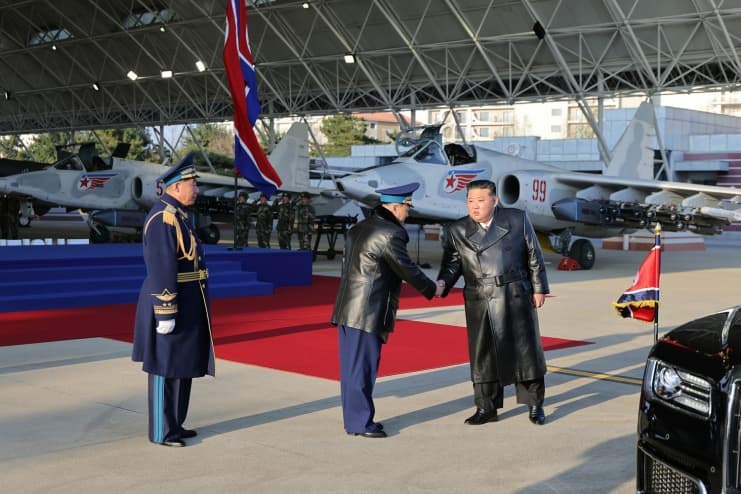
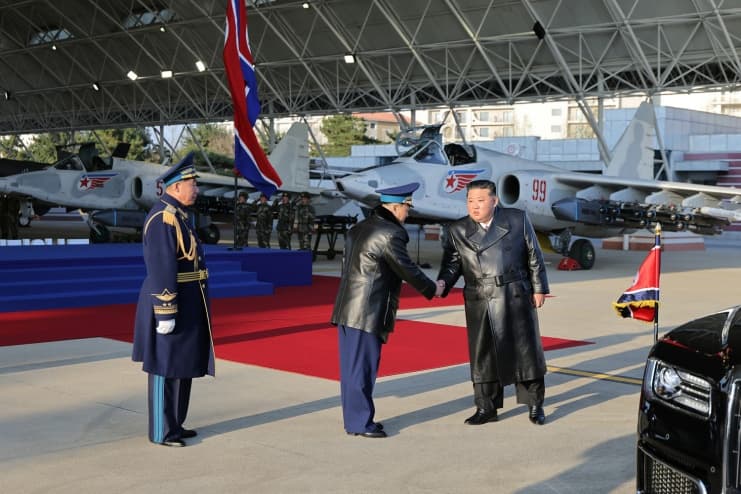
A nephew of North Korean Air Force commander Kim Gwang Hyok was spared from execution after leader Kim Jong Un issued a personal directive overturning the sentence, sparking a growing backlash over unequal enforcement of the country’s strict foreign content laws.
A source in Pyongyang told Daily NK on Monday that the nephew had been arrested for watching and distributing banned foreign video recordings and was sentenced to death under the Reactionary Thought and Culture Rejection Law, a statute enacted in 2020 that criminalizes the viewing or circulation of foreign content, including South Korean films and television programs. Under the law, those found to have organized group screenings or distributed large volumes of such material face penalties ranging from life sentences at hard labor to execution. The nephew’s sentence was set to be carried out when Kim Jong Un’s personal directive arrived, instantly reversing the outcome.
According to the source, the nephew had been caught in possession of a large quantity of banned recordings and had regularly gathered acquaintances to watch them together, in addition to distributing the material without apparent concern. Given the scale and nature of the violations, prosecutors within the State Information Bureau (formerly the Ministry of State Security), the country’s primary political security agency responsible for investigating ideological crimes, had concluded that the maximum penalty was warranted and were finalizing the timing of the execution.
The directive that halted it instructed the bureau to reclassify the nephew as a mere curious viewer rather than a deliberate offender, citing the need to protect the record of loyalty and service built by Air Force Commander Kim Gwang Hyok. The source said that while the outcome was publicly framed as an expression of Kim Jong Un’s generosity and compassion, it set off considerable internal debate within party, government and judicial circles.
Anger spreads as double standard comes into focus
Judicial officials expressed frustration at being required to re-examine and reclassify an already finalized case. Privately, some questioned whether connections to a senior military figure had been the decisive factor, and whether future cases would require investigators to weigh a suspect’s background and personal ties before reaching a verdict.
The episode has crystallized a broader concern: that punishment under the Reactionary Thought and Culture Rejection Law is applied unevenly depending on who the accused is. Ordinary North Korean people caught with foreign content routinely face severe punishment, making the commutation of a sentence for a senior commander’s relative all the more conspicuous.
News that a single directive from Kim Jong Un had pulled a senior commander’s relative back from the brink of execution spread quickly, drawing particularly sharp reactions among young people. “The view among young people is that if someone lives and someone else dies for breaking the same law, there must be a problem with how the law is applied,” the source said. “Everyone is careful about what they say out loud, but inside they feel it is unfair that the law ends up working differently depending on who you are.”
Reporting from inside North Korea
Daily NK operates networks of sources inside North Korea who document events in real-time and transmit information through secure channels. Unlike reporting based on state media, satellite imagery, or defector accounts from years past, our journalism comes directly from people currently living under the regime. We verify reports through multiple independent sources and cross-reference details before publication.
Our sources remain anonymous because contact with foreign media is treated as a capital offense in North Korea — discovery means imprisonment or execution. This network-based approach allows Daily NK to report on developments other outlets cannot access: market trends, policy implementation, public sentiment, and daily realities that never appear in official narratives.
Maintaining these secure communication channels and protecting source identities requires specialized protocols and constant vigilance. Daily NK serves as a bridge between North Koreans and the outside world, documenting what’s happening inside one of the world’s most closed societies.