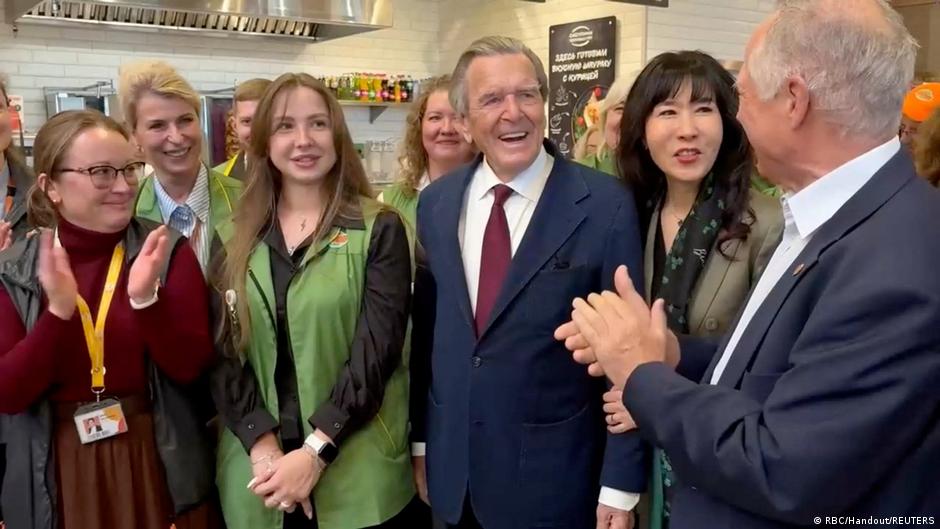
Gerhard Schröder visited one of the Moscow branches of the new Hyperglobus supermarket chain on Wednesday, a few days after being named a member of its supervisory board.
Russian TV footage showed employees at the branch greeting the former German chancellor and his current wife, So-yeon Schröder-Kim, with sustained applause.
Schröder has current or recent links to a series of Russian businesses and to President Vladimir Putin, issues that have become increasingly contentious in Germany in recent years, particularly since Russia’s full-scale invasion of Ukraine in 2022.
What is Hyperglobus’ link to Germany?
The new Russian supermarket chain Hyperglobus was spun off from Germany’s Globus Holding last year.
Last week, Hyperglobus announced that Schröder had been appointed to the supervisory board. The supermarket confirmed that the former chancellor and Social Democrat had visited a branch on the western outskirts of Moscow on Wednesday.
“I’m very pleased to be here, to see this wonderful hypermarket, to see the results of your work and to meet you, my wonderful colleagues,” RBC television in Russia quoted Schröder as saying.
Schröder also reportedly called last week for the continuation of remaining trade ties between Russia and countries like Germany amid the sanctions imposed since the start of the war in Ukraine.
“It is exactly in these crisis times that these ties are especially important: they allow us to hear each other and look for ways forward,” newspaper RBK reported him as saying last Friday.
What’s the deal with Schröder, Putin, Russia and Ukraine?
Schröder’s close ties to Putin came under scrutiny even while he was still in office, notably in 2004 when Schröder responded to a question from a reporter by saying that, yes, he believed Putin was a “flawless democrat” or lupenreiner Demokrat.
Even 22 years ago, this assertion strained credulity in many eyes — not least among opposition groups or in war-torn Chechnya.
On leaving politics, Schröder kept close ties to the Kremlin and took up a series of senior roles, perhaps most famously on the board of the Rosneft energy giant and before that on the board of the Nord Stream gas pipeline project that was majority owned by Gazprom.
In 2014, not long after the annexation of Crimea and as a Russian-backed civil war brewed in Ukraine, Schröder was Nord Stream’s guest of honor in St. Petersburg, where he celebrated his 70th birthday in lavish style.
Four years later, after an election many in the West decried as bordering on a sham, Schröder took a prominent place at the 2018 swearing-in ceremony for Putin’s fourth presidential term at the Kremlin (pictured above).
Now-deceased Russian opposition leader Alexei Navalny once said Schröder was Putin’s “errand boy.”
In 2024, Schröder was stripped of a state-funded office and staff — typically provided to former chancellors — on the basis that he was no longer fulfilling any obligations tied to his previous role in government.
His party, the center-left Social Democrats, tried on several occasions to eject him as a member. Each attempt failed to clear the high legal bars required, and he remains a member, having joined in 1963.
Putin has often suggested him as a possible peace mediator between Russia, Ukraine and Europe — with Schröder also expressing a willingness to take on the role — even though the reality is he would likely be entirely unacceptable as a mediator to all parties other than Russia, and particularly to Ukraine.
Edited by: Sean Sinico
If you rely on our team for trusted reporting, please take a moment to select us as your Preferred Source on Google, so you’ll always see our verified news first.