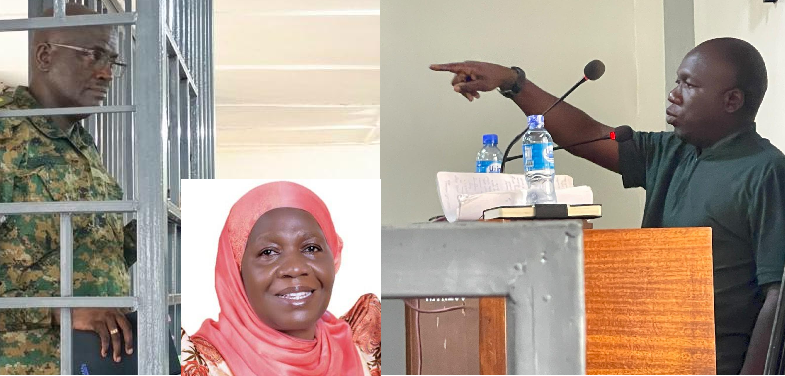
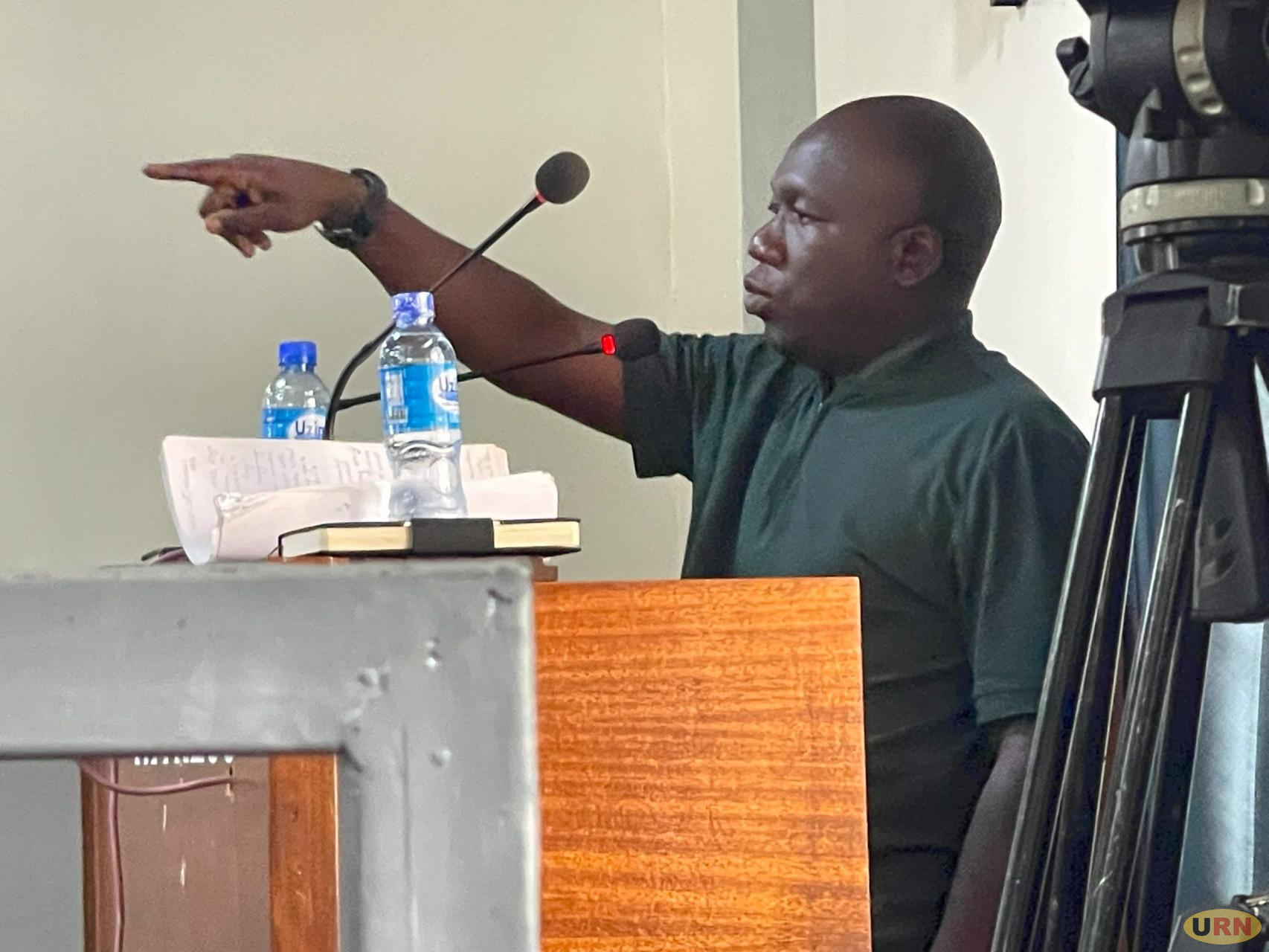
KAMPALA — Kampala Minister Hajjat Minsa Kabanda has been named in court proceedings over the alleged staged bomb attacks in Munyonyo and Kalerwe, as a prosecution witness accused former Deputy Chief of Military Intelligence (CMI) commander Brigadier General Abdul Rugumayo of torturing him and pressuring him to implicate jailed General James Birungi.
Hamza Lyavala, who was recently convicted of murder alongside Adil Walusansa after pleading guilty, told the General Court Martial in Makindye that Rugumayo wanted him to falsely claim that Birungi had provided Shs10 million to finance the alleged bomb missions.
Testifying against his co-accused, Lieutenant Colonel Ephraim Byaruhanga, Lyavala said Rugumayo also wanted him to claim that he had met Birungi after the latter handed over his office to Major General Richard Otto.
Lyavala insisted the allegations were untrue.
“He wanted me to implicate General Birungi, which I didn’t. He even gave me words and phrases to falsely accuse General Birungi,” Lyavala told the court.
The witness made the allegations during cross-examination by defence lawyer Frank Kanduho before the court, chaired by Brigadier General Richard Tukacungurwa.
He said the alleged pressure occurred while recording a statement at the Special Investigations Bureau of the Uganda People’s Defence Forces (UPDF) in Mbuya in June 2025.
Lyavala told the court that he recorded a 69-page statement over three days — June 22, 27 and 29 — in the presence of several intelligence officers, including Rugumayo, Major Habyarimana, Major Ssekajja and, on the final day, Major Okumu.
He alleged that Rugumayo tore up his first statement because it did not contain the accusations he wanted made against Birungi.
“I was being interrogated by Gen. Rugumayo. He was very harsh on my side. He tore my first statement, and later I wrote down another one,” Lyavala testified.
He said the first statement contained the facts as he knew them, but Rugumayo was dissatisfied because he had not implicated Birungi.
“He tore the first one because he didn’t find it satisfactory to his interests, but those were the facts I knew,” he said.
Lyavala further alleged that Rugumayo wanted him to tell investigators that Birungi had sent the group Shs10 million to facilitate the alleged bomb missions.
“He wanted me to tell the committee that Gen Birungi sent us Shs10 million to facilitate the fake bomb missions, yet it was not true,” he testified.
Lyavala said he was arrested on June 21, 2025, and recorded his first statement the following day. He later made another statement on June 29, which he said followed the alleged torture.
The allegations against Rugumayo were made by Lyavala during court proceedings and have not been independently established.
KABANDA LINK
In a separate part of his testimony, Lyavala recounted how he allegedly moved from membership in the Allied Democratic Forces (ADF) to working as a government informer.
He told the court that he joined the ADF around 2022 before becoming involved with the Pan Ugandan Liberation Initiative (PULI), a breakaway faction formed by members opposed to the ADF’s association with the Islamic State.
According to Lyavala, members of the rival factions sought his assistance because he was educated and had begun practising Islam. He alleged that PULI members manufactured 15 explosive devices and that Isaac Thomas, a son of former ADF leader Jamilu Mukulu, instructed them to identify targets.
Lyavala said he became alarmed by the activities and sought a way to surrender to the authorities and obtain forgiveness.
Through his guardian, Twaliha Batambuze, he was linked to Kabanda, who allegedly took him to the then-CMI commander, General Abel Kandiho.
Lyavala testified that Kandiho and Kabanda later took him to meet President Yoweri Museveni, where he confessed to his activities and provided information about the ADF.
He told the court that Museveni forgave him and directed him to continue working with Kandiho as an informer.
According to the witness, his subsequent intelligence work led to operations in which four groups were arrested and firearms recovered, including a PK machine gun, seven pistols and two AK-47 rifles.
He said he was later assigned to work with Birungi before being transferred to the intelligence structure headed by Otto, while Byaruhanga remained his handler.
ALLEGED SUICIDE MISSIONS
Lyavala told the court that Byaruhanga repeatedly sought intelligence from him about developments in the Democratic Republic of Congo and later complained that Otto was not acting on his reports.
He said he considered the disagreement an internal leadership matter and advised Byaruhanga that senior officers should resolve it.
The witness further alleged that Byaruhanga asked him to contact a man identified as Nkalubo, whom he described as an Islamic State coordinator operating in Central Africa, to persuade three people to travel to Kampala for suicide missions.
Lyavala said he rejected the proposal, arguing that it was beyond his responsibility, but Byaruhanga continued pressing him by telephone.
He also alleged that Byaruhanga later involved him and Walusansa in plans concerning women who had reportedly expressed interest in carrying out suicide attacks.
The women included Sumaya Byaruhanga and Azatu Sawiya, who were later killed in the Munyonyo and Kalerwe incidents, respectively.
Lyavala said he reported developments to Byaruhanga and Nkalubo because he did not want to be accused of withholding intelligence.
He alleged that Byaruhanga proposed using the women to carry out explosions in Kampala, while he advocated arresting those involved.
MUNYONYO AND KALERWE INCIDENTS
Lyavala also recounted the events surrounding the June 3, 2025, incident at Munyonyo, saying Byaruhanga took him and Walusansa to the area before proceeding to meet soldiers and later taking them to the Joint Anti-Terrorism Task Force (JATT) headquarters in Mbuya.
He testified that after they returned to Munyonyo, a woman arrived carrying an explosive device that detonated, killing her.
Lyavala said Byaruhanga later recorded videos of the scene and claimed to have shared them with Otto and Birungi.
The testimony comes against the background of allegations that the Munyonyo and Kalerwe incidents were staged to create the impression of a genuine terrorist threat.
Prosecutors allege that Byaruhanga convened a meeting at Gowers Hotel in Namulanda, where he briefed Lyavala and Walusansa about a suicide mission.
Court documents further allege that Byaruhanga facilitated the pair to rent a house in Kinaawa, Nateete, transport two women from Busoga to carry out the missions, and connect them to Anthony Ssekalaala, who allegedly manufactured the improvised explosive devices.
According to the prosecution, Byaruhanga drove Lyavala and Walusansa to Munyonyo on June 3, 2025, and told them he had contacted JATT officers, who believed they were responding to a genuine operation.
Prosecutors further allege that Lyavala brought Sumaya Byaruhanga from Busoga and that she detonated an explosive device at Munyonyo, killing herself.
On June 21, 2025, Sawiya Azatu was shot dead at Kalerwe after Byaruhanga allegedly alerted JATT that she was carrying two bombs intended for detonation at the market.
The prosecution maintains that investigations later established that the incidents had been staged to instil fear among the public and the state.
Byaruhanga has denied the charges, and the allegations against him remain subject to determination by the court.
DEATH PENALTY PLEA
Last week, the General Court Martial convicted Lyavala and Walusansa on two counts of murder relating to the Munyonyo incident during the June 3 Martyrs Day celebrations and the attempted attack at Kalerwe market on June 21, 2025.
The two had pleaded guilty to the murder charges.
Prosecutor Lieutenant Regina Nanzala has asked the court to impose the death penalty, arguing that the pair murdered innocent women and that a severe sentence is necessary to protect public safety.
Defence lawyer Major Simon Busagwa Nsubuga has asked the court for leniency.
The court is continuing to hear the case against Byaruhanga, who is accused of masterminding the alleged staged security operations following disagreements with his superiors.
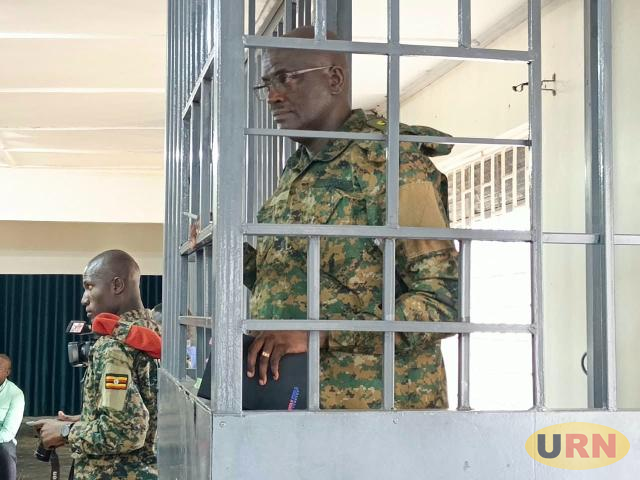
Meanwhile, Birungi, who has been in detention for more than a year on charges of treachery and security-related offences, is expected to appear before the court later today for the hearing of his bail application. He had not appeared by press time.
Birungi was among several senior UPDF officers arrested following the Munyonyo and Kalerwe incidents.
The proceedings against Byaruhanga and the separate case involving Birungi have drawn attention to allegations of manipulation of intelligence operations and the circumstances surrounding the two bomb incidents.
GOT A HOT STORY? LET US KNOW!
Got breaking news, explosive secrets, or hard evidence?
Email us: [email protected]
We accept tips, documents, videos, photos, and recordings—the more evidence you have, the better.
CONFIDENTIALITY IS OUR TOP PRIORITY. SOURCES ARE ALWAYS PROTECTED!
About Post Author