Uganda’s mineral wealth is sitting on a powder keg of governance failures, illegal trading, questionable licensing and financial accountability concerns, with the Inspectorate of Government (IGG) now moving against top bosses at the state-owned National Mining Company.
In the latest dramatic twist, the IGG has directed the acting board chairperson to interdict Chief Executive Officer Dr Gerald Banaga-Baingi and Chief Corporate and Legal Affairs Officer Lelia K. Bwambale as investigations into alleged maladministration, financial mismanagement and abuse of office get underway.
The directive, issued on Thursday afternoon, invokes Article 230(2) of the Constitution and Section 13(6) of the Inspectorate of Government Act, empowering the Inspectorate to suspend the officials’ powers and functions in the public interest.
“The interdiction is intended to facilitate investigations into allegations of maladministration, financial mismanagement, and abuse of office involving the two officials,” the IGG said.
The Inspectorate also ordered the acting board chairperson to put interim arrangements in place to ensure the company continues operating while the investigations proceed.
Although the IGG statement did not spell out the specific acts under investigation, the intervention comes against the backdrop of a turbulent leadership shake-up and wider concerns about governance in Uganda’s mineral sector.
Red Pepper previously reported on troubling findings in the Auditor General’s 2025 report on the Mineral Development Programme, which painted a picture of a sector struggling to enforce its own laws, collect revenues, complete projects and protect the country’s interests in its mineral resources.
The latest developments raise a hard question: who is safeguarding Uganda’s mineral wealth when the institutions entrusted with managing it are themselves grappling with serious governance and accountability concerns?
MINING COMPANY IN LEADERSHIP FREEFALL
The National Mining Company, established to protect government interests in the mining industry and support Uganda’s long-term development ambitions, has endured a turbulent start.
In less than two years, its pioneer board chairperson, James Mukasa Ssebugenyi, has departed, his deputy James Byakagaba has been removed, and the company’s chief executive and legal affairs chief have now been interdicted.
The Ministry of Energy and Mineral Development announced the departure of Ssebugenyi and Byakagaba on September 24, 2026, describing the leadership changes as part of measures to address governance and management challenges affecting the company.
While Ssebugenyi tendered his resignation, Byakagaba was removed from his position. Questions and speculation subsequently emerged over the circumstances surrounding the former chairperson’s departure, although it has not been established that he was forced to resign.
Energy and Mineral Development Minister Dr Monica Musenero appointed Maria Kiwanuka as acting board chairperson, tasking her with addressing the governance challenges and supporting the company’s recovery.
The subsequent interdiction of Banaga-Baingi and Bwambale has added another layer to the crisis at an institution expected to help Uganda secure a meaningful stake in its mineral riches.
Reports of alleged financial mismanagement, procurement and recruitment irregularities, and claims that some board members influenced the appointment of relatives have also circulated around the company. These allegations have reportedly fuelled divisions between the board and executive management, prompting the Ministry of Finance, Planning and Economic Development to conduct an audit.
Reports that some board members declined to attend sessions related to the investigations have further raised questions about cooperation and accountability.
The allegations have not all been established as findings against particular individuals. The IGG’s investigation is expected to determine the facts surrounding the specific matters referred to it.
AUDITOR GENERAL UNCOVERS A WIDER MINING MESS
The turmoil at the National Mining Company is unfolding as the Auditor General’s 2025 report exposes weaknesses across the wider mineral development programme.
One of the most glaring findings concerns illegal mineral trading.
Section 140(1) of the Mining and Minerals Act prohibits buying and selling minerals without a valid licence. Yet the report identified at least 17 traders dealing in minerals without the required mineral rights or dealer licences.
The finding raises serious questions about enforcement by the authorities responsible for regulating mineral trading.
The Ministry has said that, working with the Police Mineral Protection Unit, it shut down more than 30 illegal mineral outlets in Kampala. It has also pointed to plans to strengthen controls, integrate the sector into the Uganda Revenue Authority’s single window and establish formal mineral markets.
But the discovery of unlicensed dealers underscores the challenge of controlling a trade in which minerals can change hands outside the licensing and revenue systems designed to protect government interests.
Illegal trading threatens to undermine regulatory oversight and deprive the state of revenue, while creating opportunities for minerals to move through channels that are difficult to monitor.
BILLIONS IN ROYALTIES HANG IN LIMBO
The report also raises concerns about mineral royalties, with billions of shillings in collections and payments still requiring attention.
According to the findings, the government received Shs5.862 billion in mineral royalties during the period under review, in addition to an opening balance of Shs3.913 billion. Of the available funds, Shs8.33 billion was distributed, leaving Shs1.443 billion unpaid.
The royalties are intended to be shared among government, local authorities and landowners, making timely and accurate disbursement important for both public revenue and communities living around mining operations.
The report points to payments involving districts such as Kamwenge and Kitagwenda that were reportedly being processed. However, the presence of beneficiaries whose identities were recorded as unknown raises questions about the completeness of records and the systems used to identify those entitled to the money.
There is also a separate collection problem.
The Auditor General reported that Shs2.82 billion in assessed mineral royalties remained unpaid beyond the legally prescribed 30-day period.
Although notices of non-compliance had been issued and the Ministry had engaged the Attorney General and URA, the outstanding payments point to continuing challenges in ensuring that mineral operators meet their obligations on time.
At a time when government is seeking greater value from the mining industry, failure to collect assessed royalties or distribute money due to beneficiaries risks undermining public confidence in the management of the country’s natural resources.
GHOST-LIKE LICENSING RED FLAGS
Uganda’s mining licensing system also came under scrutiny.
The Auditor General found that ten mining licences faced delays in conversion, while eight applicants had been granted licences without proper evaluation. A further 114 licence applications had remained pending for more than 100 days.
The findings point to a system battling both delays and concerns about the quality of decisions made along the licensing chain.
Slow processing can frustrate legitimate investors, while approvals issued without adequate evaluation can weaken due diligence and create opportunities for irregularities.
More troublingly, the report identified 14 exploration areas where full-scale mining operations were taking place beyond the scope of the licences issued.
Exploration licences are not a blank cheque for unrestricted mining. Operations beyond their authorised scope raise questions about compliance monitoring and whether enforcement agencies are adequately protecting the integrity of the licensing system.
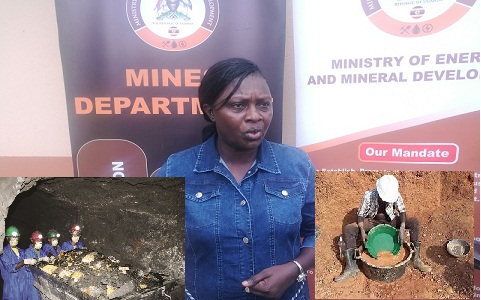
The findings place pressure on the Ministry and the Geological Survey and Mines Department, headed by Commissioner Agnes Alaba, which oversees mineral development, geological infrastructure and the digital mining cadastre.
The report’s findings do not, by themselves, establish personal wrongdoing by any named official. However, they expose serious regulatory gaps that demand explanation and corrective action from the responsible institutions.
SHINY MINERAL CENTRES, NO MACHINES
In Ntungamo and Fort Portal, two mineral beneficiation centres constructed in 2023 were found to be non-operational because they lacked the essential equipment required to function.
The facilities were intended to support local mineral processing, increase value addition and improve the earnings of communities by helping Uganda move beyond exporting raw minerals.
Instead, the centres were left unable to deliver their intended purpose.
The report indicated that the equipment was expected to arrive in March 2026. Red Pepper could not independently establish by press time whether it had since been delivered.
The delays expose a familiar problem in public projects: infrastructure can be constructed and money spent, yet the intended service remains unavailable because critical components have not been secured.
For mining communities, the consequences are practical. Without functioning processing facilities, opportunities to add value locally remain limited, while the country continues to face the challenge of extracting greater economic returns from its mineral resources.
The report also highlighted the absence of clear value-addition requirements for most mineral commodities.
While some minerals, including gold and sponge iron, have prescribed purity levels, other commodities such as tungsten and tantalum lack clearly defined thresholds, despite active mining and exports.
The Ministry has commissioned a Mineral Value Chain Analysis study to help address the gap. But the need for such work also highlights the importance of establishing clear standards that can guide operators and support effective enforcement.
NATIONAL MINING COMPANY SHORT OF CASH AND DELIVERY
The Auditor General’s report also identified operational and financial challenges at the National Mining Company itself.
The company had an outstanding Shs1 billion receivable from government shareholders, while it received only 43 per cent of its approved budget, leaving a funding gap of Shs5.4 billion.
The shortfall affected critical activities, including recruitment, ICT acquisition and office establishment.
Procurement performance was also weak. The company executed only 28.4 per cent of its planned procurement, completing contracts worth Shs921 million against a planned Shs2.86 billion.
The report further flagged payments totalling Shs76.2 million made without supporting procurement files, raising accountability concerns over whether the necessary documentation was available to justify the expenditure.
Some contracts were also reportedly awarded without proper management structures.
These findings present a troubling picture of an institution expected to play a strategic role in Uganda’s mining industry but struggling to translate its mandate and budget into operational delivery.
The report also found that the company had not secured the government’s mandatory 15 per cent equity stake in seven mining licences issued after the Mining and Minerals Act, 2022 came into force.
That omission could affect the state’s ability to benefit from future returns associated with those licences, making the protection of government equity interests a critical matter for the company and the responsible authorities.
The company’s challenges must, however, be considered alongside the reported funding shortfall and the distinction between weaknesses identified by the Auditor General and allegations now being investigated by the IGG.
WHO WILL ACCOUNT FOR THE MINERAL WEALTH?
Uganda has repeatedly identified mining as a potential driver of industrialisation, jobs, investment and economic growth. The National Mining Company was established to help secure the government’s interests in that ambition.
But the succession of leadership changes, the latest IGG interdictions and the Auditor General’s findings have placed governance and implementation under intense scrutiny.
Unlicensed mineral dealers, delayed royalty payments, licensing irregularities, idle beneficiation centres and weak procurement performance point to problems that extend beyond the fortunes of individual executives.
The central question is whether the institutions responsible for regulating the industry and protecting public interests can enforce the law consistently, account for public money, complete projects and ensure that the country receives its fair share from its mineral resources.
The IGG’s intervention at the National Mining Company is a significant development, but interdictions are not findings of guilt. The investigations must establish whether the allegations against the suspended officials are substantiated and identify any individual responsibility supported by evidence.
Meanwhile, the broader findings in the Auditor General’s report call for answers from the relevant authorities on why enforcement gaps, unpaid royalties, delayed projects and procurement weaknesses persisted.
Uganda may be rich in minerals, but the value of that wealth depends on the systems entrusted to manage it.
For now, the latest suspensions have put the National Mining Company’s leadership under the spotlight. The bigger test is whether the investigations and any subsequent reforms will help close the gaps that have left the country struggling to turn its mineral wealth into tangible public benefit.
GOT A HOT STORY? LET US KNOW!
Got breaking news, explosive secrets, or hard evidence?
Email us: [email protected]
We accept tips, documents, videos, photos, and recordings—the more evidence you have, the better.
CONFIDENTIALITY IS OUR TOP PRIORITY. SOURCES ARE ALWAYS PROTECTED!
About Post Author