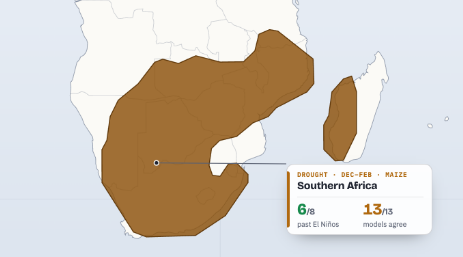
The publisher of the weather blog, The Climate Brink, Zeke Hausfather, is fairly convinced that Namibia’s regular summer rainfall area will experience drought conditions from around the end of November this year to the beginning of February next year.
Hausfather is basing his forecast on an analysis of the eight strongest El Nino events over the past fifty years, saying that December to February was drier than normal in six of these events. Citing an academic authority, he states that Dr Catherine Pomposi and her co-researchers estimate an 80% chance of below normal rainfall during a strong El Nino.
In recent meteorological history, only the 1997_98 El Nino failed to produce a Namibian drought which he explains by the interaction of persistent low pressure over Angola versus a high pressure cell over Botswana.
The regional phenomenon that will ultimately prove to be important for Namibia is the development of the so-called Indian Ocean Dipole. As a rule of thumb, meteorologists classify the Indian Ocean Dipole as either negative or positive. When it is positive, temperatures off the African east coast are warmer than usual while the ocean near Indonesia is cooler. The opposite applies to a negative dipole. Currently, the Indian Ocean Dipole is positive.
The anomaly that arises from a positive Indian Ocean Dipole during a strong El Nino is that the southern African subcontinent is divided along a recurved north-south axis that roughly cuts Namibia into a western and an eastern half.
This typically leads to drought conditions in the eastern half during the main summer rainfall season, while the mid-level Angolan trough is displace to the west, bringing above normal rainfall to Omusati, Kunene and Erongo.
The current El Nino is described as unprecedented, forecast to reach about 4°C above normal oceanic temperatures in the Nino 3.4 zone in the central Pacific Ocean.
“The 2026-27 El Niño is on track to be the strongest event in the instrumental record. The latest (September 2026) runs of the 14 seasonal forecast models that I track at the Climate Dashboard put the event’s peak at around 4.1°C in the Niño 3.4 region (with the middle 80% of ensemble members between 3.4°C and 4.6°C), well above the prior record of 2.75°C during the 2015-16 El Niño,” Hausfather argues.
The 14 forecast models he mentions use the same methodology as the Oceanic Nino Index developed by the US Government’s National Oceanic and Atmospheric Administration (NOAA). For his southern Africa forecast, he uses a slightly different set of 13 models tracking rainfall and temperature anomalies.

For the seasonal forecast that runs up to the end of February 2027, 13 models are unanimous in their prediction of below average rainfall for most of southern Africa, including the eastern half of Namibia.