MADRID: Spanish Prime Minister Pedro Sánchez has denied that Morocco was the cause of the mass migration influx into the Spanish enclave of Ceuta last month, indicating that Spanish intelligence agencies have not found any evidence that Rabat was involved in the unprecedented border crossing.
Sanchez indicated that the cooperation with Morocco was still good and that compromising bilateral trust would complicate an already challenging situation in Ceuta.
Read more: Lebanese PM Rejects Israel Normalization, Southern Situation is Still Worrying
No intelligence agency information casts any doubt on the role of the Moroccan authorities, Sánchez said in a radio interview, and the crisis could only be resolved by further collaboration between Madrid and Rabat.
This is said following speculation that Morocco might have intentionally permitted or even encouraged the flow of tens of thousands of individuals towards Ceuta as a means of exerting pressure on Spain over its growing close ties with Algeria.
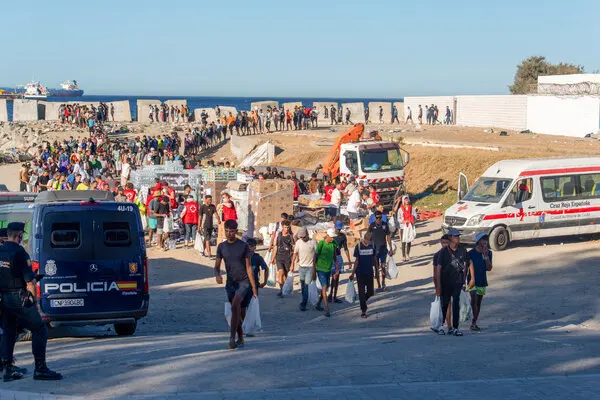
At the end of July, an estimated 70,000 people tried to reach the Spanish territory, which led to a significant humanitarian and political crisis. The Moroccan organizations have estimated that up to 141 individuals were killed on both sides of the border during the incident.
Sánchez rather blamed the unprecedented influx to criminal networks and disinformation campaigns. He charged social media accounts linked to Russia, Israel and the international far right with propagating fake claims aimed at capitalizing on migration tensions and destabilizing Spain and Europe.
More News: Lebanon Arrests Five Suspected of Plotting Attacks on Syrian Government Forces
The accusations have caused a diplomatic backlash. Israeli Foreign Minister Gideon Saar dismissed the remarks of Sánchez as false, and the Kremlin denied any Russian involvement in the migration crisis.
Sanchez alleged that criminal organizations had spread false information about Spanish court decisions, such as a supposed decision that individuals who had entered Ceuta by swimming could not be deported to Morocco.
Ceuta is Under Ongoing Humanitarian and Security Pressure
Even though the majority of the people who entered Ceuta have since gone back to Morocco, the enclave continues to grapple with the consequences. Thousands of migrants are left on the territory, with many of them being minors, which puts a strain on local accommodation and public services.
The tensions have also spilled over to the streets with reports of clashes between residents, police and migrants. There have been cases of migrants sleeping in the streets having their property burnt and Spanish police have detained people who are suspected of assaulting security officers.
Sanchez indicated that the government would soon be able to house those who are left in the enclave.
The Spanish government has also been under increased political pressure due to the crisis. Opposition leader Alberto Núñez Feijoo accused Sánchez of not defending Ceuta and letting the situation escalate into a crisis of public order.
Vox leader Santiago Abascal has gone even further, calling the episode an invasion and accusing Morocco of encouraging it whilst saying that Sánchez has been unable to effectively respond.
A Test for Spain’s Migration Strategy
The argument about who caused the Ceuta influx has become nearly as politically significant as the migration crisis itself. In the case of Sánchez, the publicly denial of Moroccan participation serves to maintain a relationship with Rabat that Madrid believes is valuable in controlling migration and border security.
However, the episode also reveals how the migration policy of Spain is vulnerable to sudden influx and fake news on the Internet. Although the involvement of Moroccan authorities may not have been the case, the fact that criminal networks or organized online campaigns could mobilize masses of people shows how fast a border crisis can destroy local infrastructure and turn into a national political concern.
The fatalities that have been reported in the crossing have given the confrontation a human price, and the thousands who still need to be accommodated demonstrate that the effects of the July events are not over with the initial rush to the border.
In the case of Spain, the short-term problem is to stabilize the situation in Ceuta without letting the crisis permanently harm the relations with Morocco. To the broader European Union, the incident is yet another wakeup call that the issue of migration pressure at a strategically sensitive border can quickly turn into a challenge to diplomatic relations, domestic politics and regional security simultaneously.