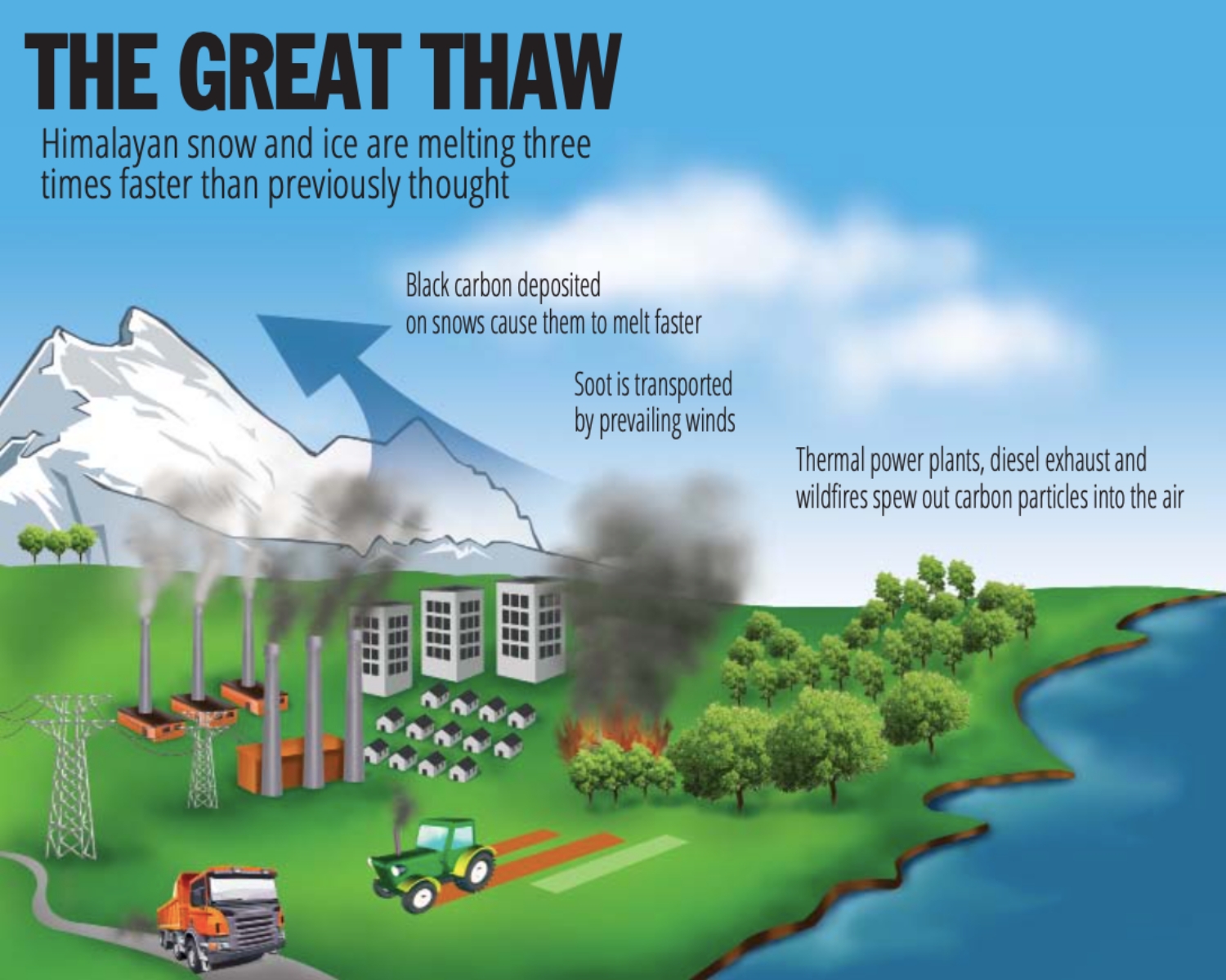
The accelerated melting of Himalayan glaciers is mainly caused by global warming due to the buildup of greenhouse gases in the atmosphere. But a new study has confirmed that air pollution deposits also melt the icecap by making it darker.
The two phenomena work in different ways. While the buildup of greenhouses gases due to fossil fuel burning traps solar radiation and raises global surface temperatures, soot particles make snow and ice absorb more sunlight and cause additional melting.
Record high temperatures led to the ice-rock avalanche on the north face of Langtang Lirung on 26 August that unleashed the catastrophic flood downstream.
The Air Quality and Climate Bulletin of the World Meteorological Organization (WMO) released this month shows that ‘black carbon’ from air pollution accelerates melting when deposited on snow or ice surfaces.
Aerosols like soot particles are carried by prevailing winds across oceans and continents, and lifted by terrain onto glaciers.
A previous study by the International Centre for Integrated Mountain Development (ICIMOD) on Yala Glacier in the Langtang region showed that India and Nepal together contributed 69% of atmospheric black carbon over the central Himalaya.
The sooty deposits contributed 39% of Yala Glacier melting in the pre-monsoon season.
Though microscopic, soot is one of the greatest enhancers of glacial destabilisation, and the WMO warns of a vicious climate cycle: a warming climate increases wildfires and sand storms, which adds more suspended ash and dust that are then deposited on mountains, accelerating glacial melting.
Scientists are hesitant to pinpoint exactly how much of the glacier collapse on Langtang last month was due to black carbon, and say it will need measurements.
“Avalanches are often driven by a mix of thermal thawing, internal glacier instability, and structural weakness rather than a singular factor, so it is difficult to establish a causal relationship. But black carbon undeniably plays a role in it,” explains air quality expert Parth Sarathi Mahapatra at ICIMOD.
Black carbon is fine particulate matter smaller than 2.5 microns (PM2.5) made from incomplete combustion of diesel and coal from vehicles and industries, firewood or farm residue burning. Technically, it is called a ‘short-lived climate pollutant’ that stays in the atmosphere for a week or so only, while CO2 gas can remain in the air for hundreds of years.
Besides making glaciers melt more rapidly by reducing their albedo reflectivity, black carbon also has 1,500 times more warming impact than CO2.
“In general, the presence of black carbon in the atmosphere can significantly enhance solar heating by up to 50%,” says Abhishek Kumar Upadhyay from ICIMOD.
Glacial melting exposes bare rocks, which are darker and lead to more ice and permafrost thawing. The ice structure and the bedrock itself gradually weakens and can collapse like it did on Langtang last month and other Himalayan peaks in recent years.
Scientists have confirmed that the deadly debris flood that swept across China and Nepal on 26 August originated as an ice-rock avalanche on the northern slope of the Langtang Lirung.
WMO has also launched the Atmospheric Deposition Initiative (WADI) to produce detailed global maps of total deposition of major atmospheric pollutants, using satellite and surface measurement.
REGIONAL RESPONSE
“The transboundary nature of black carbon needs coordinated regional response due to its interconnected impact on health, climate, and water resources,” says Ashish Tiwari at ICIMOD.
Cleaner brick kilns and vehicle emissions and curbing wildfires can reduce black carbon buildup in South Asia. Household fires account for nearly half of black carbon emissions globally, and clean energy for cooking, heating, lighting and transportation can lower total soot emissions.
Says glaciologist Tenzing Chogyal Sherpa: “We cannot pinpoint exactly how much of the glacial slide can be attributed to black carbon specifically because it is difficult to disentangle individual sources of glacial melt without measuring deposition.”
But even while scientists try to find the exact causes of the Langtang slope collapse, there is proof that black carbon is a culprit, and reducing air pollution can slow glacier melting and global warming.