Ever since the RSP won an outright majority in the March election, Prime Minister Balendra Shah has had a near-absolute mandate to push through his government’s programs.
The three main opposition parties were nearly uprooted, and are still in great disarray. Not only are the NC, the UML and the NCP not able to put up a united front against the RSP juggernaut, their ageing leaders do not seem to have a sense of the public sentiment against them.
Further, each of the three is rocked by internal power struggles between younger aspirational leaders and entrenched septuagenarians who have been prime minister at least 15 times between them, and been in power since 2006.
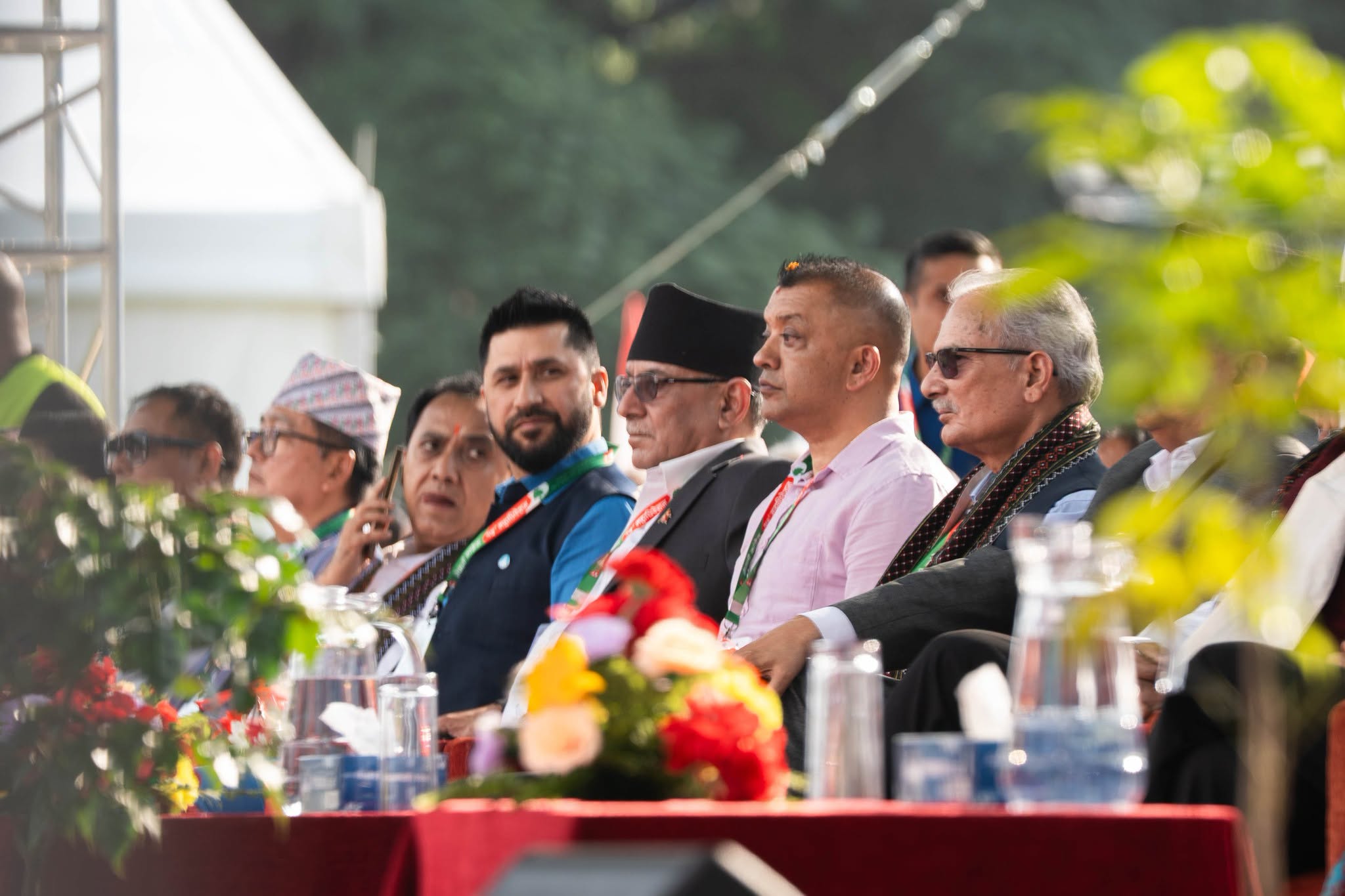
The case in point was the Nepali Congress which held its 15th General convention with hundreds of delegates—including an assortment of animal mascots and a robot—in the very heart of Kathmandu.
The tonal contrast between previous conventions and this year’s gathering reflected the generational shift from the old guard to party president Gagan Thapa, who himself is now 50.
The NC is the only mainstream party that has at least made an effort to upend the status quo and make way for newer, younger, leadership in the wake of last year’s youth revolt. But the old guard has not given up, with former president Sher Bahadur Deuba still sulking.
Thapa is a fiery orator from his student days, and laid out in stark terms his party’s political failures that precipitated its present predicament: ideological drift, corruption, poor governance, internal power struggles, and a growing distance with youth.
Leaders from across the political spectrum addressed the convention in a usual show of political goodwill, but not without some barbs and innuendos.
RSP chair Rabi Lamichhane mused that he too would have joined NC — had the party prioritised the loyalty of members over their wealth, and had they not limited their promises of proportional representation to paper. He advised Thapa not to waste time appeasing the old guard.
This was ironic, given that cohabitation between Lamichhane and Prime Minister Balendra Shah have not been smooth. It is not just the opposition parties that suffer from infighting and lack of intra-party unity – factions of the governing party also often work at cross-purposes, and at times it seems as if the PMO and the Ministries run parallel governments.
At the closed session, Thapa laid out a reform agenda that included a two-term limit on prime ministership, primaries for candidate selection, an end to electoral alliances, and allowing out-of-country voting.
He also defiantly declared an end to factionalism and political dynasties within the NC. That could be wishful thinking since the Koiralas and Poudels are still prominent Deuba allies.
Deuba and his loyalists have mobilised to hold their own general convention in December. Deuba’s continued rejection of Thapa’s leadership is ironic considering he himself came to helm NC after upending the party’s lineage-dominated history in 1995.
On Friday delegates will cast votes to elect new leadership. Party president Gagan Thapa’s test will now be whether or not he is willing and able to translate his decades-long aspiration for party reform into action.
Having lost the election in March, Thapa has had the time to focus on internal party reform. His role should also be to ensure that NC fulfils its role as the primary opposition in Parliament.
In an interview with The Kathmandu Post this week, Thapa said his party was not more aggressive in Parliament because NC did not want to be seen like it did not gracefully accept the outcome of the March election.
But, he said, that would now stop, and delivered a sharp criticism of Prime Minister Balendra Shah’s governing style, his refusal to engage with the legislature and for his ad hoc decisions.
Shah responded, as is his wont, on Facebook and taking credit for renovating the venue where the NC convention was held. At least it showed that despite his reclusive and elusive behavior, PM Shah is still paying attention.