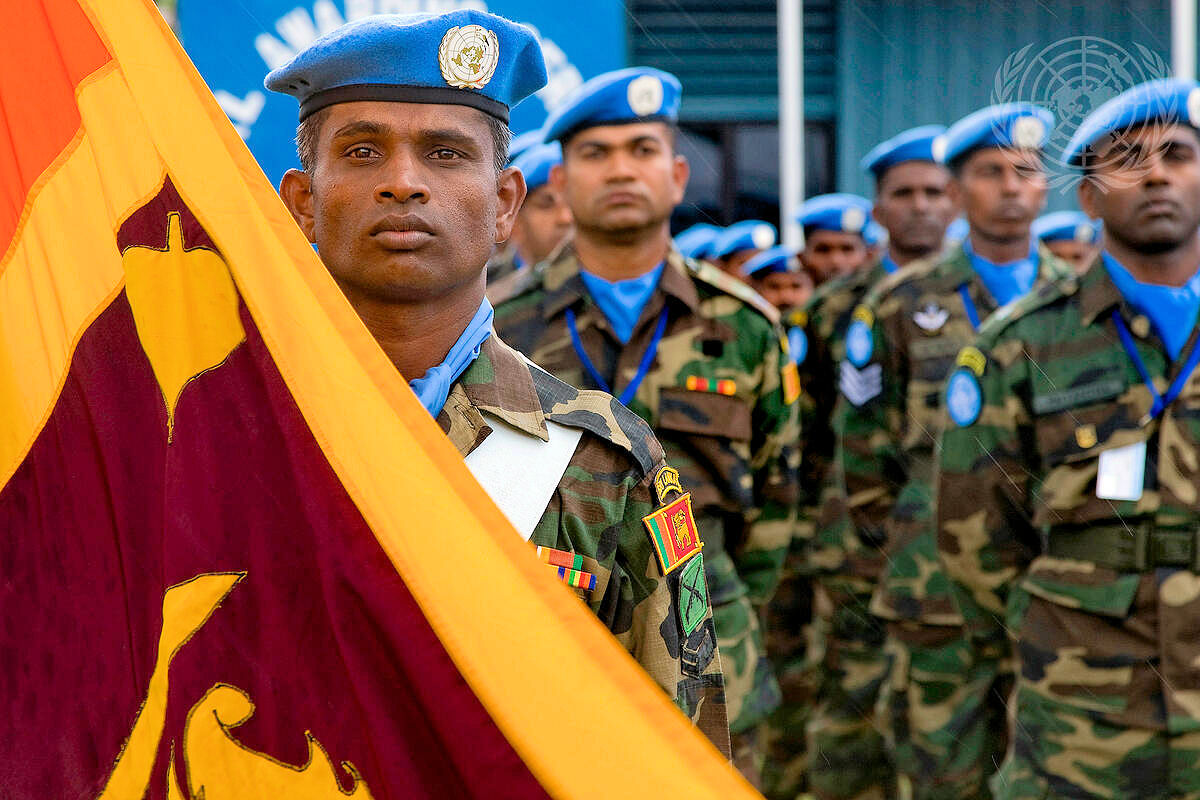

This statement by an international coalition of human rights non-governmental organizations (NGOs) provides a comprehensive and well-documented review of the rape and sexual abuse committed by Sri Lankan soldiers deployed as part of the UN Mission to Stabilize Haiti (MINUSTAH), which militarily occupied the country from 2004 to 2017. It also explains how perpetrators, as well as force commanders, mostly avoided prosecution and accountability. None were imprisoned.
While the groups do not oppose the deployment of the UN-blessed, Washington-devised GSF on grounds of law and principle, as Haïti Liberté does, we found very edifying their well-formulated warnings that history may repeat itself if 1,040 Sri Lankan soldiers and cops soon join the GSF, as is now planned, without rigorous safeguards and vetting.
Kim Ives
(Printable PDF with footnotes here)
International human rights and victims’ groups call on the United Nations, the Government of Haiti, and the Gang Suppression Force (GSF) Standing Committee to immediately suspend the planned deployment of reportedly 900 Sri Lankan soldiers and 140 police officers to Haiti, scheduled to proceed imminently, pending the establishment of an independent credible vetting and screening mechanism conducted with meaningful Office of the High Commissioner for Human Rights (OHCHR) participation and access to all relevant UN information (The Morning, 21 June 2026). Any official whose conduct, command role, or prior involvement may give rise to an actual or perceived conflict of interest should play no role in supervising, certifying or approving that process.
Whether the final contingent consists of 900 personnel or a smaller number, the fundamental concern remains unchanged: no individual should be deployed without an independent assessment of involvement in past violations.
Our understanding is that currently the screening of Sri Lankan peacekeepers for the GSF relies primarily on information supplied by the Sri Lankan authorities, together with diplomatic and administrative checks. While the UN and specifically OHCHR have indicated that vetting measures are being undertaken, the precise criteria, methodology, scope and degree of independence of that process remain unclear. None of the publicly described measures amount to a transparent and independently verifiable human rights screening mechanism.

The fact that at least one candidate has already been rejected by the American Embassy illustrates exactly the gap this leaves: if the Sri Lankan military is putting forward individuals with known human rights red flags, a process that relies on their good faith has already failed.
This deployment from a country — whose security forces have been repeatedly implicated in serious violation of international humanitarian law, international human rights law, and conflict-related sexual violence, and where accountability for such violations remain largely absent — is proceeding without a credible independent human rights vetting and screening mechanism (OISL 2015; SLAP 2026). The resulting risk is not merely theoretical, it is foreseeable, well documented and is incompatible with the standards that the UN has committed itself to uphold.
1. No Independent or Credible Human Rights Vetting Mechanism Exists
The UN’s Human Rights Due Diligence Policy requires the UN to assess whether there are substantial grounds to believe that support may contribute to violations of international humanitarian, human rights or refugee law. Such assessments cannot be delegated to the very institutions whose personnel are under scrutiny. A process based on self-certification, internal military review, and diplomatic consultations falls short of the independence and impartiality required by international standards (UN Human Rights Due Diligence Policy; Special Measures for Protection from Sexual Exploitation and Sexual Abuse; UN Security Council Resolution 2272).
In the absence of a transparent and credible screening mechanism capable of identifying individuals implicated in serious human rights violations, concerns regarding the deployment remain unresolved.
The only screening arrangement that previously provided any meaningful check — a joint process between the Human Rights Commission of Sri Lanka (HRCSL) and OHCHR, which has access to the confidential information held by the UN in Geneva that is essential to rigorous vetting — collapsed in 2024. The HRCSL withdrew in June 2024 under sustained political pressure from Sri Lankan state officials, including demands to reverse decisions not to clear specific candidates. Its own Lessons Learnt Report, published in December 2024, is candid that the process only functioned with real credibility when conducted jointly with OHCHR: the HRCSL relied on publicly available information and lacked access to OHCHR’s confidential investigations and witness testimonies on Sri Lanka. That joint arrangement is now gone. (HRCSL thematic reports)
The credibility of vetting was also undermined by the Sri Lankan military’s own conduct during the screening period. In 2017, the army deployed troops to a UN peacekeeping mission without completing the agreed screening process. The breach forced a suspension of all deployments and a complete renegotiation of procedures that took nearly a year. The military that ignored its own agreed vetting process when it was inconvenient is now the institution being trusted to self-certify.
2. The Officials Supervising The Deployment Present an Apparent Conflict of Interest
Given the longstanding concerns raised regarding the conduct of senior military and political officials during the armed conflict, any screening mechanism should be demonstrably independent of individuals whose own conduct has been the subject of credible allegations and international scrutiny.

The two most senior Sri Lankan officials reportedly associated with facilitating this deployment are themselves individuals whose military service coincided with operations that have been the subject of extensive scrutiny by UN investigations. Their involvement does not establish individual responsibility for violations. However, where senior officials are associated with military units, operations, or command structures that have been the subject of credible allegations of serious violations, their participation in certifying, supervising, or advocating for the screening of others risks creating at least the appearance of a conflict of interest and undermining public confidence in the integrity of the vetting process.
H.S. Sampath Thuyacontha — Secretary of Defence
Sri Lanka’s Secretary of Defence commanded No. 9 Squadron of the Sri Lanka Air Force — the Mi-24 attack helicopter unit (Sri Lanka Air Force, No. 09 Attack Helicopter Squadron) — throughout the final phase of the civil war (Onlanka; Ministry of Defence profile; Ceylon Digest; Daily News). The OHCHR Investigation on Sri Lanka (OISL, 2015) found reasonable grounds to believe that aerial attacks during this period, including on civilians in declared no-fire zones and on clearly marked UN humanitarian convoys, could constitute war crimes. Thuyacontha personally flew approximately 60 missions and described the assault on the heavily populated civilian area of Puthukkudiyiruppu as “like 31st night — full of fireworks.” (The Island, reproduced source) He has been consistently promoted since the war’s end (Ministry of Defence profile) and has reportedly met personally with Haiti’s Prime Minister to discuss this deployment, asserting that the vetting process is ‘almost complete.’ (Ministry of Defence, 25 April 2026)
Air Commodore Asela Vasantha Jayasekara — Sri Lanka’s Military Adviser to the UN, New York
The officer who interfaces directly with GSF peacekeeping bodies on behalf of Sri Lanka served in No. 12 Squadron — the MiG-27 ground attack unit — during the final ground battles (Fighter Pilots Flirted With Danger). His commanding officer has stated publicly that Jayasekara flew offensive attack missions during operations in which the OISL documented serious violations of international humanitarian law (Men who killed Thamilselvam speak).
Neither individual has been adjudicated responsible for specific violations. The issue is therefore not one of presumed guilt, but of institutional independence and public confidence. The UN’s own Human Rights Due Diligence Policy is intended to ensure rigorous scrutiny where credible concerns arise. Individuals whose conduct command responsibilities, or operational roles could themselves reasonably warrant independent assessment should not be responsible for supervising, certifying, or advocating for the screening of others.
3. The History That Makes This Unacceptable
From late 2004 to October 2007, at least 134 members of successive Sri Lankan military contingents deployed to Haiti under a UN mandate sexually exploited and abused Haitian children, some as young as eight years old (UN News, 2007). Boys and girls were raped in exchange for food and sums as small as USD 3 to 5. The UN’s own confidential investigation (OIOS case ID-0881/07) found the abuse “frequent… at virtually every location where Sri Lankan military were deployed,” and that commanding officers were not only aware but directly implicated. One young child told investigators he had been sexually abused by more than 100 Sri Lankan soldiers. [Source noted in original statement: OIOS investigation report]
Not one perpetrator has ever been imprisoned. The Sri Lankan Army’s account of what happened has shrunk from 134 suspects to 23 “convicted” (U.S. Department of State report) (three of whom had already died in combat while still on active duty (CAT/C/LKA/5) — raising the question of why men under investigation for child rape were permitted in a combat zone) to 18 (The Independent), then nine [Source noted in original statement: Sunday Leader], then — in a 2018 Right to Information response — just three (RTI Commission case). Sri Lanka told the UN Committee Against Torture the matter was ‘closed’ in 2014 (CAT/C/LKA/5, para 110; Sri Lanka Guardian) but never answered the Committee’s follow-up questions. No UN body has confirmed the matter was resolved to its satisfaction. The commander of the sixth contingent — the last to be repatriated — was substantiated in his temporary rank of Colonel the day before he retired (Sri Lanka Gazette; The Island, 9 June 2007), leaving with a larger pension. Every contingent commander from all six Haiti deployments was subsequently promoted.
the UN’s own confidential investigation found the abuse “frequent… at virtually every location where Sri Lankan military were deployed.”
In 2013, a Haitian teenager was allegedly raped by a Sri Lankan peacekeeper. Sri Lanka sent Major General Jagath Dias — himself an alleged war criminal — to investigate (AP, 26 May 2017). He did not interview the victim or the alleged perpetrator and cleared the soldier, who completed his tour. In 2016, Sri Lanka made a single paternity payment of USD 45,243 to a Haitian woman whose daughter had been fathered by a Sri Lankan commander. The UN called this ‘best practice.’ (AP report, republished by The Peninsula) The Defence Secretary who signed the payment said he knew ‘little’ about it and whether other such claims existed (same source).
Whistleblower testimony gathered by the ITJP describes an environment in which sexual exploitation was commonplace, commanders bore no consequences, and investigators sent from Sri Lanka were received with sex workers and alcohol at their hotels. “There was never any court martial,” one witness told us. “A lot of women had children from Sri Lankan soldiers. The commander was responsible, but he didn’t take action.” This history has never been satisfactorily investigated, prosecuted or remedied. Instead, it has largely been characterised by institutional denial, contradictory official accounts, and the absence of meaningful accountability.
The UN has repeatedly committed itself to a policy of zero tolerance for sexual exploitation and abuse (UN Peacekeeping Standards of Conduct). The Sri Lankan contingent in Haiti became one of the most notorious examples of systemic sexual abuse committed under a UN mandate. The absence of meaningful accountability more than two decades later raises profound questions about institutional reform, command responsibility, and the effectiveness of domestic disciplinary mechanisms. Deploying another large Sri Lankan contingent without independent scrutiny risks signalling that these lessons have not been learned.
4. Training Cannot Substitute for Accountability
The Haiti GSF has confirmed that Sri Lankan troops will receive pre-deployment and in-country training, that cross-national investigators will handle complaints, and that mitigation measures will be applied. We question whether any of this can work in the absence of the structural conditions that make accountability real:
- The institution certifying these troops has a documented record of protecting perpetrators, not investigating them.
- No criminal accountability has ever followed from the 2004–2007 abuse — the message to the current contingent is that consequences do not follow.
- Pre-deployment training was a feature of every previous Sri Lankan peacekeeping cycle, including those that produced the systematic child rape of 2004–2007.
- The OISL report of OHCHR found reasonable grounds to believe that Sri Lankan security forces used rape and sexual violence on a widespread and systematic basis as a deliberate tool of oppression against Tamils, with some acts potentially amounting to war crimes and crimes against humanity. This is not a military with an isolated misconduct problem. It is a military with a structural impunity problem.

Training, monitoring and complaint mechanisms are important safeguards, but they cannot in and of themselves compensate for the absence of credible screening before deployment. Vetting is intended precisely to prevent foreseeable risks before they materialise. Once deployment occurs, preventive opportunities are significantly diminished and accountability mechanisms become reactive rather than protective. The purpose of vetting is not simply to respond to abuse after it occurs but to prevent foreseeable harm before deployment takes place.
Calls to Action
The UN and the GSF Standing Committee:
- Immediately suspend deployment of all Sri Lankan military and police personnel to Haiti until an independent vetting and screening mechanism has been completed, with meaningful OHCHR-participation and access to all relevant UN information and records.
- Ensure that officials who are themselves subject to unresolved allegations or who may reasonably be perceived as having a conflict of interest play no role in certifying, supervising, or approving the screening process.
- Require publication of the names and photographs of all deploying personnel, together with the retention of DNA samples and other identification records, before deployment, to facilitate the investigation of any allegations involving sexual exploitation, sexual violence or paternity claims.
- Publish a summary of the screening methodology and safeguards sufficient to ensure public confidence while protecting confidential sources and witnesses.
- Establish a victim-accessible, confidential complaints mechanism in Haiti with genuine investigative independence involving civil society groups.
The Government of Sri Lanka:
- Reply to the UN Committee Against Torture’s pending questions regarding how the prosecutions were proportionate to the gravity of the crimes in 2004–7. Provide a full, transparent public accounting of all actions taken against perpetrators.
- Provide effective remedies and reparations, including compensation, rehabilitation and acknowledgement for all identified victims.
- Engage constructively with all the recommendations of the recent conflict-related sexual violence (CRSV) report by the Sri Lanka Accountability Project of OHCHR.
Member States:
- Press for suspension of the deployment until credible, independent vetting is in place and accountability for past violations.
Conclusion
The undersigned organisations welcome any efforts by OHCHR and other UN entities to strengthen human rights screening procedures. However, the existence of a vetting process is not, in itself, sufficient. Given the extensive and well-documented allegations concerning members of the Sri Lankan security forces, including units and commanders implicated in serious violations of international human rights and humanitarian law, exceptional scrutiny is required. The credibility of this deployment will depend on whether the screening process is independent, transparent, adequately resourced, informed by all relevant UN-held information, and capable of excluding individuals against whom credible allegations exist.
Are the UN and participating states prepared to apply human rights standards and safeguards consistently and without exception?
The issue is not whether Sri Lanka should contribute to international peace support operations. The issue is whether the UN and participating states are prepared to apply human rights standards and safeguards consistently and without exception. Given Sri Lanka’s history of grave violations, entrenched impunity, and the unresolved legacy of abuse committed by its previous Haiti contingents, deployment should not proceed until an independent and credible vetting process has been completed and demonstrated to satisfy the requirements of the Human Rights Due Diligence Policy. Failure to do so risks exposing Haitian civilians particularly women and children, to foreseeable harm while undermining the credibility of the United Nations’ own human rights commitments.
Signatories
-
International Truth & Justice Project (ITJP), UK
-
Sri Lanka Campaign for Peace & Justice (SLC), UK
-
People for Equality & Relief in Lanka (PEARL), USA
-
British Tamil Conservatives (BTC), UK
-
Tamils for Labour, UK
-
Australian Tamil Congress (ATC), Australia
-
British Tamils Forum (BTF), UK
-
Journalists for Democracy in Sri Lanka (JDS), Sri Lanka
-
North-East Coordinating Committee (NECC), Sri Lanka
-
Mannar Economic & Social Development Organisation (MSEDO), Sri Lanka
-
United States Tamil Action Group (USTAG), USA
-
Australian Centre for International Justice (ACIJ)
-
International Centre for Prevention & Prosecution of Genocide (ICPPG), UK
-
Association of Exiled Relatives of the Enforced Disappeared in Sri Lanka (AEREDSLUK), UK