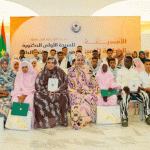
YESTERDAY marked the beginning of Women’s Month, a time when speeches will be delivered, banners unfurled and social media flooded with messages celebrating the resilience, strength and achievements of women.
Those celebrations are deserved. Women have carried families, communities and this nation through some of its most difficult moments.
But as we celebrate, we must also confront an uncomfortable truth. Gender Based Violence (GBV) continues to rob thousands of Basotho women and girls of the very dignity and security that Women’s Month seeks to honour.
This year’s Women’s Month should not simply be another annual ritual of awareness campaigns and symbolic gestures. It should be the month when Lesotho collectively resolves that GBV must become yesterday’s news.
Sadly, the latest figures from the police Child and Gender Protection Unit (CGPU) remind us how far we still have to go. Between January and May this year, police recorded 215 GBV cases involving current or former intimate relationships. Nearly half of these involved spouses, while almost 93 percent of all reported GBV occurred within intimate relationships. Women and girls accounted for more than 93 percent of the victims.
These statistics expose a painful reality. For many women, the greatest threat to their safety is not lurking in dark streets or isolated places. It exists inside the home, where they should feel safest. The people entrusted to love, protect and support them too often become their abusers.
For years, the country has responded to GBV largely by reacting after the damage has already been done. We mobilise after a brutal assault. We express outrage after another woman is killed. We demand justice after another child has been abused. Then, as public attention shifts elsewhere, the cycle begins again. This reactive approach has clearly failed.
The challenge is not that Basotho do not understand what GBV is. Awareness campaigns have become commonplace. Radio stations discuss it. Churches preach against it. Schools teach learners about it. The government ministries organise workshops. Civil society organisations conduct community dialogues almost every month. Yet the violence persists.
The problem is that awareness alone cannot change behaviour when harmful attitudes remain deeply rooted. Too many men continue to view women as possessions rather than equal partners. Too many families encourage victims to “persevere” instead of reporting abuse. Too many neighbours hear screams through the wall and decide that domestic violence is “a private family matter”. Silence has become an accomplice to violence.
The police deserve recognition for strengthening reporting systems and encouraging survivors to come forward. Indeed, the concentration of cases in Maseru Urban may partly reflect greater access to police stations and victim support services. But the CGPU itself acknowledges that GBV remains significantly under-reported because of stigma, fear and limited access to support services.
If over 200 cases are reported in just five months despite widespread under-reporting, one can only imagine how many incidents never reach police records. That should concern policymakers just as much as the statistics that are already available.
Women’s Month therefore presents an opportunity for more than colourful commemorations. It demands concrete action.
The government must ensure that laws protecting victims are implemented consistently and that perpetrators are prosecuted swiftly. Justice delayed often becomes justice denied, especially for vulnerable women who rely on the criminal justice system for protection.
The police require continued investment in specialised investigators, counselling services and victim-friendly facilities. Courts handling GBV matters must move cases faster to minimise secondary trauma for survivors.
Communities also have responsibilities that cannot be outsourced to the government. Traditional leaders, church leaders, employers and educators all have influence over attitudes and behaviour. They should use that influence not only to condemn violence after it occurs but to challenge the beliefs that normalise control, intimidation and abuse long before fists are raised.
Parents, too, must teach boys that strength is measured by respect, not dominance. Girls must grow up knowing that abuse is never proof of love and that seeking help is an act of courage rather than shame.
Men must become active participants in ending GBV. This cannot remain a “women’s issue”. The overwhelming majority of perpetrators are men, which means the solution requires men who are prepared to challenge toxic notions of masculinity among their friends, colleagues and relatives. Real manhood is demonstrated through responsibility, compassion and self-control, not fear and violence.
Equally important is economic empowerment. Many women remain trapped in abusive relationships because they lack financial independence. Expanding employment opportunities, skills development and access to credit for women is not only an economic priority but also a powerful tool in preventing abuse.
The beginning of Women’s Month should therefore be remembered not for speeches but for commitments. Commitments from the government to strengthen institutions. Commitments from communities to reject silence. Commitments from families to raise children differently. Commitments from men to become part of the solution.
The greatest tribute we can pay to Basotho women is not another commemorative event. It is creating a society where every woman can return home without fear, speak without intimidation and pursue her dreams free from violence. Only then will Women’s Month truly have meaning.
Post Views: 975