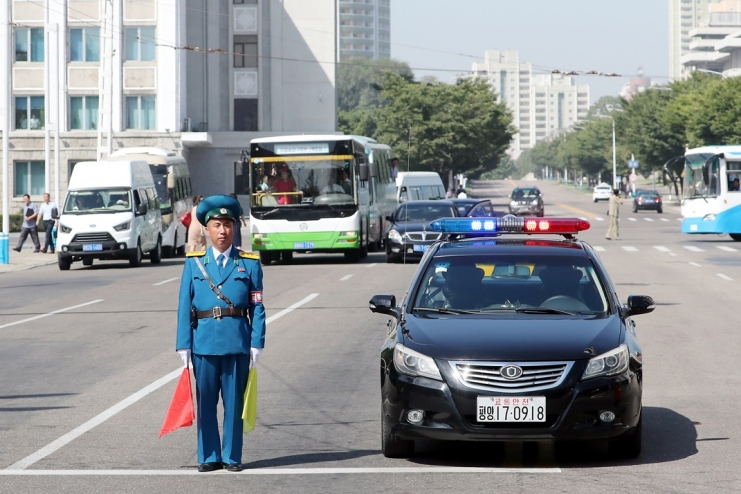

North Korean authorities are struggling to manage a surge in traffic accidents as private car ownership expands, with more than 30 accidents reported in a single province over the past quarter.
A source in North Pyongan province told Daily NK on Tuesday that more than 30 private vehicle accidents occurred in Sinuiju and the surrounding counties of Uiju, Ryongchon and Yomju between April and June, and that a significant share involved newly licensed drivers, including a considerable number of women. Most of the crashes happened while drivers were parking, reversing or entering intersections, and involved minor collisions between vehicles or damage to roadside structures rather than serious injuries, the source said, attributing the pattern to inexperience behind the wheel.
The source explained that private car registration has become more accessible in North Korea in recent years, driving up both the number of vehicles on the road and the number of people seeking licenses to drive them. It has become increasingly common for multiple members of the same household, not just the vehicle’s registered owner, to obtain licenses so several family members can share a single car, the source added.
Driving was once considered a specialized profession in North Korea, requiring more than a year of training at a driver training institute, a state-run facility that certifies new drivers, before a person could get behind the wheel. “In the past, becoming a driver required more than a year of training at a driver training institute, so being a driver itself was seen as a specialized profession,” the source said.
Today, however, prospective drivers need only pass a written test and a practical exam, a comparatively easier path to a license than in the past. The spread of automatic-transmission vehicles, which are simpler to operate than older manual models, has made it easier for newly licensed drivers with limited training and little road experience to get behind the wheel, and accidents have followed as a result, according to the source.
No clear system for compensation
“Because drivers have cars but lack real experience, accidents keep happening during parking, reversing and turns into intersections,” the source said. “Traffic safety officers say their workload has grown significantly as the number of new drivers has suddenly increased.”
The bigger problem, the source said, is that North Korea still lacks an adequate system for processing accidents and compensating victims. The country has no functioning auto insurance or damages framework, so when an accident occurs, the parties involved are typically expected to negotiate a settlement between themselves. If they cannot agree, a safety agency steps in to determine fault and punish whichever driver is found responsible.
But punishing the at-fault driver does little to cover a victim’s actual losses, such as medical bills or vehicle repair costs, and there is no clear standard for calculating or enforcing compensation, which leaves traffic officers struggling each time they have to close out a case, the source said.
“People are calling for driver safety education and the accident-handling system to be overhauled together, since the age of private car ownership is arriving faster than the institutions meant to manage it,” the source said. “Cars keep increasing, but the relevant systems are still built around the old model of state-owned vehicles, and there’s real concern that these problems will only get worse.”
Reporting from inside North Korea
Daily NK operates networks of sources inside North Korea who document events in real-time and transmit information through secure channels. Unlike reporting based on state media, satellite imagery, or defector accounts from years past, our journalism comes directly from people currently living under the regime. We verify reports through multiple independent sources and cross-reference details before publication.
Our sources remain anonymous because contact with foreign media is treated as a capital offense in North Korea — discovery means imprisonment or execution. This network-based approach allows Daily NK to report on developments other outlets cannot access: market trends, policy implementation, public sentiment, and daily realities that never appear in official narratives.
Maintaining these secure communication channels and protecting source identities requires specialized protocols and constant vigilance. Daily NK serves as a bridge between North Koreans and the outside world, documenting what’s happening inside one of the world’s most closed societies.