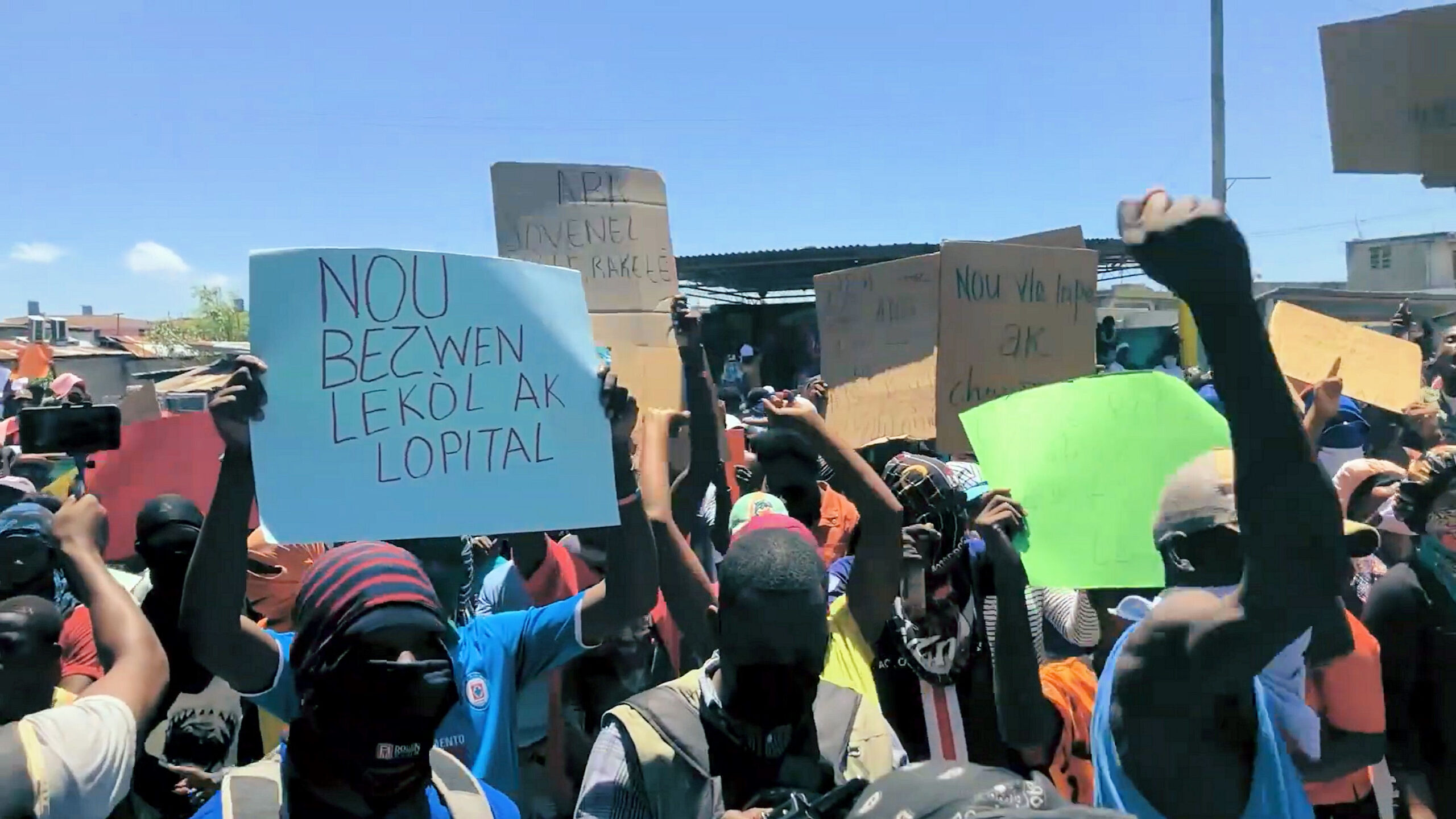

Temporary Protected Status (TPS) was created as an emergency humanitarian measure not as a permanent immigration program or a substitute for responsible governance. Yet 16 years after Haiti’s devastating 2010 earthquake, an important policy question remains: Did the repeated extension of TPS reduce pressure on Haiti’s political leaders to provide services, create jobs, rebuild infrastructure, restore security, and strengthen democracy?
And now that the Trump administration has not renewed TPS for Haitians, will this create the conditions for radical social change in Haiti?
On Jan. 12, 2010, a magnitude 7.0 earthquake struck near Léogâne, approximately 16 miles west of Port-au-Prince. The disaster killed an estimated 46,000 to 85,000 people, displaced millions, and devastated much of greater Port-au-Prince’s infrastructure. The Haitian government lost most of its ability to provide basic services, creating one of the worst humanitarian crises in the Western Hemisphere in recent times.
In response, on Jan. 15, President Barack Obama designated Haiti for TPS, allowing Haitian nationals already present in the United States to remain and work legally for a renewable period of 18 months. Then Department of Homeland Security (DHS) Secretary Janet Napolitano explained that TPS was intended to provide temporary refuge for Haitians whose safety would be endangered by returning, while at the same time to support Haiti’s recovery. The decision reflected over two decades of U.S. policy to protect individuals who could not safely return home.

TPS was established by Congress through the Immigration Act of 1990 to provide temporary protection for foreign nationals when their countries are experiencing armed conflict, environmental disasters, or extraordinary conditions that make their safety there impossible. Congress never intended TPS to become a long-term or quasi-permanent immigration status. Nevertheless, Haiti’s TPS designation was repeatedly extended because the country has continued to experience political instability, natural disasters, institutional collapse, and widespread violence.
For many Haitian families, TPS was lifesaving. Haitian TPS holders legally worked in the United States, supported their families, paid taxes, and contributed billions of dollars in remittances that sustained relatives back home. Today, remittances account for just over one-quarter of Haiti’s gross domestic product, making them one of the country’s largest income sources.
While these remittances have prevented an even greater humanitarian catastrophe, they have also exposed a structural weakness in Haiti’s economy. Private remittances have increasingly functioned as an economic lifeline in place of sustainable economic development. Rather than creating an environment that encourages investment, employment, and public services, successive Haitian governments have continued to preside over declining institutions, widespread corruption, and deteriorating security.

Vania André/Haitian Times
The country’s political crisis has deepened dramatically since the assassination of President Jovenel Moïse on Jul. 7, 2021. Haiti has not held national elections in over a decade, has lacked functioning elected institutions, and much of Port-au-Prince is now controlled of armed neighborhood groups. Millions have been displaced, transportation corridors remain insecure, and access to food, healthcare, and education has become increasingly limited.
As state authority has weakened, the neighborhood armed groups have assumed functions traditionally performed by government, including collecting taxes, regulating access to neighborhoods, controlling transportation routes, and resolving local disputes. Political scientist Robert Rotberg describes a failing state as one whose institutions can no longer provide security, basic public services, or legitimate governance. By that standard, Haiti exhibits many characteristics associated with state failure.
Haiti cannot rely indefinitely on remittances or humanitarian programs abroad to sustain its economy.
Rather than addressing the underlying causes of Haiti’s instability including corruption, neglected, underfunded government institutions, unemployment, and foreign economic domination and political interference, Haiti’s unelected transitional governments since Moïse’s murder have increasingly relied on foreign military contractors, including the Multinational Security Support mission (MSS), the Gang Suppression Force (GSF), and, primarily, Erik Prince’s Vectus Global private mercenaries. Far from increasing public security, the latter force, in particular, in concert with the Haitian National Police (PNH), has carried out the horrific, indiscriminate killing of hundreds of innocent Haitian civilians in the capital’s poor neighborhoods using drones and armored vehicles, as Haïti Liberté has extensively documented. This slaughter raises pressing alarm about accountability and civilian protection.
Corruption has remained one of Haiti’s greatest obstacles to recovery. Investigations into the PetroCaribe program documented how billions of dollars intended for infrastructure, schools, hospitals, and post-earthquake reconstruction were mismanaged or diverted. These failures deprived Haiti of an historic opportunity to rebuild after the earthquake and further weakened public confidence in government institutions.
Much of the post-earthquake corruption was the result of Washington controlling and directing Haiti’s would-be recovery. Instead of investing in agriculture, infrastructure, housing, and services, some $13 billion in international aid was frittered away on NGO bureaucracies and enrichment, as well as ridiculous projects like building two luxury hotels and an assembly industry park in Haiti’s north, far from where the earthquake hit.
More recently, when the Haitian people and neighborhood armed groups chased from power de facto Prime Minister Ariel Henry in February 2024, Washington established the Transitional Presidential Council (CPT). This was another example of foreign-enabled corruption. Huge salaries and expense accounts were squandered over the course of two years to support nine “presidents” and their staffs to travel on foreign junkets and hold elaborate ceremonies that accomplished absolutely nothing for the impoverished Haitian masses.
The demands of Haiti’s neighborhood armed groups, allied since September 2023 in the Viv Ansanm (Live Together) coalition, for state investment in healthcare, schools, housing, sanitation, infrastructure, and social programs for the poor were completely ignored. Under Washington’s stern glare, Haitian politicians assiduously rejected Viv Ansanm’s repeated calls for national dialogue to find a way to uplift the millions in Haiti’s teeming masses mired in poverty and desperation.
But now, the situation is about to become even more critical. Many of the 350,000 Haitians who previously enjoyed TPS will be returning to Haiti, either voluntarily, accepting Washington’s $2,600 cash payment and free one-way flight back to Haiti, or involuntarily, if captured and deported by Immigration and Customs Enforcement (ICE) agents.

This will mean more people suffering in Haiti’s hellscape, with far fewer remittances flowing into the country to support the un- and under-employed.
The central issue, therefore, is not whether TPS benefitted Haitian families; it unquestionably did. The more difficult question is whether the repeated extension of TPS, combined with billions of dollars in remittances, has unintentionally reduced the urgency for Haiti’s political leadership to implement the difficult reforms, both economic and political, necessary to rebuild the country. A government that can rely on remittances to sustain much of its population may face less immediate pressure to generate employment, improve public services, establish lasting security, and respond to the politically scorned and marginalized.
In short, 16 years of TPS may have acted as a social pressure release-valve in Haiti, forestalling the revolutionary change that Haiti’s underclass, represented, at least in part, by the Viv Ansanm, is calling for.
Ultimately, Haiti cannot rely indefinitely on remittances or humanitarian programs abroad to sustain its economy. Long-term national recovery requires accountable leadership, functioning democratic institutions, economic investment, job creation, respect for the rule of law, and effective public security. Most importantly, it necessitates a nationalist government focussed on meeting the masses’ needs, not puppets beholden to foreign masters. Making these changes happen will mean great struggle and strife in the months and years ahead.
TPS was rolled out at the peak of the U.S. empires’s strength, at the very start of the unipolar moment in world history. But now that U.S. power is visibly crumbling, it makes sense that such programs are being jettisoned. TPS was never intended to replace responsible governance or become a permanent solution to Haiti’s longstanding political and economic problems. On the contrary, the end of TPS may deepen our national crisis and thereby force the Haitian people to finally carry out the profound changes that our nation needs.