President Yoweri Museveni has directed the leadership of the Uganda People’s Defence Forces (UPDF) to review the length of active military service and consider provisions for earlier retirement as the army seeks to address a backlog of officers who have served for decades.
Museveni said the long service of some senior officers was largely a result of Uganda’s transition from a resistance army to a national army, as well as concerns over the welfare of officers who would retire without adequate financial support.
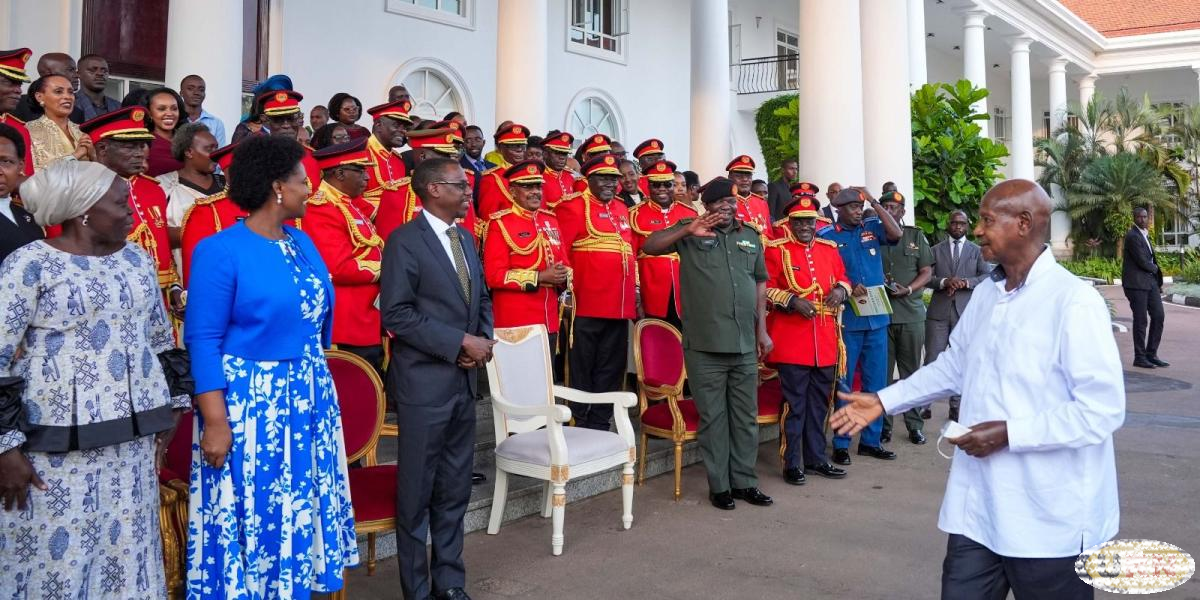
He made the remarks on Thursday while presiding over the ceremonial send-off of 19 senior UPDF officers who have retired from active service.
Museveni said the UPDF leadership, led by Chief of Defence Forces Gen. Muhoozi Kainerugaba and his deputy, Gen. Sam Okiding, should study how other militaries manage the length of active service during peacetime and determine an appropriate entry and exit age for officers.
Museveni said Uganda’s experience was different from that of established national armies because the UPDF emerged from a prolonged period of political and armed conflict.
“We were transitioning from a resistance army to a national army, unlike other established armies. That is why we ended up with elderly officers,” Museveni said, citing Gen. Edward Katumba Wamala, who is about 70 years old and has served in the military for 47 years.
He said financial constraints also contributed to delays in retiring officers because he did not want them to leave the army without adequate means of support.Museveni said this concern led to the establishment of a casualty unit in Mubende where injured soldiers could continue receiving military support and salaries rather than being discharged to return to their villages without financial support.
He said the facility at one time had more than 500 injured soldiers.
According to Museveni, the government began addressing the retirement welfare of officers more deliberately with the 2021 retirement batch, led by the late Gen. Elly Tumwine, by ensuring that officers leaving the army received substantial retirement packages.
He said the government now needs to address the remaining backlog of retirees by reviewing the military’s recruitment, promotion and retirement system.
The UPDF currently has mandatory retirement ages based on rank. Generals and Lieutenant Generals retire at 65, Major Generals at 62, Colonels at 51, Lieutenant Colonels at 47 and Majors at 45. Captains and Lieutenants are generally expected to retire or seek retirement by the age of 40, particularly where they do not meet promotion requirements within the prescribed period.
Museveni said the retirement system should be reviewed to ensure officers do not remain in active service for unnecessarily long periods.
He also cited the experience of other countries, including Israel, where senior military commanders are required to leave active service at considerably younger ages. Museveni said the review should take into account Uganda’s transition into a period of relative political stability and the changing role of the military.
The 19 officers sent into retirement on Thursday include Gen. Edward Katumba Wamala, who served for 47 years, and Lt. Gen. Charles Awany Otema, who served for more than four decades.Other senior officers include Lt. Gen. Charles Angina, Maj. Gen. Godfrey Katsigazi Tumusiime, Maj. Gen. Henry Ndarubweine Masiko, Maj. Gen. Apolo Kasiita Gowa, Maj. Gen. Leopold Kyanda and Maj. Gen. Abel Kandiho.
Museveni also cautioned the retired officers to be careful when investing their retirement benefits, warning them against entrusting their money to people without adequate safeguards.
He advised them to consider relatively secure investment instruments, including government securities and insurance bonds, rather than immediately putting large amounts of their retirement savings into businesses that require close supervision.
Museveni specifically warned against ventures such as hotels, restaurants and fish farming, saying they can expose inexperienced investors to losses if they are not closely managed.
The President’s directive now places the UPDF leadership at the center of a review that could reshape how long officers remain in active service and how the army manages retirement in the future.
GOT A HOT STORY? LET US KNOW!
Got breaking news, explosive secrets, or hard evidence?
Email us: [email protected]
We accept tips, documents, videos, photos, and recordings—the more evidence you have, the better.
CONFIDENTIALITY IS OUR TOP PRIORITY. SOURCES ARE ALWAYS PROTECTED!
About Post Author