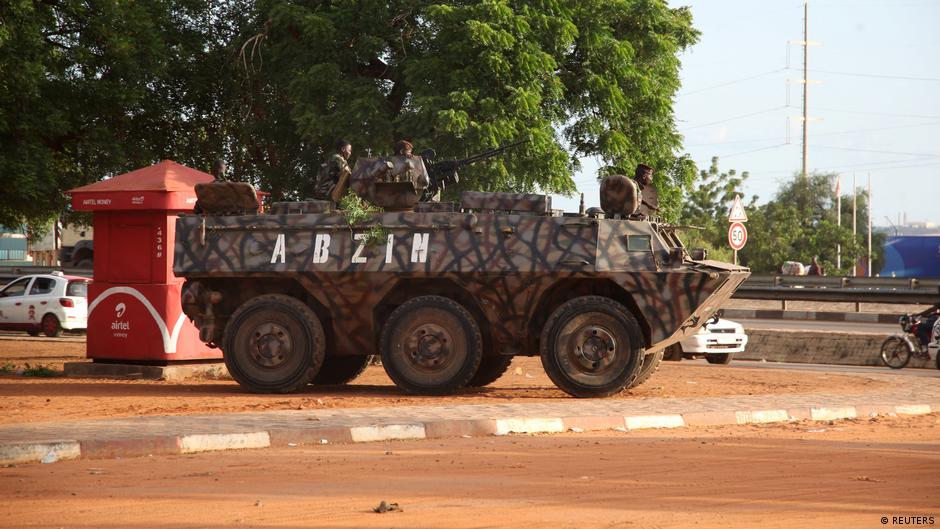
What does it mean to be a soldier in Niger today? It means fighting jihadist groups under difficult conditions and at considerable personal risk for little pay, says Sahel expert Abdoulaye Sunaye, a professor at the Leibniz-Zentrum Moderner Orient (ZMO) in Berlin.
In an exclusive interview with DW, he described the hard conditions facing Nigerien soldiers: “The vast majority earn less than 150 euros a month, and many have to support six, seven or more family members on that monthly salary.”
“This naturally contributes to discontent within Niger’s armed forces,” he adds, hinting at some of the motivation behind the increasing levels of discontent among soldiers.
At the same time, military personnel are expected to follow a strict military leadership which only came to power through a coup.
Junta versus Islamists
At the top of this junta sits General Abdourahamane Tiani, the erstwhile commander of the presidential guard prior to the military takeover in 2023.
Tiani ousted democratically elected President Mohamed Bazoum, with his junta largely justifying its rule by invoking the ongoing fight against jihadist violence in the country, which it claims the Bazoum administration had failed to sufficiently address.
But the failed uprising in Niamey puts that claim to the test amid growing frustration within the military over the unending battle against Islamist insurgencies.
On the weekend, parts of the army temporarily took control of Air Base 101 at Niamey’s international airport, and attempted to advance toward the Presidential Palace and Niger’s state broadcaster.
The government has described the incident as a mutiny.
But Senegalese governance expert Pape Ibrahima Kane told DW in an exclusive interview that “this was not just a mutiny, but an attempted coup. If this is not an attempted coup, then what does an attempted coup look like?”
Growing frustration within the army
Niger’s military has been fighting jihadist groups for years without managing to contain the violence.
The capital Niamey itself has come under attack several times this year alone.
For soldiers, this means that they’re exposed to high risks daily, compounded by serious problems with equipment, supplies and logistics.
Kane describes an army struggling to move its troops and equipment across the country’s vast territory. Whether the government has the financial resources to address these shortcomings meanwhile remains an open question.
There also appears to be growing frustration over military pay and work conditions.
Sahel expert Mamadou Mouth Bane sees the possible preferential treatment of the presidential guard over frontline units as one factor behind the discontent that resulted in the uprising.
“The men who are at the front are being neglected. They feel forgotten and treated worse” than the presidential units, Bane explained in a DW interview, highlighting that the junta cannot afford to alienate these soldiers.
The military uprising also highlights the junta’s chief dilemma: The loyalty of its forces remain key to the current military rulers’ ongoing grip on power, which in the light of the latest developments might just be slipping.
Russia: Niger’s security guarantor
The role of Russia’s Africa Corps is also particularly significant in this context.
The force has taken over large parts of the former activities of Wagner mercenaries in Africa.
Following the failed mutiny against the Kremlin of Wagner Group chief Yevgeny Prigozhin and his mysterious death in a plane crash in August 2023, Russia quickly reorganized its operations in Africa, placing them more firmly under the control of its defense ministry.
In Niger, the Africa Corps has become an important security partner of the junta. During the latest uprising, Russian forces actively helped retake Air Base 101, according to a statement by Russia’s ambassador — at the direct behest of the country’s military rulers.
By helping the Nigerien army put down an attack from within its own ranks, it is becoming evident that the role of the Africa Corps now reaches well beyond their stated objective of assisting with the military government’s counterterrorism strategy.
Kane described Niger’s reliance on the Africa Corps as a “strategic dependency” in his exclusive interview with DW, claiming that the junta would have fallen without Russian assistance.
“Without the Russian army, we would have a new government in Niger today,” he stressed.
Is Tiani playing Russian roulette?
But there are further factors to take into consideration, which could challenge Kane’s statement.
According to DW information gathered on the ground, the presidential guard and other forces loyal to the regime were also heavily involved in the response to the coup attempt.
Algeria — Niger’s neighbor to the northwest — meanwhile also backed Niamey, deploying four Su-30 fighter jets to Niger.
The involvement of the Africa Corps was probably a decisive factor in the rapid suppression of the uprising, but not the only one, although it appears to have exposed Tiani’s dependence on a foreign armed partner to ensure his grip on power.
A risk for the Sahel at large
It is evident that the Africa Corps alone cannot defeat the ongoing insurgency of jihadist groups; otherwise it would have solved the crisis by now after years of involvement in the region. Neither can it solve the Nigerien army’s structural problems.
This makes Niger a test case for the strength of this security model pursued by the Alliance of Sahel States (AES), which is comprised of Niger, Mali and Burkina Faso.
All three military juntas have increasingly been turning to Russia while distancing themselves from Western partners.
But Russian support can only help stabilize the juntas in the short term. As long as foreign forces have to take over critical security tasks, the underlying causes of the military crisis remain unresolved.
The failed coup attempt was ultimately a victory for Tiani’s junta — but equally a warning sign about the state of Niger’s armed forces, as in the face of mounting challenges, their loyalty to the regime can clearly no longer be taken for granted.
Edited by: Sertan Sanderson