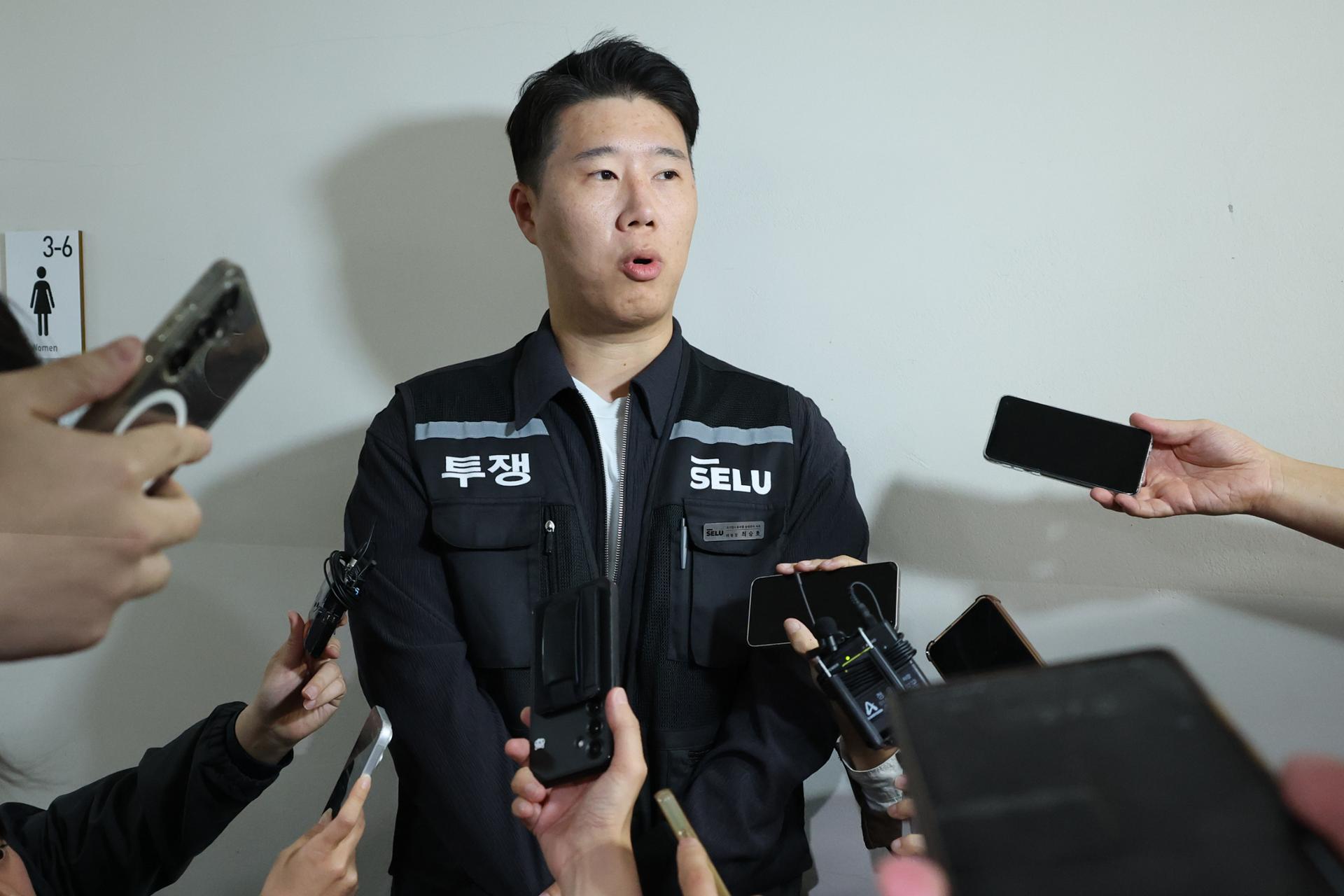
Choi Seung-ho, chairman of Samsung Electronics’ largest labor union, speaks to reporters during a follow-up mediation session at the National Labor Relations Commission in Sejong, Tuesday. Yonhap
An additional round of wage negotiations between Samsung Electronics’ management and labor unions collapsed Wednesday, as the dispute spirals toward an 18-day strike involving more than 40,000 employees, mostly from the company’s chipmaking division, starting May 21.
While a last-minute settlement before the strike remains possible, concerns are growing over potential fallout from a walkout, with losses expected to reach 1 trillion won ($671 million) per day. Prolonged disruptions to semiconductor production lines could lead to structural damage for the company, including the possible loss of key clients such as Nvidia.
Samsung Electronics has filed an injunction with the Suwon District Court seeking to ban the planned labor actions, and the court is expected to issue its ruling before the strike begins. If the court accepts the request, the company may avoid large-scale disruption, but problems could drag on longer under a reduced workforce maintained only by essential personnel.
According to the government and industry officials, the two-day follow-up mediation session arranged by the National Labor Relations Commission ended at 3 a.m. without tangible outcomes.
Choi Seung-ho, the unions’ leader, stated that the talks had broken down, saying the two sides had failed to narrow their differences and had waited for the government’s mediation proposal, “only to see the talks regress further.”
Samsung Electronics expressed deep regrets over the collapsed talks in a statement released hours later.
“The unions’ decision is causing significant concern and anxiety not only for the company but also for employees waiting for a settlement, shareholders and the public, and we deeply regret the decision,” the company said.
“The unions have continued to insist only on a rigid institutionalization framework, rejecting the company’s proposal for a more flexible system tied to performance. The company will continue making every effort until the end to prevent the worst-case scenario through sincere dialogue.”
The unions demanded that the company institutionalize its bonus system in order to improve transparency and predictability, by legally guaranteeing the allocation of 15 percent of operating profit as the source for performance bonuses. The unions indicated that if the full 15 percent allocation is difficult, part of the compensation could be paid in shares.
Management maintained its position of distributing an amount equivalent to 10 percent of operating profit without fixing the ratio in its collective bargaining agreement. It is also rejecting the unions’ demand to remove the bonus cap, out of concerns that it may undermine investment momentum for future growth.
The government also attempted to mediate, but failed as its plan maintained the existing bonus system, according to Choi. The government took the view that accepting the unions’ demands in full may cause severe disruption to wage systems in Korean industries, potentially deepening polarization between large and small companies.
People enter Samsung Electronics’ office in Seocho District, Seoul, April 30. Yonhap
Currently, more than 40,000 union members have expressed their intention to participate in the strike through internal surveys.
Industry officials estimate that with losses of around 1 trillion won per day, total damage from the strike could potentially reach 30 trillion won in long-term fallout.
In 2007, Samsung Electronics suffered a 40 billion won loss due to a four-hour power outage at its plant in Giheung, Gyoneggi Province. The company’s Pyeongtaek campus, where its main semiconductor fabs are located, also incurred damages estimated at 50 billion won in 2018 due to an outage which lasted less than 30 minutes.
Even if the two sides fail to reach an agreement, the court could still block the strike through an injunction. Samsung Electronics filed a request to ban the planned walkout by the unions with the Suwon court on April 16.
Under Korea’s labor laws, unions are prohibited from halting any work deemed necessary to prevent damage to equipment or deterioration of raw materials and products. They are also banned from occupying key production facilities such as manufacturing lines. If the court determines that the planned strike violates those restrictions, it could ban the walkout.
Last month, Incheon District Court partially granted an injunction request filed by Samsung Biologics, a biopharmaceutical affiliate of Samsung Electronics, seeking to curb its union’s strike.
In its ruling, the court rejected the company’s request to ban the strike itself, but said labor actions should not take place during final-stage production processes, where there is a significant risk of product deterioration.
Given this precedent, industry officials expect the Suwon court to take a similar view toward Samsung Electronics’ injunction, meaning the company’s plants may not come to a complete halt but production disruptions could be unavoidable.
Another scenario is the government invoking an “emergency adjustment of industrial action.” Under Korea’s labor laws, the labor minister can suspend industrial action for 30 days when the scale of a strike is deemed likely to impair the national economy or endanger citizens’ daily lives.
Given that semiconductors account for 38 percent of Korea’s total exports, a Samsung Electronics strike could potentially be viewed as harmful to the national economy. However, such a move would also carry significant political risks.
Although labor groups in Korea have so far not openly aligned themselves with Samsung Electronics’ unions, direct government intervention restricting labor actions could trigger strong backlash from organized labor, as it would be seen as the state interfering with workers’ rights.
The emergency adjustment measure has been invoked only four times in Korea’s history, most recently in 2005, when pilot unions at Asiana Airlines and Korean Air went on strike.