
By Daniel Cullen
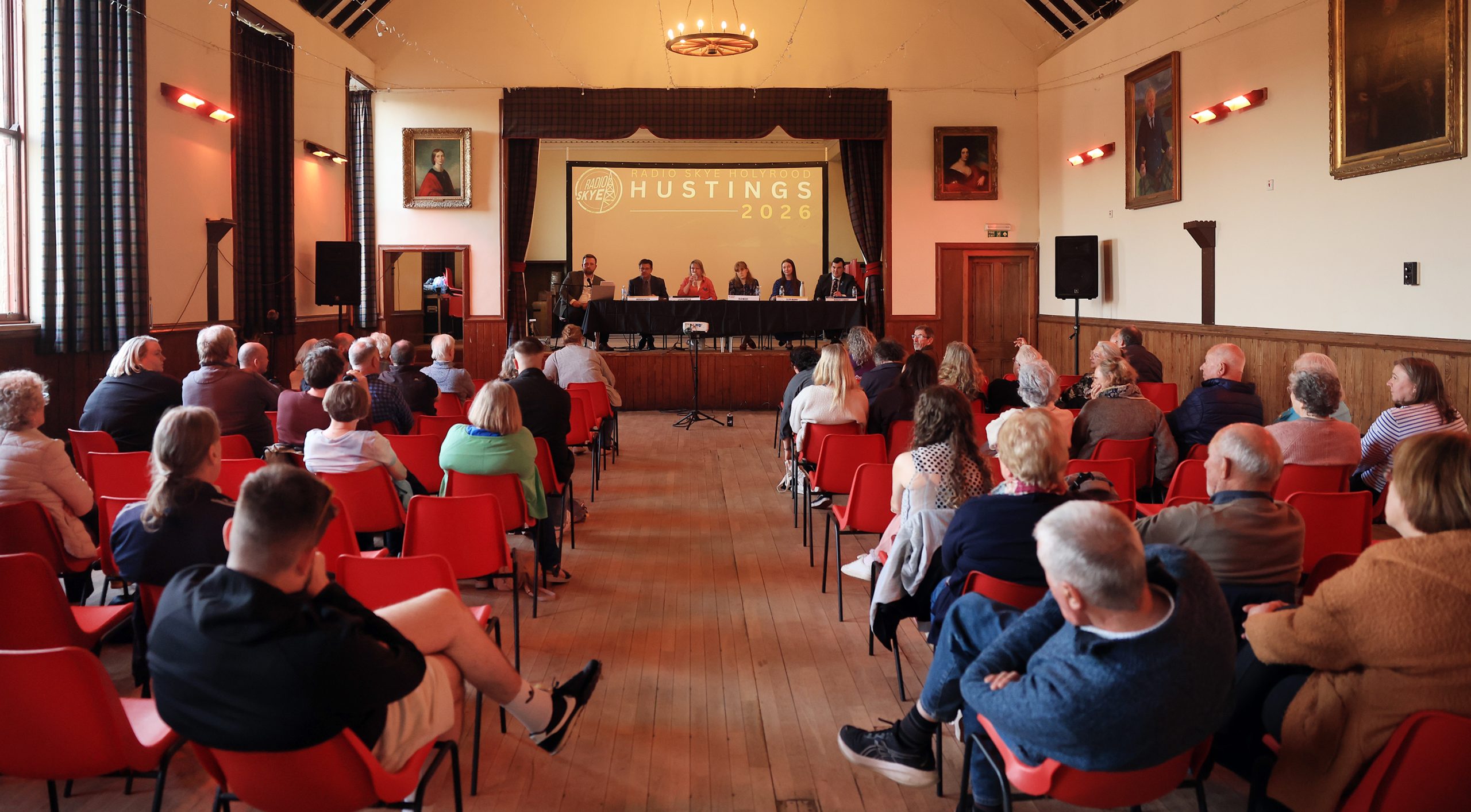
A hustings event held in Portree ahead of the local elections on Thursday 7th May drew a crowd of around 40 people at the Skye Gathering Hall on Thursday 23rd April.
Facilitated by Radio Skye, journalist Jamie MacDonald chaired a panel of five politicians: Andrew Baxter (Scottish Liberal Democrats); Laùra Hänsler (Alliance to Liberate Scotland); Isla McCay (Scottish Labour); Eilidh Munro (SNP) and Ruraidh Stewart (Scottish Conservatives stand-in for Helen Crawford), with Reform UK’s John Whitton pulling out of the event.
Though few people gathered in the room, a large number of questions had been submitted in advance, ensuring a wide-ranging discussion. Housing quickly emerged as a key issue of the night – cutting across debates on population decline, public services, infrastructure and the wider sustainability of Highland communities.
The sharpest exchange came in response to a question from an audience member who had inherited a second home on Skye and asked whether Highland Council’s 300 per cent council tax levy was fair.
Scottish Labour’s Isla McCay acknowledged the difficulty of the measure but framed it within the scale of the crisis: “So long as we have such a shortage of housing, we have to think on a wider level,” she said, adding that while “the 300% increase is difficult for folk to manage,” there must be “a serious conversation” about resourcing local authorities to respond.
Laùra Hänsler of the Alliance to Liberate Scotland drew a distinction between small-scale ownership and corporate investment. “It’s not second home owners we should be targeting… it’s the third, fourth and fifth homes,” she said, arguing that “big companies from down south” were driving up prices, while calling the 300 per cent rate “prohibitive when it’s a family property.” She argued for a “more focused regime targeting private investment companies.”
Scottish National Party (SNP) candidate Eilidh Munro similarly pointed to the difference between inherited homes and commercial use.
“Many people have a family home they want to keep while they work away – that’s different to people who buy another property to visit or for Airbnb,” she said, adding that councils must balance taxation with efforts to build more homes, and “bring empty houses back into use.”
Andrew Baxter, standing this year as a Liberal Democrat, backed the principle of the tax – but with caveats.
“In my own village or across the Ardnamurchan peninsula, which I represent, 50 per cent of homes are second homes,” he said, noting that while some are held for family use, many were not, and represented housing market speculation by those living further afield.
“However, I recognise the law of unintended consequences,” he added, suggesting exemptions may be needed in cases where homes are being retained for future generations, but concluding: “I prefer to see those from away being penalised by this policy.”
Conservative Ruairidh Stewart rejected the approach outright. “No, I do not support the tax,” he said. “The policy is just another way of Highland Council taking money out of the hands of hard-working families.” He argued the focus should instead be on government failure to meet housing targets, warning against “demonising second home owners” while underlying supply issues remain unresolved.
The discussion broadened into wider concerns about housing supply, planning and depopulation. Isla McCay agreed with an audience member’s suggestion that “inaccurate classification of rural house builds” allows government to obscure the scale of the crisis, warning that shortages in the Highlands are “driving depopulation.” Any solution, she said, must include “an increase in social housing and homes people can purchase,” alongside planning reform and long-term rental security.
Audience contributions reflected growing frustration, including concerns about anonymous companies buying up properties in Broadford and a perception that national policy does not reflect Highland realities.
While housing dominated much of the debate, other issues, including renewable energy, health and social care, youth provision and drug policy were also raised. On renewables, all candidates voiced concern that communities may not see sufficient benefit from large scale local industrial projects and suggested they’d like to see more local ownership – though none set forward any plans of how they would go about achieving this.
Closing statements offered a final glimpse of each candidate’s pitch.
Eilidh Munro described the evening as “valuable,” highlighting “housing, healthcare and sustainability of transport” as key rural issues, while stressing the need to be “realistic and ambitious” within current funding constraints – suggesting that there would be “more we can do with independence – but we need to work hard to do what we can with the powers we have.”
Laùra Hänsler emphasised representation rooted in lived experience: “It matters that your representative understands the challenges you face. I do,” she said, while calling for “housing that works for local people” and “someone who will stand up for the local area.”
Ruairidh Stewart said: “In this election you can choose more of the same from the SNP – delays and excuses – or a common sense approach to politics that puts you first.”
Isla McCay urged voters to use the election as “an opportunity to refocus on the issues that matter most to you”, claiming, “but that will only happen if you use your vote for change.”
Andrew Baxter concluded the evening with his short closing statement, telling voters: “With me you see what you get… I’m passionate about the constituency and communities within it.”
Despite the modest turnout, the evening laid bare some of the central political problems facing Skye, Lochalsh and Raasay as well as the wider region ahead of an election in which SNP leader John Swinney has suggested that, should the SNP achieve an overall majority, an independence referendum would be called for.
Interestingly, Swinney’s suggestion was something – in a break from their party leaders – both Liberal Democrat Andrew Baxter and Scottish Labour’s Isla McCay expressed support for on the night, agreeing a majority would be a realistic mandate for a new referendum on Scottish independence.
You can listen back to the hustings via Radio Skye’s ‘listen again’ service – https://radioskye.com/listen-again/