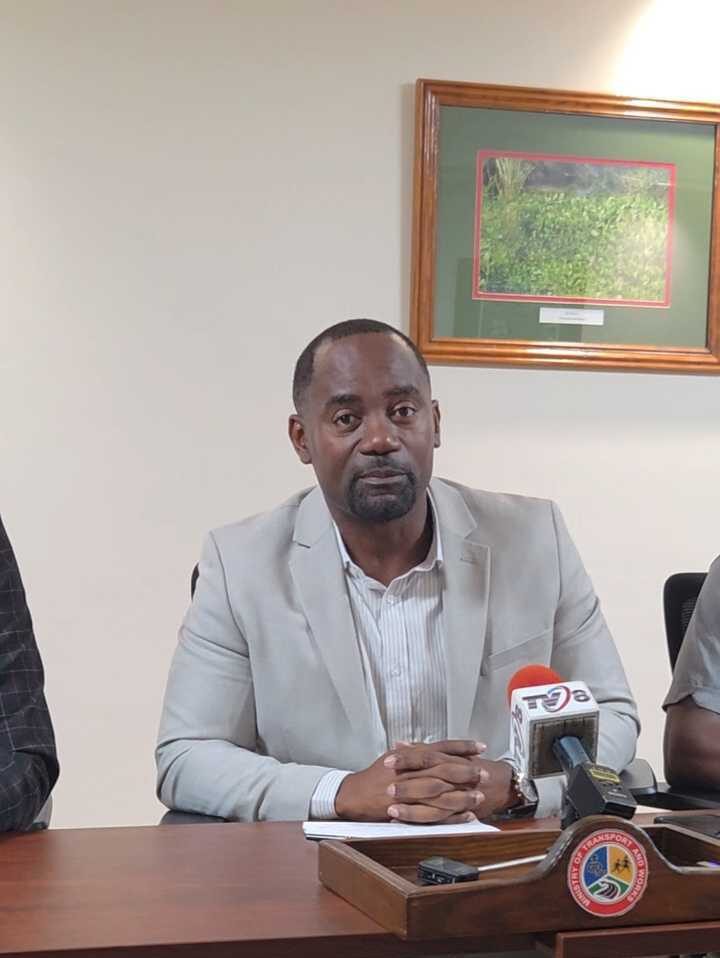
Minister of Transport and Works Kirk Humphrey, has announced a major road repair and pothole patching programme for communities across Barbados, starting with northern parishes.
Responding to recent complaints about the state of the island’s roads, he assured residents that help is coming soon, with more work, private sector support and a step-by-step approach in each community.
Humphrey responded to concerns from people in St Peter, St Joseph and St Lucy, as well as Silver Sands, by explaining that much of the planning and preparation has already been done in several areas, so roadwork can begin.
He noted that officials have just done a tour of problem areas in St Joseph, where some work has already started.
For residents of St Peter who have voiced frustration over badly deteriorating road surfaces, the minister revealed that a targeted maintenance drive will roll out imminently.
“St Peter can anticipate that in the next few weeks, the vast majority of the potholes in St Peter will be attended to, using all the machinery that we have and engaging the private sector as well,” he said.
Humphrey admitted that people are often frustrated because they expect roadwork to happen faster, especially in places like St Lucy, where underground utility upgrades have to be finished before new paving can start.
You Might Be Interested In
“St Lucy has already received a lot of roadworks,” Humphrey noted. “The truth with St Lucy is that the government has done 20 kilometres or so of main replacement, and if you’re going to be doing that, that wasn’t small work, that’s deep work. So we’re going to have to replace those roads. A lot of those roads have to be reinstated properly as well. I anticipate St Lucy is probably going to receive the most work over the next few years after we’ve done the mains replacement.”
Humphrey explained that old water pipes under the roads can be damaged by heavy road rollers during resurfacing, and it costs about $1 million per kilometre to replace them. He said it is not possible to replace all the pipes at once, but the ministry is working carefully to manage road repairs.
To ensure rapid execution of the national road rehabilitation plan, the Ministry of Transport and Works is mobilising specialised machinery, local depots and private sector contractors. Humphrey dismissed social media claims regarding equipment not working, specifically the ministry’s Pothole Patcher Pro units.
“Those have been deployed, but there are six, and the country has 2 400 kilometres of road,” Humphrey said. “There was one Pothole Patcher Pro that was in an MTW yard. That unit, like any other machine, has to go either for routine maintenance or servicing. It was going for repair; it wasn’t put down to rust out. But the pothole programme must be bigger than the Pothole Patcher Pros. It is us using all of the resources of the ministry, utilising the depots and engaging the private sector. There are three major contractors in Barbados, and we’re engaging all of them to be able to do work on the potholes as well.”
Humphrey said the ministry needs to do a better job of telling the public how many repairs are done each day, so drivers know what is happening.
“The potholes bother me as much as they bother the next fella. I drive on the roads. We have to be able to fix the potholes, and we have to report to the public more frequently. People have to be sure that they can plan their business.”
Priority is also being given to high-traffic areas and school zones to ensure smooth transit as the academic year begins. Additionally, crews have completed clearing drains in flood-prone areas like Heywoods, St Peter, so permanent road repairs can happen next.
“The public can look forward to an intensification,” Humphrey concluded. “The north can hold their breath and know that relief is coming soon.”
(RR)