Recently, South Korea-US relations have taken a troubling turn. After North Korea’s military pushed ahead with fortification work along the Military Demarcation Line, including building tactical roads, laying mines and installing obstacles, Seoul strongly condemned the move as a clear violation that guts the armistice’s buffer zone. The armistice agreement established a 2-kilometer buffer zone on each side of the Military Demarcation Line to prevent military clashes, but North Korean troops have pushed right up to the line, undermining the framework for peace.
But the United Nations Command has struck a different tone. Citing the reality that heavy weapons have already entered the Demilitarized Zone through South and North Korean guard posts, the command has taken a cautious stance, saying it is difficult to conclusively call North Korea’s fortification work a violation of the armistice. That position puts it at odds with Seoul.
President Trump’s own actions have widened the gap further. In a social media post on Aug. 16, U.S. time, Trump said he had personally directed the defense secretary to significantly scale back the joint South Korea-US military exercise, warning that it could send an “inappropriate signal” to North Korea. At the same time, he emphasized that he maintains a good relationship with Kim Jong Un. The remarks appear to be a response to North Korea’s provocations, including a series of short range ballistic missile launches, with ranges of 300 to 1,000 kilometers, ahead of the joint exercise, known as UFS. South Korea’s National Security Office, by contrast, condemned the missile launches as a violation of U.N. Security Council resolutions and called for an immediate halt, again exposing the differing views between Seoul and Washington.
At a White House press briefing on Aug. 17, when asked whether he was prioritizing North Korea’s interests over those of an ally, Trump pushed back, calling the decision “a step that makes the situation safer.” The remarks are widely interpreted as a calculated move, similar to his approach during his first term, to send a conciliatory gesture to Kim Jong Un and open the door to talks between Washington and Pyongyang. Some analysts say Trump may also be using the prospect of talks with North Korea to try to reverse his declining approval ratings ahead of November’s midterm elections, ratings hurt in part by the prolonged Iran war.
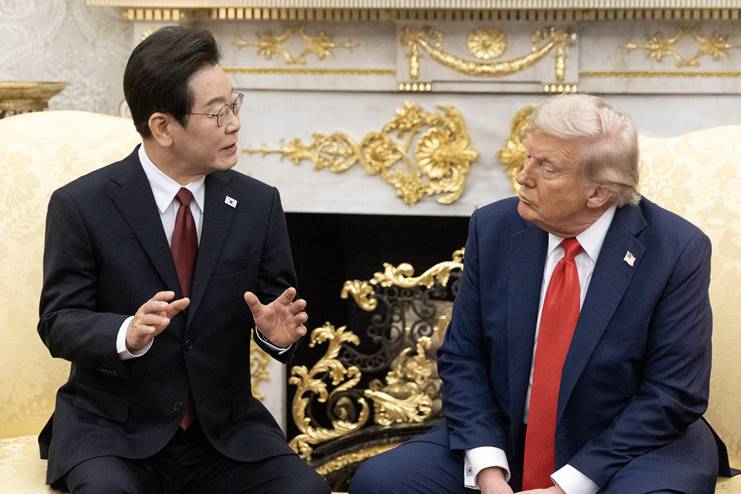
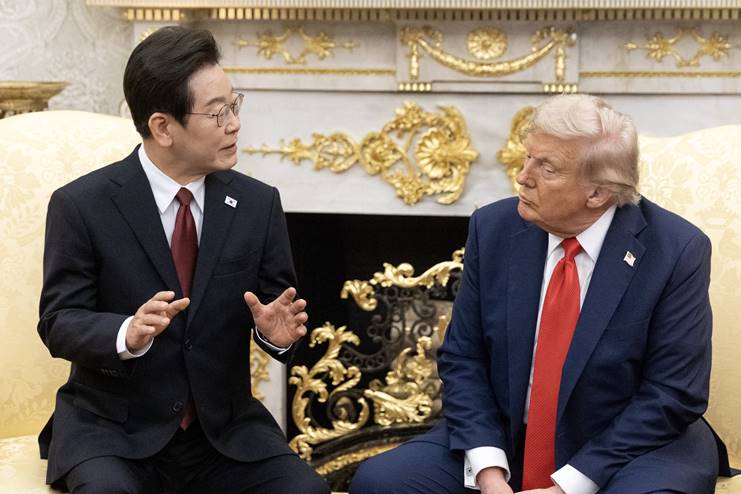
The trouble is that Trump, in the course of announcing the scaled back joint exercise, publicly called out President Lee Jae-myung’s government for refusing to offer support on the Iran issue. Visibly displeased throughout the press briefing, Trump noted that the United States spends billions of dollars keeping U.S. troops stationed in South Korea to protect the country, yet Seoul has declined to help safeguard the Strait of Hormuz, the transit route for its own oil imports. In making the point, Trump disclosed details of a phone call he had with President Lee. The remarks amount to overt pressure, using the prospect of renegotiating South Korea’s defense cost sharing and scaling back the joint exercise as leverage to extract Seoul’s military support on the Iran issue.
Trump’s political survival strategy and a stark warning for Korean Peninsula security
What is making Trump increasingly impatient is not only the Iran crisis but also the prolonged war in Russia and Ukraine. Contrary to his early promise to end the war quickly, the situation has worsened, and paradoxically, Kim Jong Un appears to hold significant sway over how the conflict unfolds.
If reports that North Korea plans to send additional troops to Russia, potentially as many as 50,000, prove true, North Korea stands to earn up to $1.2 billion in cash, equivalent to 38% of its annual trade volume. It would also gain access to Russian fuel assistance and advanced weapons technology, including nuclear submarine technology, along with real world combat experience in modern, drone centered warfare.
Given North Korea’s continued missile support for Russia, the ballistic missile that North Korea recently launched into the East Sea, which traveled 700 kilometers before landing near Nakhodka in Russia’s Far East, was most likely a test of an export bound ballistic missile. That would have been impossible without prior coordination with Moscow. South Korea’s government treats this North Korea-Russia military cooperation as a direct security threat and a violation of U.N. Security Council resolutions. The United States, too, appears to feel considerable pressure and concern over the issue.
From Trump’s perspective, blocking additional North Korean troop deployments to Russia and further missile support has become urgent. He appears to have concluded that direct negotiations with Kim Jong Un are the most useful tool available to address it. International media have reported that Trump wants to hold a summit with Kim Jong Un this fall.
If a summit between Washington and Pyongyang takes place, Trump stands to gain on three fronts at once. It could give him an edge heading into November’s midterm elections, provide a justification for bringing the Russia-Ukraine war to an early end, and give him leverage to pressure South Korea into supporting the Iran effort. Even so, this should not be dismissed as a cynical political maneuver that sacrifices an ally’s security for Trump’s own political survival.
Viewed within the broader context of international affairs, this looks more like a strategic necessity Trump has little choice but to pursue. It may reflect a comprehensive calculation: securing at least minimal military cooperation from ally South Korea to manage the Iran crisis, while also preventing the war in Russia and Ukraine from escalating further due to closer North Korea-Russia ties, and using direct talks with Pyongyang to confront the security crisis in Northeast Asia head on. As Trump himself pointed out, South Korea, as a country with a direct stake in the Strait of Hormuz and Middle East affairs, declining even part of its ally’s request is a disappointing response that shakes the basic framework of the South Korea-US alliance.
The truly worrying scenario is this. If Kim Jong Un responds favorably to Trump’s plan and direct talks between Washington and Pyongyang move forward, President Lee Jae-myung’s government could effectively lose its footing in the process. The “pacemaker” role that Lee promised Trump he would play could be sidelined entirely, and South Korea, a central party to Korean Peninsula and Northeast Asian security, risks being reduced in an instant to a bystander or a marginal player. Kim Jong Un, meanwhile, holds an unusually large number of cards he can use to move Trump according to his own interests. In the end, this could push South Korea’s security into an even more precarious position.
Restoring the South Korea-US alliance quickly is the only way forward
Following Trump’s order to scale back the joint exercise, the U.S. Department of Defense officially announced on Aug. 18, U.S. time, that the exercise would be significantly reduced. South Korea’s Joint Chiefs of Staff also issued a press release confirming that, at Washington’s request, the length and scale of the exercise, known as UFS, would be partially adjusted. As a result, the exercise, originally scheduled to run through Aug. 27, is now set to end a week early, on Aug. 21. The joint exercise, a core pillar of the deterrence structure meant to prevent North Korean provocations, has been shaken, marking a significant crack in South Korea-US military coordination.
Still, the situation has not reached a point beyond repair. There is still time. President Lee’s government now needs to move past unjustified go it alone posturing or passive observation, and fundamentally reestablish its Korean Peninsula and regional security strategy with the value of the South Korea-US alliance as its top priority. If Seoul fails to mend the cracks in the alliance before direct talks between Washington and Pyongyang gain momentum, it could lose strategic initiative altogether. As turbulent diplomatic and security challenges loom ahead, restoring trust with its ally and pursuing thorough coordination may be the only way to safeguard South Korea’s national interests and peace.
The views expressed in this column are the author’s own and do not necessarily reflect Daily NK’s editorial position.