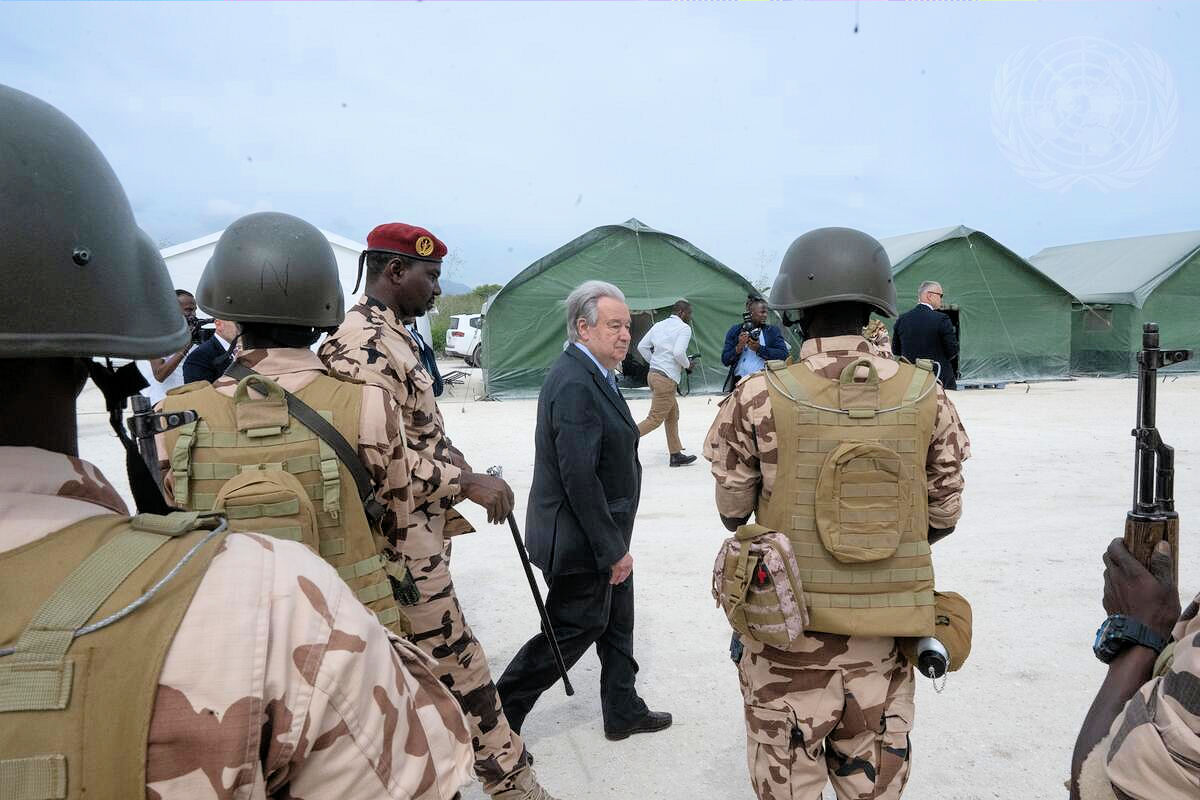

When UN Secretary-General António Guterres touched down in Port-au-Prince on Jun. 16, his first stop was Camp Vertières, the operating base of the multinational Gang Suppression Force (GSF) now battling for control of a capital largely governed by neighborhood armed groups. At the military base, briefers from the UN Support Office for Haiti (UNSOH) walked him through the logistics chain — fuel, water, rations, medical evacuation, transport — that keeps the GSF in the field.
The visit, UN Spokesman Stéphane Dujarric told reporters the next day, was meant to let the Secretary-General assess the UN’s support to the force, delivered “in accordance with Security Council resolution 2793.” It was a carefully staged display of institutional confidence. It also unfolded against a financial backdrop that could quietly hollow out the very support system Guterres came to inspect — a backdrop rooted in how this force, and the one before it, came to exist in the first place.
Following President Jovenel Moïse’s assassination in July 2021 and then de facto Prime Minister Ariel Henry’s ouster in the armed popular uprising of February-March 2024, the first proxy military force that Washington sent to Haiti was the Multinational Security Support Mission (MSS), headed by Kenya, which began deploying in June 2024. Although it was supposed to muster 2,500 troops, it never amassed more than about 1,000, mainly because it was not an official UN Peacekeeping Operation (UNPKO) approved as such by the UN Security Council. It was only a sort of “coalition of the willing,” assembled and primarily funded by the U.S..

Washington pressured the Security Council to give its benediction to the force — though Russia and China abstained — and hoped other nations would support it with troops and voluntary contributions. That aid never fully materialized; the MSS trust fund collected barely a sixth of the roughly $600 million the mission needed annually.
So when the Trump administration took over in 2025, Secretary of State Marco Rubio backed a new resolution — co-sponsored with Panama and shaped in consultation with Guterres’s Secretariat — to find a way to draw on the UN peacekeeping budget for the logistics of his GSF, which, like the MSS it replaced, is not itself an official UNPKO.
By tapping into the mandatory peacekeeping dues that all 193 member states are obligated to pay, rather than relying solely on voluntary pledges, Rubio’s approach was meant to provide for a larger, 5,500-troop force with funding more dependable than its predecessor ever had. The arrangement is arguably illegal — using assessed peacekeeping money to prop up a force that the Security Council deliberately declined to make an official UN peacekeeping mission.

The deeper irony, though, is that even while leaning on the UN to help finance its Haiti policy, the Trump administration has simultaneously been starving the very same assessed-dues system that Rubio’s shell game depends on.
A force built on two different funding streams
The mechanics matter here. When the Security Council adopted Resolution 2793 on Sep. 30, 2025, it split the GSF’s financing in two. Personnel costs were authorized “on the understanding” that they would be covered by voluntary contributions into a trust fund — the same model that left the MSS perpetually short-handed. UNSOH, the support office created by the same resolution, was instead authorized to draw on peacekeeping assessed contributions — the dues every member state, including the United States, owes by law. The General Assembly approved roughly $301 million for UNSOH’s first nine months of operation, through next June.
That arrangement was meant to give the GSF a guaranteed, predictable funding stream insulated from the chronic shortfalls of voluntary pledging. The irony – and it is a sharp one – is that the assessed peacekeeping budget UNSOH depends on is the very pool already buckling under nonpayment — overwhelmingly Washington’s own.
How much does the U.S. owe?
The numbers behind that standoff are large and growing. According to a senior UN official who briefed reporters in late January, the United States owed roughly $4.5 billion in total arrears across the regular budget, peacekeeping operations, and international tribunals — built from about $2.2 billion in unpaid regular-budget assessments (covering both lingering 2025 arrears and the unpaid 2026 bill) and close to $1.9 billion owed to peacekeeping, plus the remaining balance to the UN’s war-crimes tribunals (which should of course be prosecuting egregious, never-ending Israeli war-crimes in Gaza and now Lebanon and Iran).
Washington alone accounts for the lion’s share of money the UN is still owed.
By comparison, total unpaid assessments owed by all 193 member states combined stood at roughly $2.8 billion for the regular budget and $3.5 billion for peacekeeping as of Apr. 30 — meaning Washington alone accounts for the lion’s share of money the UN is still owed. UN officials have put the U.S. share of regular-budget arrears specifically at around 95%.
Other governments owe far less. China, the second-largest contributor, had paid only a fraction of its more than $600 million regular-budget bill for 2026 as of early June — it tends to settle later in the year — and still owed some money on its roughly $844 million peacekeeping assessment even after sending a large installment. Russia paid about $67 million in arrears in late March. Venezuela, which the UN says owes the equivalent of nearly 16 years of assessed contributions, and Mexico and Saudi Arabia, each with smaller eight-figure balances, round out the list of persistent debtors. But none of these sums approach Washington’s: the site PassBlue, which tracks UN finances closely, reported that the United States “has failed to pay its dues in full since 2024.”

That detail matters for the question of when the U.S. last met its obligations. The most recent substantial U.S. payment came in October 2025, when the Trump administration agreed to pay $682 million toward its 2025 peacekeeping assessment — roughly half of the $1.4 billion owed for that year, leaving the rest as new arrears layered atop $1.58 billion already outstanding.
The regular budget fared worse: the United States made no payment at all toward its 2025 regular-budget assessment, and as of this spring had not paid any part of its 2026 assessment either, missing the Feb. 8 deadline along with more than 130 other member states. The administration did separately release about $2 billion at the end of 2025 for UN-coordinated humanitarian aid — money that flows through voluntary channels, not the assessed dues at the center of the reform fight.
Rubio made Washington’s rationale for withholding those dues explicit in congressional testimony on Jun. 3, telling lawmakers that the “UN is in need of continued dramatic reform, and we intend to continue to use our fees that they claim we owe as leverage for that”— without ever detailing what reforms it actually wants.
The squeeze reaches Haiti
The liquidity crisis has already reached the GSF directly. Last October, Guterres ordered a 15% reduction in expenditures across all peacekeeping operations and the repatriation of roughly a quarter of deployed peacekeepers worldwide, anticipating that member states would not pay in full. To get UNSOH off the ground before the General Assembly formally approved its budget, the Secretariat drew roughly $54 million from the Peacekeeping Reserve Fund — the emergency liquidity mechanism meant to smooth cash gaps across all peacekeeping missions.
Because the fund’s usable ceiling is capped, budget documents note that tapping it for UNSOH’s startup could reduce, by as much as $14 million, the cash available for urgent needs in other active peacekeeping operations, from the Democratic Republic of Congo to Lebanon to Cyprus. Before the GSF had even reached a quarter of its authorized strength, UNSOH was already drawing down a shared emergency reserve depleted by the same arrears crisis Washington’s reform fight has helped produce.
“Unlike a government, the UN cannot borrow or print money.”
The numbers on the ground underscore the stakes. By June, the Secretariat had expected roughly 3,447 uniformed personnel to be deployed. The voluntary trust fund covering personnel costs had drawn pledges of about $223 million from 13 countries, with roughly $174 million in cash and $66 million disbursed, led by Canada, Germany and a $30 million commitment from Qatar. That stream, while still short, has at least been growing.
UNSOH’s assessed funding, by contrast, is exposed to the same systemic shortfall afflicting every peacekeeping mission the UN runs — a vulnerability the voluntary trust fund doesn’t share, because it depends on willing donors rather than on a treaty-based formula which the largest contributor, the U.S., is refusing to honor in full.
An administration funding what it wants, withholding the rest
Washington was, as noted, the principal architect of both the MSS and the GSF that replaced it, and after Resolution 2793 passed, Rubio said the U.S. would work to ensure the force’s “swift deployment” to address Haiti’s immediate security crisis.
The administration has continued to frame the GSF — operating roughly 90 minutes’ flight from Miami — as a security priority distinct from the broader UN system it considers wasteful, even releasing targeted humanitarian and security funds for Haiti while the wider dues fight drags on. That à la carte approach — paying for what serves Washington’s own ends in Haiti while withholding the assessed dues that keep the rest of the peacekeeping system solvent — sits at the heart of the contradiction in U.S. policy: using the UN as an instrument of its Haiti strategy while undermining the UN’s capacity to sustain that very instrument.
Senators have started probing the gap between rhetoric and resourcing. Sens. Tim Kaine and Cory Booker wrote to Rubio this month pressing for documentation on what the Defense and State Departments have actually obligated toward the GSF, and for assurances that U.S. funding is being spent transparently and in line with human rights standards. Their letter reflects a broader unease in Congress: that a mission Washington championed as essential to hemispheric security could crash and burn due to a lack of cash flowing through a UN financial architecture the administration itself is squeezing.
Dujarric and his colleagues at UN headquarters in New York have tried to keep the spotlight on results rather than risk, while still being candid about the institution’s exposure. “There’s no hard date for the doomsday scenario,” he told reporters on Jun. 1, shortly after Japan and China sent large dues payments that bought the organization a few more months of runway. Pressed on why the crisis keeps recurring, Dujarric was blunter about the structural problem Washington’s nonpayment has created: “Unlike a government,” he said, speaking for Guterres, “the UN cannot borrow or print money.”

In a detailed piece on the UN’s financial crisis, PassBlue reported that Guterres warned members that the body was at risk of “imminent financial collapse” and might run out of cash by July. A Wall Street Journal article speculated that the “doomsday” might come in August.
Missteps around the empire
None of the reporting on Guterres’ trip to Haiti last week even hinted that he discussed the UN’s financial woes with any of Haitian, Dominican, or GSF officials with whom he met. Haïti Liberté also wrote to spokesman Dujarric for clarification on whether the cash-flow crisis was raised or will impact the GSF. We received no response.
However, it is hard to imagine that the subject did not come up in at least some of the meetings.
Meanwhile, this self-inflicted crisis in its handling of Haiti seems to mirror the Trump administration’s blunders in its war against Iran, from which it now appears to be trying to retreat while saving face.
Also, the GSF is not Washington’s only proxy force in Haiti. The U.S. is also using the so-called “Task Force” composed of about 200 Erik Prince-commanded mercenaries, now operating under the name of Vectus Global, which continues to kill innocent civilians almost daily in Port-au-Prince shanty towns through drone attacks and armored-car forays. However, officially, Vectus Global is hired by and working for the government of de facto Prime Minister Alix Didier Fils-Aimé.
The GSF currently has less than 1,000 troops, mostly from Chad (which heads the force), and also Jamaica, El Salvador and Guatemala. But the U.S. can only quintuple that number by establishing funding that is as solid as the assessed contributions backing it — and those contributions are precisely what Washington has chosen to leverage in pursuit of reforms it has yet to specify, even as it owes the UN system roughly $4.5 billion and has not paid a regular-budget assessment in full since 2024.
So is there UN money to support the Gang Suppression Force? On paper, there should be — Rubio’s Resolution 2973 saw to that. But in practice, the money runs through an assessed peacekeeping budget that Washington’s own arrears have pushed toward collapse. The United States built itself a proxy force in Haiti and then started undercutting the account meant to keep it running. Whether that contradiction gets resolved may be decided less in Port-au-Prince than in the unresolved fight over Washington’s own unpaid bill to the world body.