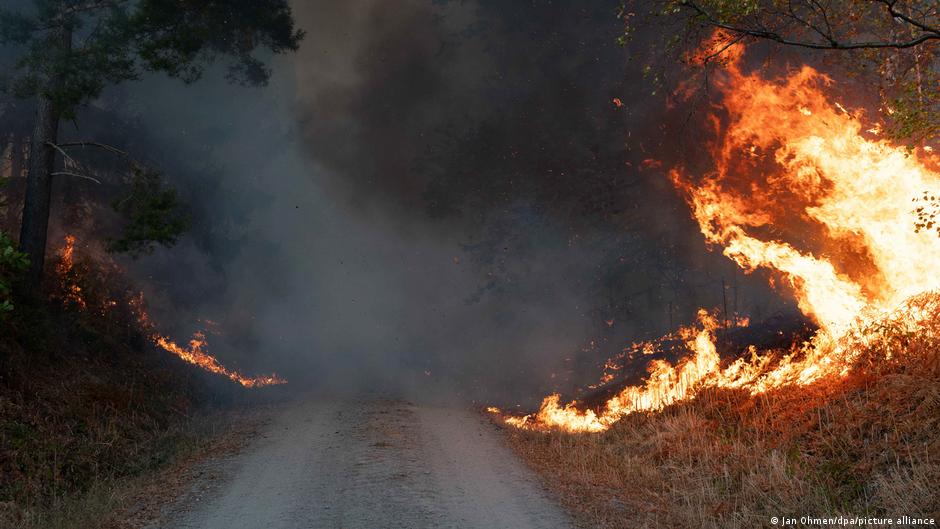
This year, wildfires have already burned more land than the annual average from 2006 to 2025 in Germany. North Rhine-Westphalia, the country’s most populous state, has just seen the largest recorded wildfire in its history. It destroyed or damaged about 300 to 400 hectares in the Hürtgen Forest in the Eifel region.
After weeks without rain, the wildfire spread rapidly across the arid landscape with wind driving the flames in different directions. Unexploded munitions from World War II that were at risk of exploding or did explode complicated the firefighting efforts. Around 1,500 firefighters battled the flames for almost a week until the fire was stabilized, with some working 12-hour shifts.
Peter Berndgen, a spokesperson for the volunteer fire department in the Düren district in the west of the state, said that the physical and mental strain was enormous.
“Your eyes itch every night, your nose is always black and the airways and lungs are under pressure. During a 12-hour-shift, you’re constantly on high alert, ready for whatever might happen,” he said.
This can be trees falling or the flames changing direction, he added.
And on top of that, the constant fear that “the situation is spiraling out of my control, we won’t be able to cope, you get that kind of feeling sometimes. And then you start wondering whether you’ll manage to get it under control at all.”
Can Germany teach Europe how to prevent wildfires?
Not everyone suffers from post-traumatic stress disorder
Despite being prepared and professional, firefighters know they are also at risk of death. “The fear, or dread, that you can have is really, where can I take refuge, how will I get out of this. I’m right in the middle of a forest.”
Andreas Meyer, a psychiatrist from the Central Institute of Mental Health in Mannheim who co-authored the “Berlin Declaration on Climate Change and Mental Health,” says such situations can have long-lasting effects.
“Not everyone, but several people who experience something like this end up developing what is known as post-traumatic stress disorder. They find themselves reliving the event over and over, having nightmares, and experiencing flashbacks. Post-traumatic stress disorder is three times more common among firefighters than it is in the general population.”
A typical symptom of post-traumatic stress disorder is avoidance behavior. People might avoid places that resemble those where the trauma first occurred, as well as conversations about the event itself.
“This can lead to the disorder setting in,” said Meyer-Lindenberg.
He explained that it was totally normal to feel shaken immediately after such a disaster; to have trouble sleeping, for example, or to feel sad, but he said that if such a state persisted for more than a month and interfered with daily life, people should seek psychological help.
“The good news is that post-traumatic stress disorder can be treated very successfully with behavioral therapy,” he said, adding that it resolved the disorder in two-thirds of patients.
Apart from post-traumatic stress disorder, wildfires and other such disasters can also trigger depression, anxiety disorder or addiction. Some studies have found that people are also more likely to self-harm or even commit suicide afterward.
Meyer-Lindenberg said that the number of psychiatric diagnoses is likely to double after such a disaster. “Fortunately, for many of those affected, the symptoms subside on their own. But, unfortunately, this is not always the case. Illness might still be detected years later.”
‘A new normal’: Unprecedented wildfires in Canada
Some population groups more likely to be affected, particularly women
Some groups of the population are more likely to be affected than others, studies have found. For example, children and adolescents, as well as people who are poor or who already had a mental illness. Women are also more likely to be affected than men.
While one in three people affected by a natural disaster is at risk of developing long-lasting post-traumatic stress disorder, this falls to one in 10 amid emergency responders.
Meyer-Lindenberg said that they were helped by experience, clear rules during an operation and working together as a team.
“So much depends on these factors when you are confronted with an emergency,” he said. “Do I feel capable? Do I know what I have to do? Do I have colleagues, teammates I can rely on? Is there a structure in place or am I at the mercy of a situation?”
While ordinary people might be forced to stand by as their neighborhood goes up in flames, firefighters have the task of putting out the fire.
Peter Berndgen said that the volunteer firefighters in the Rhine region were highly motivated. “We want to protect ourselves, the population, our villages, our homes. We want to protect all of that,” he said. “And I believe that gives us energy.”
He added that psychological support was on hand if necessary and that talking about experiences was a routine part of operations as well as fighting the flames.
Taking action and control can be useful in fighting feeling of helplessness
Meyer-Lindenberg said that everyone affected by a natural disaster could benefit from action and taking control of their situation if possible. He said it was useful to put in place preventative measures against fires or floods, for example. However, it was not helpful to try to toughen oneself up for a disaster or to get used to them.
“Quite the contrary: if someone has already lived through such a disaster, they are more likely to suffer psychological consequences from the next one,” he said
Firefighters who are able to put out a fire, as Berndgen and his colleagues did in the Hürtgen Forest, are also less likely to suffer from long-term psychological stress. “It confirms that what we did made sense,” he said.
Unfortunately, he did not feel the same during the flood in the Ahr Valley five years ago, he said. “People from the Ahr region whose lives were in danger called us for help, but we knew we couldn’t help them.”
That is the worst possible situation for a firefighter, he said. “If I knew that I’d have to do this every six months, I would probably reach a point and ask whether I could really cope.”
This article was originally published in German