Even while Nepal is in shock about the 3,000 souls still missing from the catastrophic floods six days ago, on the International Day of the Victims of Enforced Disappearances on Sunday activists remember those who are still missing from the conflict that ended 20 years ago.
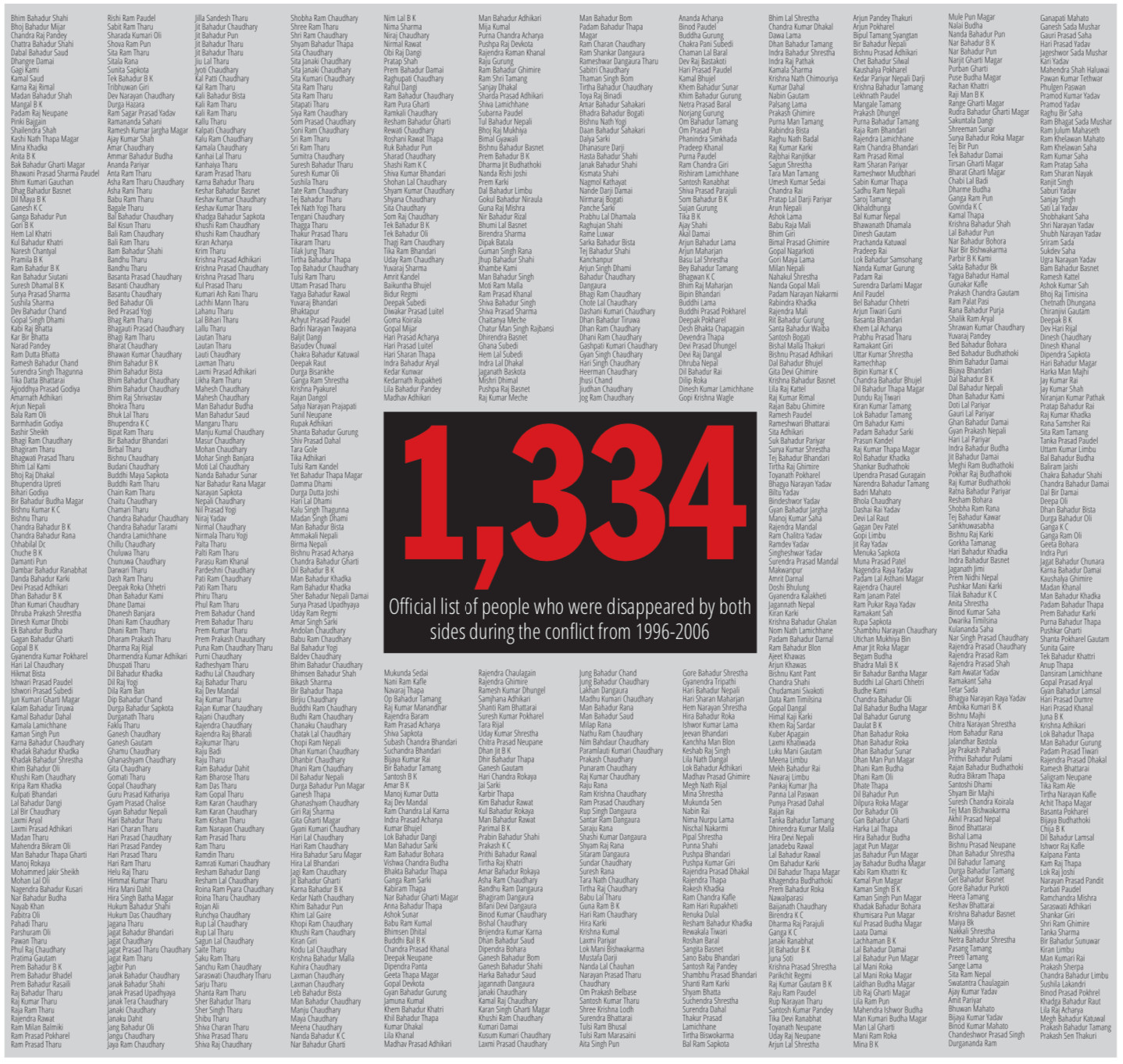
The 2006 Comprehensive Peace Agreement ended Nepal’s decade-long Maoist conflict in which 17,000 were killed and about 1,500 are still listed as missing. They were forcibly disappeared by the Maoists as well as state security, and not a single case has been resolved through the transitional justice process.
The ceasefire agreement set up the Truth and Reconciliation Commission (TRC) and the Commission of Investigation on Enforced Disappeared Persons (CIEDP) but successive government have left it in limbo. Years of delays, political interference and repeated changes in leadership have left victims’ families with little faith in the process.
‘For families of people subjected to enforced disappearance, 30 August is not simply a day of remembrance. It is also a reminder that, two decades after the signing of the Comprehensive Peace Agreement, thousands of families continue to live with uncertainty and ambiguity about the fate and whereabouts of their loved ones,’ Amnesty International said in a statement on Sunday.
The present government led by the Rastriya Swatantra Party (RSP) under Prime Minister Balendra Shah had raised hopes that truth and justice will not be delayed any further. An ordinance issued in May 2026 allows for the removal of commissioners from the TRC and CIEDP, and there was hope that they would be replaced by less partisan figures.
Amnesty International has urged the government to turn its commitments into ‘concrete action’ through a victim-centric, consultative and transparent process.
Echoing that concern, Ram Bhandari of the National Network of the Victims of Serious Human Rights Violations said the government must approach the issue “seriously and neutrally,” instead of politically manipulating the process to ignore crimes in which political actors were directly involved.
According to data from the National Human Rights Commission, 3,288 complaints related to enforced disappearances were registered. The total number of disappeared persons was 2,557. Of them, 48 were later traced, while 2,501 remain fully disappeared.
Men make up an overwhelming majority of recorded cases: 2,353, or 92.02%, and women account for 204 cases, or 7.97%.
“To not resolve even a single case from the conflict era is shameful,” Bhandari said. “This shows the existence of political corruption and gives a sense of irresponsibility.”
Bhandari’s father, a teacher, was disappeared by the Royal Nepali Army from Besisahar in 2001. For families like his, the search for truth has stretched across decades.
Many continue to raise their voices through public forums and victim networks, hoping to learn what happened to their loved ones.
International human rights agencies have repeatedly called for amendments to the laws governing the commissions. Although some changes have been endorsed, implementation remains weak.
POLITICAL WILL
“Even after two decades have passed, the ruling governments have remained mum about such a pertinent issue. This only adds to the pain of the victim families,” said Suman Adhikari, former chair of Conflict Victims Common Platform.
Adhikari’s father, Mukti Adhikari, a teacher in a village school in Lamjung, was taken from his science classroom, tied to a tree and executed by Maoist guerrillas in 2002.
Other conflict-era cases continue to shape the demand for accountability. Narjit Basnet, a teacher in Rukum, was attacked by Maoists after being mistaken for his brother, a Nepali Congress leader. In another case, journalist Dekendra Thapa of Dailekh was killed by Maoists while trying to negotiate an end to a siege that had disrupted the district’s water supply.
About 17,000 people were killed during the conflict, and many families of the disappeared continue to carry similar stories of loss and unanswered questions. Victim advocates say the repeated lack of political will has strengthened impunity, particularly because parties involved in the conflict have also controlled the state at different times.
The transitional justice process has been widely criticised as flawed. Victim groups say appointments to the commissions have often been influenced by political connections, while repeated extensions and dissolutions have further delayed justice.
Advocates argue that the process must be victim-centric rather than perpetrator-centric. Families who have waited for years say they have not received credible answers from the authorities.
“The victim families of the disappeared have been forced to perform final rites of their loved ones using a symbolic body,” Adhikari said.
The state has a responsibility to protect citizens and uphold their rights, but since the state was made up by two former enemies they decided to let things lapse. Governments have failed to ensure an impartial, transparent, merit-based and participatory process. The lack of accountability has deepened frustration among families who have already waited more than two decades.
“The families of the disappeared and those missing in the Rasuwa floods both want their loved ones found,” Adhikari said. “We hope the new government will show political will to do so.”