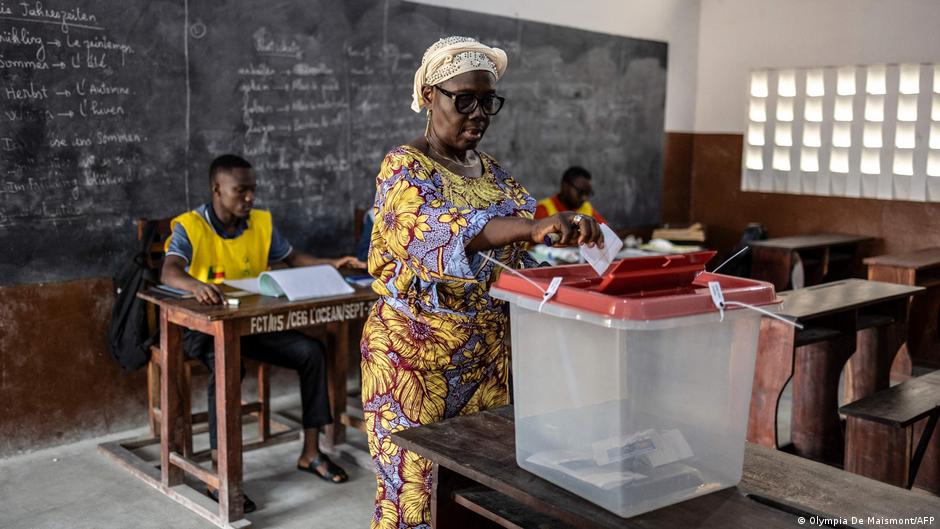
Burkina Faso’s junta leader Ibrahim Traore, who seized power in a 2022 coup, recently told Burkinabe people to “forget” about democracy.
“If an African wants to tell you about democracy, you should run away,” he said on the state broadcaster RTB in April. “Democracy kills.”
Traore’s statement shocked many, yet it also resonated with parts of the population. In Burkina Faso’s capital, Ouagadougou, some argued there is no time for democracy, as the fight against jihadism and for economic rebuilding takes priority.
While 2026 is considered a politically charged election year, many elections are marked by fraud, repression, and a growing disconnect between young people and political elites.
The question arises: are African democracies more than electoral mechanisms without real accountability?
West Africa’s rising military power
In several parts of Africa, a wave of military coups has taken hold, particularly in West Africa. In Mali, Burkina Faso, Niger, and Guinea, the military seized power between 2020 and 2023.
The three francophone West African countries Niger, Mali and Burkina Faso — led by military juntas — formally withdrew from the regional bloc ECOWAS in January 2025 and established their own partnership, the Alliance of Sahel States (AES).
In Guinea-Bissau, a coup also took place in 2025.
The trend extends beyond West Africa. Further south in Gabon, the military took power in 2023, while in the Central African nation of Chad, a transitional military council governed until 2025.
Mahamat Idriss Deby Itno now serves as Chad’s president and successor to his father, Idriss Deby Itno, who was killed by rebels in 2021 after 30 years leading the country.
In Sudan, a violent struggle between rival factions escalated into a full-scale civil war.
Military takeovers are therefore no longer isolated incidents but part of a regional dynamic.
Why coups gain public support
A 2023 report from the United Nations Development Programme (UNDP) cites “multidimensional poverty, inequality, manipulation of constitutional term limits, limited youth and women’s participation, governance deficits and higher levels of military expenditure” as factors that increase the risk of coups.
The study also notes “that when citizens have been disappointed with the delivery of democratically elected governments, they are more likely to support non-democratic styles of governance, including military rule.”
When democracy fails to deliver
“Democracy is not a standard form of government that can be implemented identically everywhere,” said Veye Tatah, who was born and raised in Cameroon but has lived in Germany since 1991 and works with nonprofit organization Africa Positive.
Tatah noted that many systems are shaped by colonial legacies and insufficiently adapted to local realities. “They do not reflect the culture, ethnicity, and lifestyles of the people,” she said. “If a system does not deliver — no food, no water, no education — people ask: what do we need it for?”
At the same time, civil rights are being increasingly restricted in many countries, with press freedom curtailed and opposition voices persecuted.
Africa’s fragmented political landscape
In North Africa, authoritarian systems dominate. In West Africa, democracies such as Ghana and Senegal coexist with military regimes in Mali, Niger, and Burkina Faso. Meanwhile, Cape Verde is consistently ranked among Africa’s most stable democracies.
Central Africa remains largely authoritarian, while East Africa and the Horn of Africa show a mix of hybrid systems, fragile states, and ongoing instability. In southern Africa, stable democracies like Botswana and Namibia coexist with more authoritarian-leaning systems such as Zimbabwe.
South Africa, Nigeria — African models?
South Africa is often viewed as a special case. Since 1994, it has built a democratic system designed to embrace social diversity. But strong institutions have not always translated into effective governance. Unemployment, inequality, and corruption have eroded trust, while the ANC party remains the dominant political force, despite weakening support.
William Gumede, a political scientist and writer, notes that the constitution’s framers aimed for a uniquely South African path — a model reflecting the country’s multicultural composition, including large Indian, Malay, European, and numerous African ethnic and linguistic communities.
The model drew more inspiration from the Indian constitution than from classic Western examples and sought to give space to a diverse civil society.
Today, South Africa maintains a comparatively strong civil society, an independent and diverse media landscape, and institutional structures in government, the judiciary, and administration that — despite shortcomings — are considered relatively robust.
Nigeria, Africa’s most populous country, illustrates this ambivalence even more clearly.
The country is deeply divided by ethnic and religious conflicts that repeatedly erupt into violence. Nevertheless, its political system has repeatedly shown adaptability over recent decades.
Farouk Bibi Farouk, a political scientist from the University of Abuja, stresses: “Democracy there is less a stable condition than an ongoing process.”
Nigeria’s 2015 transfer of power, in which Muhammadu Buhari defeated incumbent Goodluck Jonathan by 2.57 million votes, is widely seen as a democratic milestone.
Democracy: ideals vs. reality
Experts agree that rule of law, separation of powers, and civil rights are universal values that are desirable for Africa.
Cape Verde shows that democratic models can function stably.
At the same time, Tatah from Africa Positive warns that political systems must be socially rooted and reflect local realities. Ethnic and social fragmentation often leads to democracy being perceived as an instrument of specific groups.
The result is a fragile social contract in which state institutions lose public trust.
The real challenge for democracy in Africa
The central issue is less the model itself than its implementation. Where institutions function, trust emerges — where they fail, frustration grows.
For Tatah, one thing is clear: “Africa needs a mental revolution” — away from corruption and clientelism, toward responsibility and the common good.
Current developments, she argues, do not represent a clear retreat of democracy but rather a phase of renegotiation between authoritarian and democratic forces.
The key question is not whether democracy is possible in Africa, or whether “Africans can pratice democracy”, but how it can be shaped to function in people’s daily lives — not as an abstract model, but as a lived political reality.
This article was originally written in German.