BY DANIEL CULLEN
Dunvegan Community Trust has set out a roadmap for the next decade with the publication of a Community Action Plan for 2025–2035, covering the Dunvegan Community Council area.
The document combines hard data with local consultation and is intended to guide both the Trust and the wider community.
The Free Press spoke to Mali MacLennan, of Dunvegan Community Trust, who said: “The Community Action Plan is a community-led plan that pulls together publicly available statistics about our area, alongside information gathered directly from the community.”
The statistical work includes house price data, school roll numbers, catchment information and census analysis tracking population change over the past 20 years, with earlier consultations also incorporated in the 2025 plan.
Mali said: “It includes information from previous community consultations from the last five years. We didn’t want to keep asking the same questions repeatedly, so we’ve built on what we already knew.
“Part of the new survey asked for views on specific topics, but it also gathered demographic information about employment, income – whether people are retired or self-employed. That’s really important because it helps us understand, for example, how many jobs people are working to make up their income and how that compares to local house prices – and why housing affordability is such an issue.”
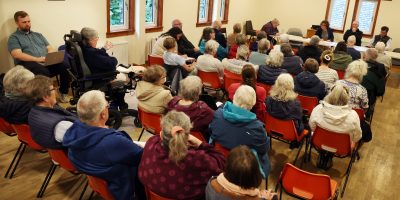
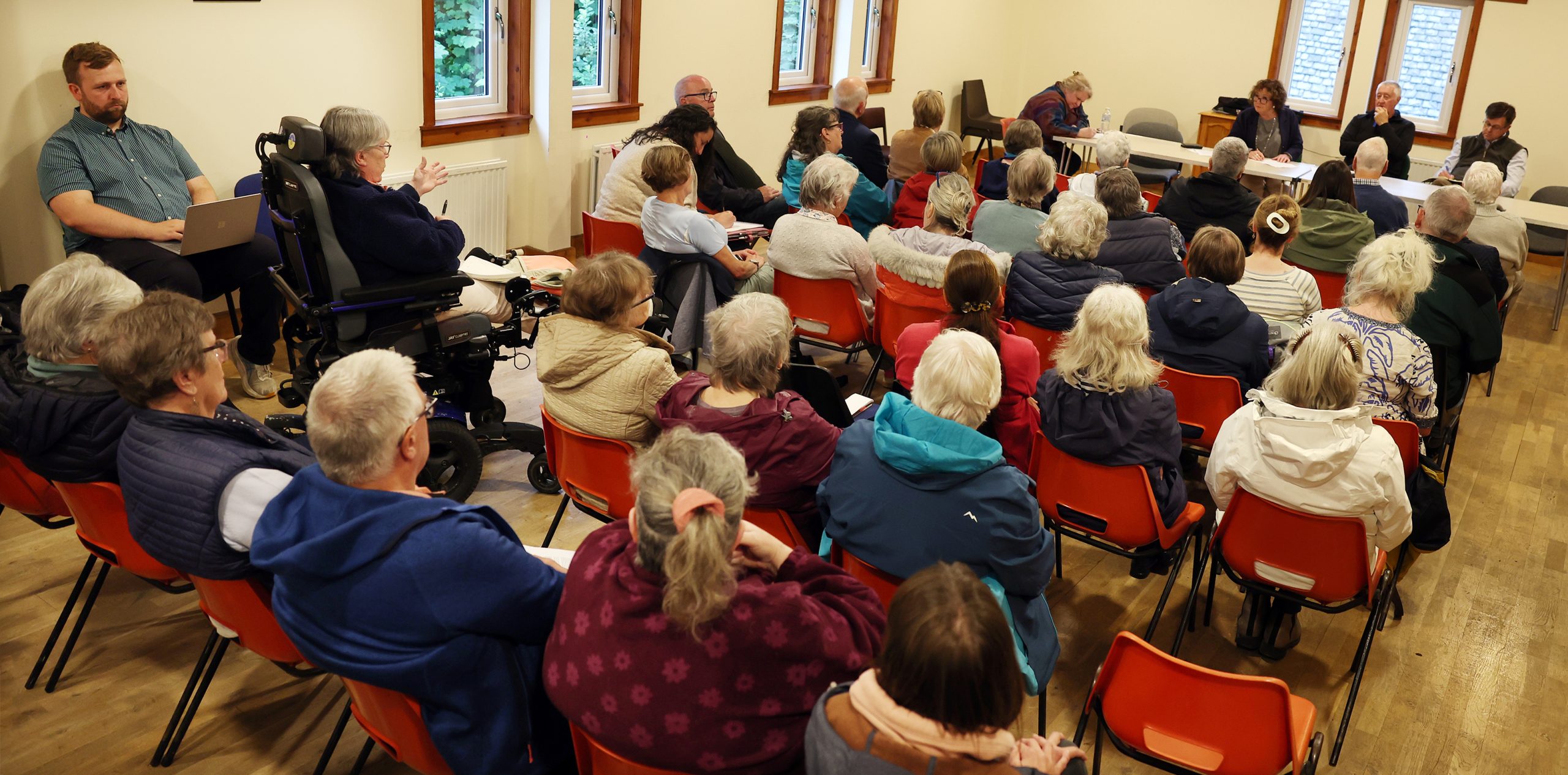
Mali went on to explain that before launching the survey, DCT held drop-in events to shape its content.
“Initially, these were to identify the topics that should be included. Then we held public events around each theme before the survey went live, so people had input into what they were being surveyed on. That’s partly why the survey ended up being quite long, but also why we had such good uptake.”
The final plan (a powerful and well-designed 113-page-long document) is split into two sections, Mali said.
“The first half of the Community Action Plan sets out all of that evidence, and the second half lays out the community’s priorities based on the survey findings.”
The Action Plan sets out a detailed picture of the local context: a resident population of around 650, heavy reliance on tourism and accommodation, rising house prices and outgoings that often require multiple jobs to cover.
Housing affordability is a recurring concern, particularly for working-age households, with other local priorities including improved footpaths, investment in the Community Hall, community energy schemes and expanded communal outdoor space. Transport measures, including broader use of the community minibus, a potential shuttle bus and subsidised taxi or community car schemes, also feature strongly.
The plan shows that without additional housing rental options it will be difficult to retain or attract working-age residents, suggesting that if the current trajectory continued, the majority of adults in the area in 2035 would be over 68 – even assuming every child living in Dunvegan today remained there at that time.
Environmental measures such as invasive species control, flood risk assessment and renewable energy projects are also included, alongside cultural initiatives and support for Gaelic.
Although produced by the Trust, Mali said the plan is intended as a shared resource. “Importantly, it doesn’t just belong to the Dunvegan Trust. It’s for everyone, any organisation, business, researcher or individual living and working in the area can use it. It’s the community’s plan – and in fact, some new businesses have already used it to demonstrate local need as part of their own planning.”
Mali recalled that when the Dunvegan Community Trust incorporated in 2022, there were already clear pressures locally.

“When we looked at population changes in the north west census data over the previous 20 years, and projections for the next 20, it was clear that if we don’t act, things could become quite bleak.
“There were already clear needs, like the community park and housing. We could see the issues and how interconnected they are. But we realised that if we didn’t take a strategic approach, we’d just keep reacting to things as they arose.”
Mali added: “You need to know what your community wants before you can develop a proper strategy. Without a strategic plan, you’re constantly reactive. We recognised that we needed the Action Plan and that other groups would benefit from having all this information in one place too.
“It turns anecdotal evidence into something concrete. Councillors and agencies can see clear data to support what the community has been saying for years.”
The demographic challenge highlighted in the Action Plan underpins many of the challenges faced by the community.
“We need to make it easier for a wider range of people to live here”, Mali said, “working-age adults, families, young people, people leaving home for the first time. At the moment, it’s quite limited who can realistically afford to live here.”
Asked about overarching themes, Mali suggested: “Community resilience? Although that word can feel overused. It’s really about how we make our community more self-sufficient and sustainable. Everything is interconnected. For example, affordable transport is a big issue. People often travel into Portree to access services like sports pitches – there isn’t one in the north west – and that travel takes time and money.”
Time itself has consequences. “That time commitment even links to things like Gaelic language learning. Many people would like to learn Gaelic but aren’t currently doing so. Opportunity plays a role, but so does time. If you’re spending six hours a week driving back and forth to Portree, that’s time you can’t spend doing something else.”
For that reason, Mali said, “it’s hard to isolate a single theme – housing, transport, services, language, demographics – they all overlap.”
The Action Plan adds to recent milestones such as acquiring the old Gaeltec building and purchasing a new community minibus (with funding and support from the Struan Community Trust and the Community Regeneration Fund), all of which has built momentum within the community.
“The minibus carries 16 seated passengers, or can accommodate up to two wheelchair-using passengers and eight seated passengers, and has a lift for wheelchair access. It is available to hire by local groups and has barely been stationary since it was delivered!” Mali said.
Also funded were ten ‘midas assessments’, which will be delivered at the end of April, and driver assessor Training for one individual – both of which will be advertised in the coming weeks.
“It does feel as though there is momentum now, locally. The new school building is now confirmed. The Highland Council owns land for a community pitch in Dunvegan. A few years ago, those things still felt uncertain.”
Mali concluded: “The Community Action Plan isn’t the Trust’s strategy – it sets out what the community wants. Our job now is to ask: what can we realistically deliver? Who can we partner with? Who else has responsibility for services in Dunvegan?”
The Community Action Plan and supporting research and survey work was collated by Dr Liza Cleland, with graphic design and photography by Emily Leonard, and additional photography by Brody Bailie Stewart.
“We’re also very grateful to everyone at Skye and Lochalsh Archive Centre and ATLAS Arts for their help and support. We’re grateful to be part of the community who made this happen, had the conversations, completed the mammoth survey and came together to share their hopes for the future,” Mali concluded.
The Dunvegan Trust Community Action Plan can be found on their website: dunvegantrust.co.uk, with hard copies also available from the trust.