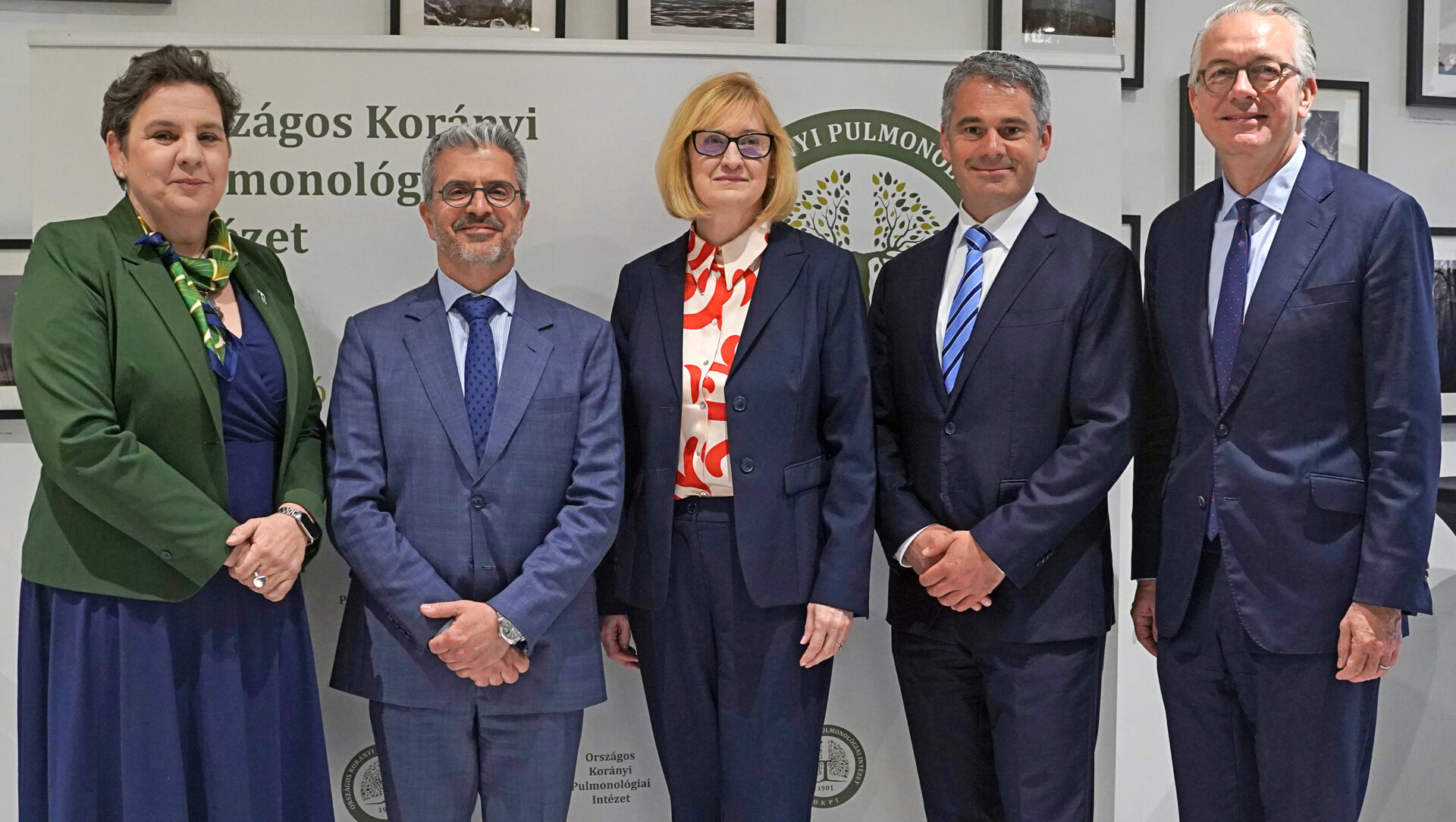
The National Korányi Institute of Pulmonology (OKPI) and Roche Magyarország Kft. have formally signed a strategic cooperation agreement, committing the parties to a long-term partnership focusing on professional-scientific, innovative, and educational activities.
The primary objective of the agreement is to enhance the treatment of oncological lung diseases in Hungary and to introduce future innovative diagnostic and therapeutic solutions to the domestic healthcare landscape. The ceremony welcomed Dr. Alan Hippe, member of the executive board and Group CFO at Roche, based in Switzerland.
The official documentation was signed by Dr. Krisztina Bogos, the general director of OKPI, Dr. Peter Ahnesorg, managing director of Roche Magyarország, and Dr. Stavros Chisimellis, country manager of Roche Diagnostics.
Shared Mission Serving Science and Patients
The strategic agreement not only provides a unified framework for existing collaboration but also defines shared goals and long-term cooperative directions. The parties expressed their intent to combine the institute’s extensive scientific and clinical experience with the innovative power of one of the world’s leading biotechnology companies.
“For our institute, this agreement is more than a professional cooperation: it is a commitment to the future of Hungarian pulmonology,” said Bogos. “Our goal is for the National Korányi Institute of Pulmonology to become a hub for domestic innovation. The joint scientific work with Roche creates an opportunity to bring the most advanced solutions (from clinical research to digital possibilities) closer to Hungarian patients and doctors. We are laying the foundations today for a modern, data-driven, and patient-centric pulmonological care system,” she added.
“Accurate and early diagnosis is the cornerstone of every successful therapy. This collaboration paves the way for us to jointly explore the integration of the latest diagnostic technologies and screening models in Hungary,” noted Chisimellis. “Through knowledge sharing and technology transfer, we envision a future where diseases are not just treated but identified at the earliest possible stage, increasing the chances of recovery for every Hungarian citizen,” he said.

Hungary possesses an outstanding scientific base and professional heritage, making local partnerships of strategic importance for Roche. This agreement underscores that sustainable healthcare is built on trust in innovation and human capital. On a global level, Roche supports initiatives that seek to address future healthcare challenges through the power of science and transparent collaboration, thereby contributing to the country’s competitiveness and the well-being of society.
“At Roche, we believe that resources spent on healthcare should be viewed not as a cost, but as one of the nation’s most vital investments,” Ahnesorg outlined. “A healthy and productive society is the cornerstone of a country’s competitiveness, and innovative therapies directly contribute to the preservation of human capital,” he said.
“This strategic agreement reflects our commitment to the Hungarian healthcare ecosystem and patient care, charting a course toward a future where science and economic sustainability go hand-in-hand. We are honored to work with OKPI to help Hungary become a regional center for healthcare innovation and clinical research,” Ahnesorg concluded.
Horizon of Opportunities
Within the framework of the partnership, the parties will deepen their existing cooperation in clinical trials and research projects that utilize real-world data (RWD). Key objectives include the development of education, as well as the enhancement of prevention and health consciousness among the Hungarian population.
The long-term goal of the strategic alliance is to increase Hungary’s scientific weight both domestically and internationally. The parties intend for OKPI to serve as an international point of reference in the future, where objective experience gained from the application of innovative technologies provides value to the global scientific community.

About Roche Hungary
Roche Magyarország Kft. is the Hungarian arm of the Swiss healthcare giant Roche (one of the world’s largest biotech and pharma companies) and is one of the key multinational healthcare players in the country. Its head office and pharma and diagnostics operations are based in central Budapest; it also operates a Roche Services & Solutions shared service center in the capital. The pharma firm has been present in Hungary for more than 35 years and employs around 3,000 people. It supplies medicines used across Hungarian hospitals. It earlier signed a strategic agreement with the Hungarian government to expand access to innovative treatments and support the country’s healthcare system development.
About OKPI
The Budapest-based National Korányi Institute of Pulmonology was originally founded in 1901, when it focused on tuberculosis treatment, a major public health issue at the time. It has since evolved into a modern national reference center for pulmonology. A state-run specialist hospital and research institute, it is focused entirely on respiratory diseases. In simple terms, it is the country’s top “lung hospital” research institute.
This article was first published in the Budapest Business Journal print issue of May 8, 2026.