
(Français)
The Haitian central authorities remain silent, while families dispossessed by the Dominicans, who are erecting their border wall, are left to fend for themselves. In Ferrier, in the Northeast, land cultivated for generations by Haitian farmers is being arbitrarily seized. In these border areas, the boundary markers are moved at the whim of the Dominican authorities, encroaching on Haitian territory. Meanwhile, the Ministries of the Interior and Foreign Affairs look the other way, abandoning the farmers to a hopeless struggle.
Ronald Saint-Martin, along with six heirs including himself, manages a plot of land of approximately four hectares located in Ferrier, in northeastern Haiti. This inheritance comes from their grandfather, Gravius Saint-Martin, and then from their father, Céleïste Saint-Martin.
All of them have been farmers for generations, producing corn, pistachios, okra, potatoes, and peas to feed their large families and sell the surplus in local markets, as is customary in rural Haiti. Whenever his father farmed, Ronald was always by his side, learning the basics of agriculture.
“Before taking possession of the land, they spent a lot of time watching, observing, and going back and forth. Encouraged by the complete absence of our authorities, they took advantage of the situation to commit this act of violence,” said Ronald Saint-Martin, whom we met a few steps from what is no longer his land. “They did it knowingly, knowing that the land hasn’t been cultivated ever since. They know perfectly well that their actions are illegal.”

After his father’s death, Ronald took over. “From then on, I lived well,” he said. There were minor disagreements between him and the other heirs, which were settled amicably. But that wasn’t all. At regular intervals, conflicts erupted with Dominicans. Dominican police, however, sided with the Haitians, asserting that this part of the territory did not belong to the Dominican Republic. They even imposed restrictions to prevent any intrusion.
The original deed of sale for the land, acquired by Gravéus Saint-Martin and reviewed by Enquet’Action, stipulates: “The said land is bordered to the north by that of William Joseph (Haitian), to the south by that of Roolian (Dominican), to the east by that of Rookatro (Dominican), and to the west by that of William Joseph (Haitian).”
When Dominicans encroach on Haitian territory
“For a while, we farmed the land. But with the wall being built at the border, the Dominicans entered our plots and we became victims,” Ronald Saint-Martin told Enquet’Action. Only a small portion of the stolen land is cultivated; the rest lies fallow, covered in trees. “They even offered me money,” he added. “I refused. Accepting money from the Dominicans for land that belongs to Haiti would be like selling part of the territory. It would be a betrayal.”
Ronald is now waiting for a response from Haiti’s central authorities, while several residents of the region have already lost their land.
A few steps away, Aval Joseph, another victim of the border wall, remembers his youth spent working this land. “Initially, there was a conflict that forced us to retreat, because the Dominicans constantly threatened us,” he explained. “They even entered our territory to attack us with Dominican army weapons. For a while, we lived in fear, hardly daring to return. Every time we went there, they attacked us. Then things calmed down, and we went back to work, despite our fears.”
Today, with the construction of the wall, Aval bitterly observes that the Dominicans have incorporated the plot into their territory. “No! We know very well that it doesn’t belong to them. But we don’t have a government to support us,” he lamented. “If we had a state to defend us, we wouldn’t have to endure all this. The Dominicans even go so far as to steal Haitians’ animals and sometimes even shoot at them. They set boundaries that they don’t respect.”
What about the “wall of discord”?
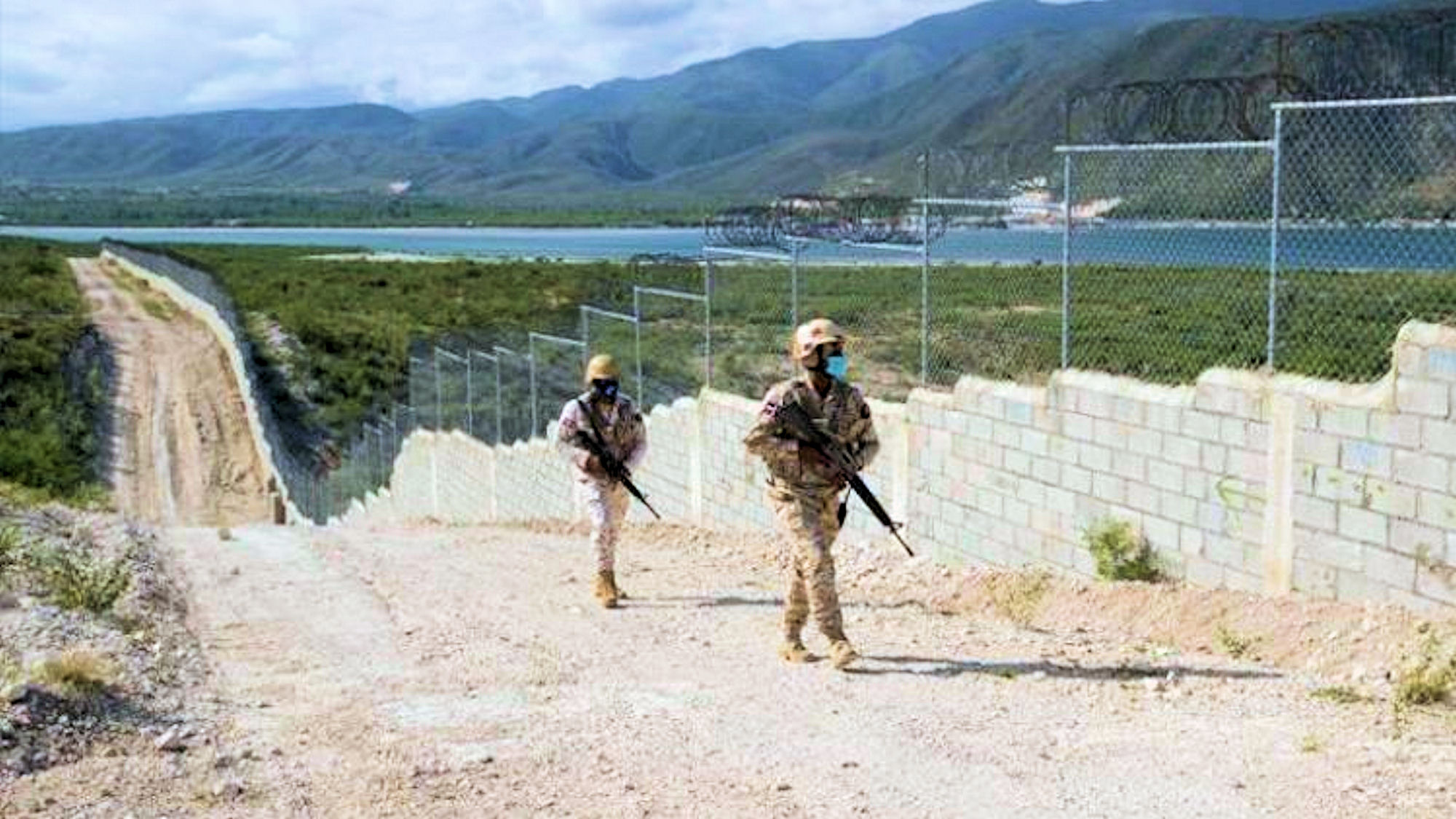
In February 2022, Dominican President Luis Abinader launched the construction of a 160 km wall along the border with Haiti. According to him, this project aims to “control” illegal immigration and crime. The initial cost was estimated at $31 million. Luis claims that this wall “will benefit both countries,” by facilitating the control of bilateral trade, the regulation of migration flows, and the fight against human, drug, and arms trafficking.
Since the launch of the Dominican wall project, successive Haitian central authorities have failed to adopt a clear position.
The first phase involves 54 km of fencing, followed by a 110 km extension, bringing the total length to 164 km along the 380 km border. The reinforced concrete wall is topped with a 3.9 meter-high and 20 centimeter-thick metal structure, with several dozen watchtowers.
But the construction is generating strong criticism. Migrant rights organizations denounce the project as a source of xenophobia and racism. On the ground, observers and residents note that the wall has not put an end to drug, arms, or human trafficking, nor to smuggling and corruption.
This initiative comes more than 80 years after the 1937 massacre, ordered by Rafael Trujillo, which claimed the lives of over 20,000 Haitians. Following this massacre, Dominicans seized Haitian land. Even today, the Abinader’s wall is causing evictions and the destruction of homes, leaving hundreds of victims with compensation deemed insufficient.
Enormous and irreparable losses
These seizures involve a vast expanse of cultivated land, including rice paddies, coconut groves, and mango orchards. This is a recurring theme in the accounts of everyone familiar with the situation.
“There were three of us brothers working this land,” laments Gentilus Saint-Martin, a victim of the border wall’s construction. “With each harvest, we easily managed to obtain a hundred sacks of rice.”
“It’s hard… Because I have children to feed,” adds Ronald Saint-Jean, who earned between 200,000 and 300,000 gourdes (US$1,500 to US$2,300) a year.
Elvie Julie, a mother of 14, is another victim we met in Ferrier. She recounted that her father was able to raise and feed his children thanks to this land, and that her family continued this tradition. “It’s thanks to this land that I was able to send my children to school and provide for their needs,” she confided with despair in her voice. “I farmed and started saving to build a house. But now, they’ve taken the land from me. I can’t find any space to lease, nor any land to share. I find myself without resources and reduced to joblessness.”
Since losing their land, several families interviewed recounted falling into joblessness, while they still have to feed their children, pay their school fees, and honor their debts.
“I farmed and started saving to build a house. But now, they’ve taken the land from me.”
The central government is completely absent, and local authorities are powerless.
Since the launch of the Dominican wall project, successive Haitian central authorities have failed to adopt a clear position. No official statements, no press releases: the silence is absolute. Attempts to elicit a response from the Ministry of the Interior and Local Authorities (MICT) have been met with no response. Faced with this silence, local authorities have tried to take over but acknowledge their powerlessness.
This indifference has not gone unnoticed by Dr. Todt Royer, a lawyer. In an article published in Le Nouvelliste in February 2022, he observed: “The leading figures in the Haitian press are not talking about it. It’s a large-scale project that interests everyone on the planet, except Haitians and their leaders; they are fast asleep… None of the news outlets consulted mentioned that a Haitian delegation was present. This shows that all of this is happening behind the scenes, away from the eyes of the Haitian leaders, who are nevertheless responsible for protecting and defending the national territory.”
For Todt, the construction of this wall is reminiscent of the Berlin Wall in 1961, erected in the context of the Cold War. [A better comparison may have been the towering walls that Israel builds on its borders with the Palestinian West Bank and Gaza Strip – HL.] “The construction of the wall that will separate Haiti from the Dominican Republic is another step in the well-established anti-Haitian sentiment in the Dominican Republic,” he said, denouncing the “deep slumber of Haitian leaders in the face of this illegal act.” According to him, “the construction of a shared wall between Haiti and the Dominican Republic, decided unilaterally by the Dominicans, is illegal since no agreement exists between the two countries.”
Haitian authorities remain absent or powerless
Central authorities were absent not only from the inauguration but also from the meetings, leaving local authorities to deal with the population alone. “They told us that everything was under control,” complained Ronald, referring to a mayor named Placide. “I was waiting for them to return. In the end, the wall was built without anyone saying a word.”

Johnny Joseph, then Ferrier’s deputy mayor, recounts having challenged the Dominicans about the illegitimacy of their work: “These lands have belonged to Haitians for years and have always been cultivated. Yet, some Dominican planters claimed that we couldn’t benefit from them. They pressured the Dominican state to take possession. I ask the Haitian state to support the farmers in obtaining the return of their land.”
Adius Josaphat, CASEC of Bas-Maribahoux, confirmed having been approached by the Dominicans: “I told them that this fell under the jurisdiction of the Ministry of Foreign Affairs and the MICT. During our visits, the Dominicans arrived with soldiers, blocked the canals, and took possession of the land. (…) As a local authority, I don’t have the means to confront the Dominicans. For me, this is the greatest abuse committed on our territory. This doesn’t just concern the Saint-Martin family, but all Haitians, here and elsewhere.”
While awaiting a response from the central government, Ronald Saint-Martin and his family are sinking into poverty. “I no longer work, I have no income, I am without resources,” he explained. “With the loss of this land, it’s as if I’ve ceased to live. Not just for myself, but for my family as well.”
Unable to provide for their needs, he hasn’t even been able to finish the house he started with the land’s income. “This entire wall I built is starting to collapse,” he said. “In two years, I’ll have almost nowhere to stay… I feel completely abandoned, like I’ve been left adrift. I’ve lost everything.”
Haïti Liberté translated from French to English this article which was first published by Enquet’Action.