Korea’s first generation of modernist painters came of age in a country shattered by colonization and the Korean War (1950-53), long before K‑culture became a global brand and art auction records made headlines.
For Park Re-hyun, Rhee Seund-ja and Kim Whanki, making art meant reinventing both themselves and their nation’s visual language while navigating poverty, patriarchy and exile in post-war Korea.
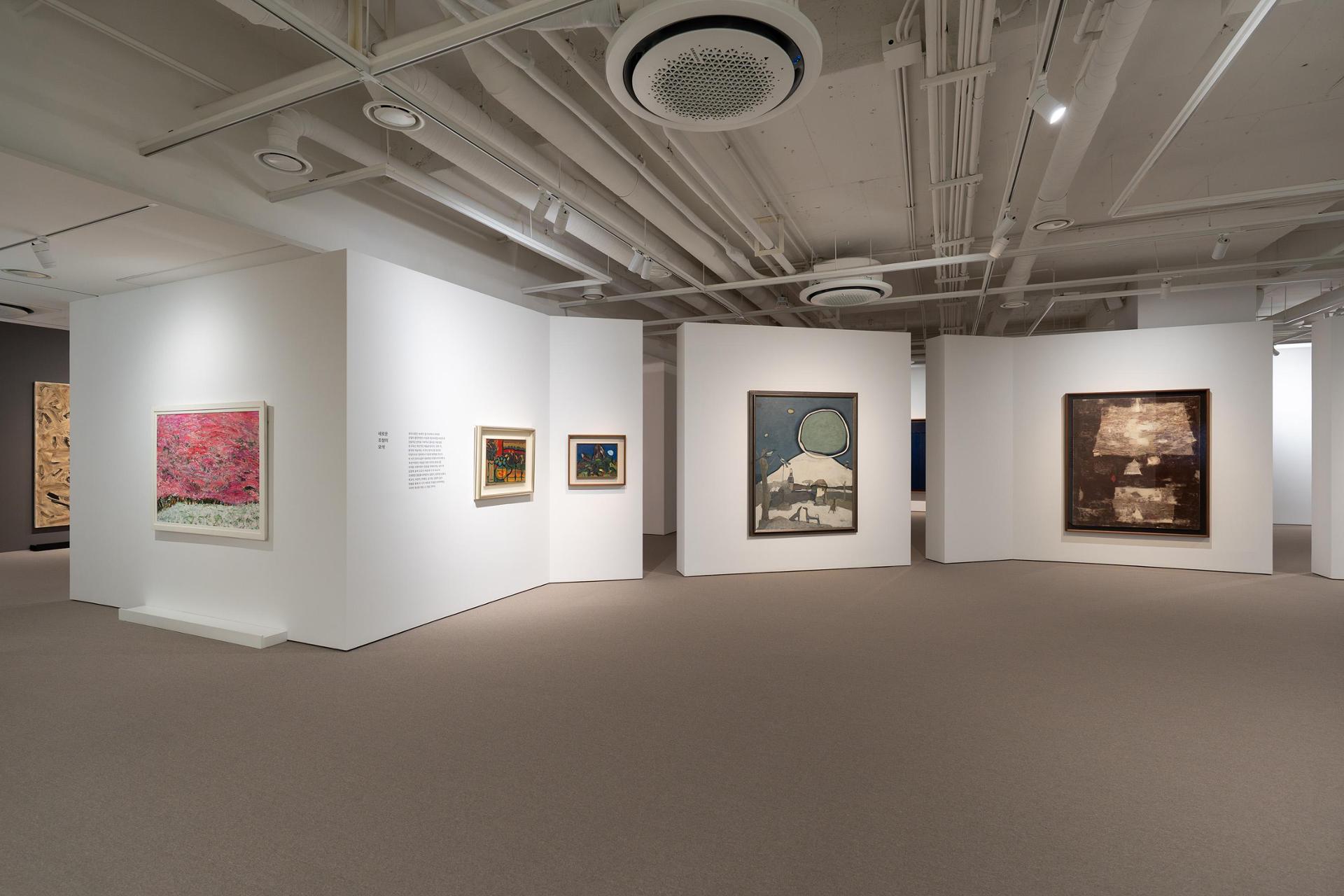
Their works, now showcased at Global Sae-A Art Space in Seoul, trace how a modern Korean identity was rebuilt on canvases long before it was projected on global streaming platforms and pop stages. The works also reflect their personal struggles, especially for the two women artists.
Exhibition “Highlights of Modern Korean Painting: Modernism and its Challenges” at Global Sae-A Art Space in Seoul / Courtesy of Global Sae-A Art Space
Modernism’s arrival in a broken country
Modernism was an art movement that emerged in the West in the late 19th and early 20th century, rejecting traditional authority and pursuing rationality and autonomy on the basis of reason and individualism.
After liberation from Japan, Korea’s art scene came into direct contact with the spirit of Western modernism, and “the realistic, academic painting style of the colonial period disappeared,” Park Mi-hwa who curated the exhibition, “Highlights of Modern Korean Painting: Modernism and its Challenges,” said in a recent statement released by the gallery.
In the mid-1950s, barely a decade after World War II and only a few years after the Korean War (1950-1953), a new generation of artists began to push beyond the styles they were used to in search of abstraction.
“Abstraction was the defining keyword and central question of modernism” in Korea, according to Park. “This huge wave of abstraction reached Korean art without exception, profoundly affecting artists who devoted themselves to developing their own unique styles and visual languages.”
Artists found themselves caught in a “double position” where they absorbed Western modernist perspectives while feeling compelled to preserve Korean tradition. This resulted in experiments like combining ink-and-wash techniques, landscape motifs and ceramic forms with radically new compositions. Some artists left Korea for France, then considered “the holy land of contemporary art,” Park explained.
This undated photo shows Park Re-hyun, right, and her husband Kim Ki-chang in their studio. Korea Times file
Park Re-hyun: painting between household chores
Among these pioneers was Park Re-hyun (1920–1976), one of Korea’s first professional women painters, and one of its most overlooked casualties of gendered expectations.
Born in 1920 to a wealthy family in Jinnampo, South Pyongan Province, she studied Japanese-style painting at the Women’s Academy of Fine Arts in Tokyo, winning the Governor-General’s Award at the Joseon Art Exhibition with “Makeup” while still a student.
“Park Re-hyun expressed our very beautiful Eastern painting in a Western way,” said Yun Hae-jung, planning manager at Global Sae-A Art Space during a walkthrough with this journalist, gesturing toward one of Park’s rare abstract ink works.
“Her expression is so soft, yet strong,” Yun said, pointing to a composition where two pools of ink spread across the canvas on “From a Forgotten History” (1963). “She uses the bleed of ink so elegantly that it feels like these shapes are separate, yet connected. The depth of ink seems flat at first glance, but she has piled up wash after wash.”
Park Re-hyun’s “From a Forgotten History” (1963) / Courtesy of Global Sae-A Art Space
“From her debut, she was a complete rising star — winning top prizes at major competitions including the Joseon Art Exhibition and the National Art Exhibition and quickly gaining recognition in Korea’s art world,” Yun explained.
Her early fame, however, collided with the realities of postwar womanhood.
After returning to Korea, Park married star painter Kim Ki-chang, who lost hearing after a childhood illness, with a single condition: she could keep painting for life.
“But at that time, it was impossible for a Korean woman,” Yun said. “She became the mother of four children, painting whenever she could steal a moment, so the number of her works is very small. She died at 56, from liver cancer. For Korean art, it was a real loss.”
In a 1948 essay for the magazine “Marriage and Life,” Park described her days in plain terms: “My daily routine is washing diapers, cooking rice, cleaning. After breakfast, there is more to tidy up … watching the baby,” she wrote, asking herself when she would ever paint again. She did, though, slowly shedding Japanese influences to create a new kind of painting that married ink’s softness with modern abstraction.
By the 1960s, Park had traveled widely, holding joint exhibitions with her husband in the United States and Europe and producing increasingly abstract works that pushed ink’s bleeding and layering effects to their limits.
Park not only emerged as one of Korea’s most prominent women artists, but also served as a “triple interpreter” for her deaf husband, mediating between Korean, other spoken languages and the physical gestures they used to communicate to support both his daily life and international career.
Rhee Seund-ja stands on a bridge over the Seine river in Paris, France, in this undated photo. Korea Times file
Rhee Seund-ja: abstraction and “earth of women”
If Park Re-hyun battled the confines of domesticity mostly from inside Korea, Rhee Seund-ja (1918–2009) waged her own struggle overseas.
Born into a prominent family in Jinju, South Gyeongsang Province, she studied in Japan, married a Korean man there and had three children. Rhee went on to divorce him over clashing values and infidelity — a radical step for a Korean woman of the time.
“She made a shocking decision for the time back then: She divorced, and went to France,” Yun said. “It was 1951, during the war, and she went without speaking a word of French.” Rhee first studied fashion, then enrolled at the famed Académie de la Grande Chaumière in Paris, where, according to Yun, “her talent was so exceptional that she was immediately recognized by the French art world.”
A 1963 canvas from her “Earth and Women” series hangs in the exhibition, covered in dense dots that suggest a carefully tilled field or an ancient landscape. “It feels primordial,” Yun said. “The series is called ‘Earth and Mother.’ She left three children behind in Korea, and we can’t imagine that longing. She said each brushstroke was like feeding her children one more bite of rice, or stroking their hair once more.”
Rhee Seund-ja’s “Mystery of Spring Water” (1963) / Courtesy of Global Sae-A Art Space
“In the ‘Women and Earth’ series, produced until 1965, she painted with the heart of caring for the family she had left in her homeland, likening the earth to women.” In “Mystery of Spring Water” (1963) she fills the canvas with countless dots symbolizing cultivated land, transforming memory and guilt into a new visual vocabulary.
Rhee returned to Korea in 1965, 15 years after leaving, for an exhibition arranged by her eldest son. “She saw that all three sons had grown up well, and that’s when she stopped the ‘Women and Earth’ series,” Yun said. “But her story ends well in another sense: the sons later came to understand her choice.” One became a French-Korean correspondent, another an architecture professor in Paris, and another a successful businessman who helped support her practice, Yun explained.
“She never stopped challenging herself,” Park said. “She was constantly changing the life of her work, exploring new formal worlds.”
This undated photo shows Kim Whanki and his wife Kim Hyang-an / Korea Times file
Kim Whanki: from roads home to infinite space
While Park and Rhee show how Korean women artists carved out space in an unforgiving social world, Kim Whanki (1913–1974) represents how a man could turn similar historical pressures into a different kind of abstraction.
Born on the small island of Anjwa in Sinan County, South Jeolla Province, he studied in Japan in the 1930s, encountering avant-garde painters like Tsuguharu Foujita and Seiji Togo, who drew him into the world of abstraction.
“Kim Whanki is the most important figure in Korean abstract art and in expressing the beauty of Korea,” Yun said. “This work’s title is ‘On the Way Back,’ the road back home. He painted a mother going home to feed her children. The load must be heavy, but he shows it lightly, with a quiet smile on her face. It’s every Korean mother we know.”
Kim Whanki’s “On the Way Back” (1950s) / Courtesy of Global Sae-A Art Space
In a 1956 painting created after his arrival in Paris, Kim compressed memories of Korea — mountains, the moon, cranes and obangsaek (traditional five colors) — into a dense, textured surface. “He titled it ‘Where I Lived,’ but it’s really where he loved,” Yun said. “Everything Korean is there, but it’s so modern, so warm.”
His later New York works, by contrast, distilled his childhood island into more austere lines and hues. “When he went to New York in the 1960s, he was not widely recognized. Even now, it’s hard for a Korean artist to be accepted there; it was almost impossible then,” Yun said. “That struggle pushed him toward complete abstraction, toward the dot paintings.”
The exhibition’s centerpiece is “Universe 05-IV-71 #200,” a monumental diptych covered in vibrating blue dots that earned a record price for Korean art at a Christie’s Hong Kong auction in 2019, and was subsequently returned to Korea.
Kim Whanki’s “Universe 05-IV-71 #200” (1971) on display at Global Sae-A Art Space in Seoul / Courtesy of Global Sae-A Art Space
“Oil painting is supposed to be oily, but here it feels like ink, transparent and bleeding,” Yun said. “He repeated tiny dots infinitely across the canvas, making them expand outward. When it was first shown in downtown New York, critics said this mysterious material evoked the mystery of the universe.”
“The original title is simply the date he started: April 5, 1971,” she added. “It was later that Kim Hyang-an, his wife and the director of the Whanki Museum, called it ‘Universe,’ and the name stuck. He left this great work and unexpectedly died only three years later from complications after surgery. In his diary, he wrote that he wanted to be discharged quickly to paint again. His death was an enormous loss to Korean art, and the fact that we have this work back here is due to his wife’s lifelong devotion.”
The exhibition covers works by all three artists, alongside works by 11 other modernist painters who lived through the war and division, searching for a distinctly Korean artistic identity in an era of upheaval.
The show runs through Aug. 1.