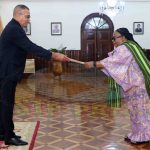
Foreign tourists and residents participating in the Seoul Hiking Week program pose at the summit of Mount Surak, April 5. Korea Times photo by Moon Ji-su
Marlon stood at the trailhead of Mount Surak on April 5, fully equipped and eager to introduce his friend to the steep trails of the South Korean capital.
The 32-year-old from the Philippines, who works at a food company in Icheon, a city about an hour from Seoul, had already scaled Mount Dobong, Mount Bukhan and Mount Acha before bringing 32-year-old Jannet along for the ascent.
“It feels like just yesterday I went on my first hike, and now I’m the one bringing a friend,” Marlon said, praising the sunrises and sunsets he witnessed from the peaks.
His enthusiasm highlights a broader shift in international tourism. Foreign visitors are increasingly trading palace visits and other well-known Seoul landmarks for mountain trails, fueling a trend known as “K-hiking.”
The Korea National Park Service reported that more than 2 million foreigners visited national parks last year, accounting for nearly 5 percent of the roughly 43.3 million total visitors. Short-term tourists drove the influx, making up more than half of the international hikers.
Mount Halla led the trend, drawing more than 300,000 international hikers, while Mount Seorak and Mount Bukhan followed with roughly 170,000 and 135,000 visitors, respectively.
As interest grew, the Seoul Tourism Organization launched Seoul Hiking Week. The initiative offered 12 guided sessions across Mount Surak, Mount Bukhan and Mount Gwanak over three weeks starting March 23, drawing 323 foreign participants.
Social media drives much of the international interest. Viyanka, a 31-year-old tourist from India, said an online video convinced her to join the trek.
“Instead of places I’ve already been, like Namsan or the Han River, I wanted to experience natural scenery, so I joined after watching a hiking video,” she said.
Karin, a 34-year-old Malaysian student, aims to scale every mountain in Seoul.
“My hometown is summer all year round, but I love that the mountain scenery in Korea changes with every season,” Karin said.
Foreign hikers walk in formation at the entrance of Mount Surak, April 5. Korea Times photo by Moon Ji-su
Manuela, a 33-year-old from Colombia, noted the easy access afforded by Seoul’s infrastructure.
“In other countries, you have to drive a long time to reach a mountain, but in Korea, you can take a subway straight to the trail, and once you descend, you can immediately enjoy the city culture,” Manuela said.
International hikers also embrace the unique camaraderie on the trails. Alex, a 33-year-old Chinese American, said locals quickly made him feel at home.
“Older hikers always ask where I am from and share their snacks. Whenever that happens, I feel deeply blessed,” Alex said.
Foreign hikers wait in line to scale Gichabawi (Train Rock) on Mount Surak, April 5. Korea Times photo by Moon Ji-su
Despite the enthusiasm, Seoul’s mountains can still challenge first-time hikers. Mount Surak rises about 640 meters, and its steep, rugged paths demand stamina. Three Mongolian tourists, who joined the hike after watching a TikTok video, said they had no idea the climb would be so exhausting. To lighten the mood for the hikers, the guide joked about calling a taxi.
The most notorious section of Mount Surak is Gichabawi, or Train Rock, a steep, slippery rock face that hikers must scale using anchored ropes. When this reporter hesitated at the daunting obstacle, Viyanka offered a push of encouragement.
“If I can do it, you can do it,” she said.
Foreign hikers take a group photo at the summit of Mount Surak, April 5. Korea Times photo by Moon Ji-su
The entire group safely navigated Gichabawi under the guide’s supervision and completed the climb. Looking over the city below, the hikers took group photos to mark the achievement.
“Reaching the top just makes me crave my favorite Korean dish, naengmyeon,” Manuela said, referring to cold buckwheat noodles. “It was a meaningful day and a truly rare experience.”
This article from the Hankook Ilbo, the sister publication of The Korea Times, is translated by a generative AI system and edited by The Korea Times.