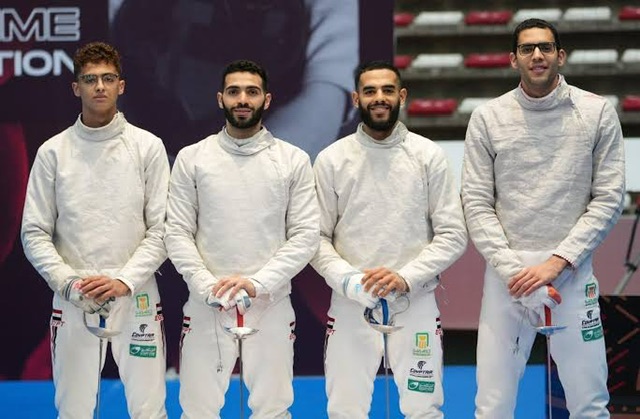
The Egyptian national sabre fencing team secured the bronze medal after defeating Israel with a score of 39–38 at the World Fencing Championships (Team Epee/Sabre) held in Hong Kong, marking a historic achievement.
The Pharaohs edged out their opponent 39–38 during the Senior World Championships hosted by Hong Kong from July 22 to 30.
The national team kicked off its campaign with a 44–33 victory over Portugal in the Round of 32, followed by a tight 36–35 win against Spain in the Round of 16.
Egypt then advanced to the semifinals after defeating Russia 45–35.
Although the team suffered a 41–32 loss to Kazakhstan in the semifinal round, they rallied to clinch the bronze medal by overcoming Israel 39–38 in the third-place match.
The Egyptian delegation is led by the President of the Egyptian Fencing Federation, Captain Tarek al-Hossainy, and the Director of National Fencing Teams, Ayman Ghoneim, who serves as administrative manager.
The medical staff includes Dr. Magdy al-Sabbagh as team physician, along with physical therapists Ahmed Abdel-Ghani and Ghada Atef.
Also accompanying the delegation is the Vice President of the Egyptian Fencing Federation, Ahmed Samir, upon an invitation from the International Fencing Federation (FIE) to attend the FIE Referees Commission meetings—in his capacity as Chairman of the African Fencing Confederation’s Supreme Referees Committee—as well as the IOC Safe Sport meetings held on the sidelines of the World Championship.