
Following last year’s return, a busy and successful Mòd Loch Aillse, with over 250 entries, was held last Wednesday and Thursday.
Piping competitions were held on Wednesday in Kyle Primary School and the six categories were judged by Alasdair Brown and Andrew Smith.
Plockton High School and Primary School hosted the 40 other competitions, with nine schools taking part. Adjudicators were Màiri Sìne Chaimbeul, Màiri MacInnes, Fiona J MacKenzie, Mary Strachan, Barbara Smith, Andrew Smith, Alasdair Brown, Shona and Arthur Cormack.
Thanks to sponsorship from the Gaelic Language Promotion Trust, R J McLeod and Urras an Eilein, the Mòd committee was able to offer help to all local primary schools to prepare for the competitions.

Particular highlights of the event included Gaelic learners and Gaelic medium pupils from local primary schools who entertained the substantial audiences with group verse-speaking, unison and solo singing, with action songs, drama, bàrdachd and òrain. High school pupils displayed their skills in singing, playing instruments and reciting bàrdachd. Several talented competitors will be taking part in the Royal National Mòd next week in Glasgow.
Fiona Henderson, chair of the committee, said: “We were delighted by the response from pupils and teachers to the two-day local Mòd and the great support from families to the young people taking part. We were particularly pleased by the number of entries from Gaelic learners. The level of enthusiasm and help, plus the numbers of competitors, show that Gaelic language and culture are valued and alive throughout our community.”

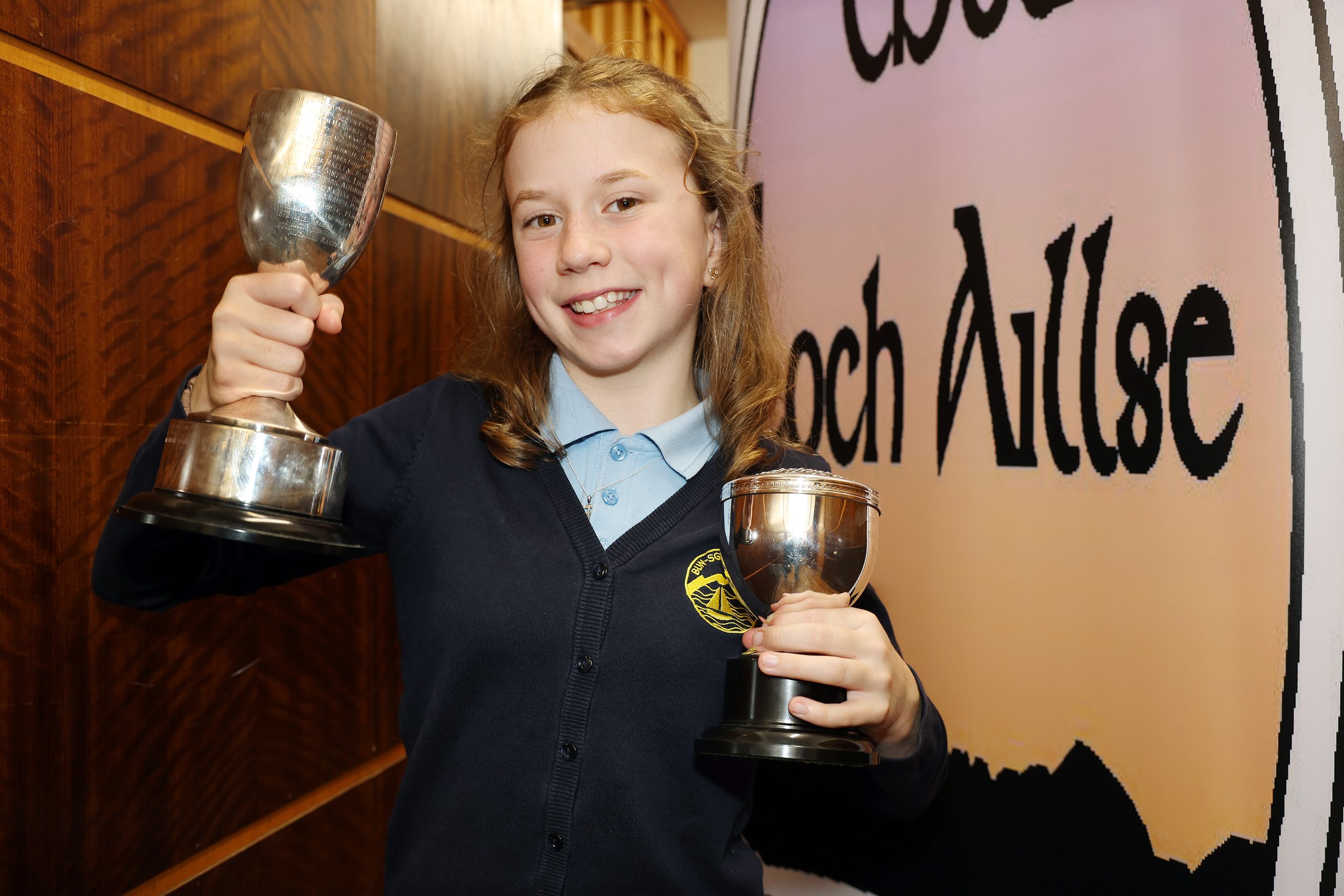
Mòd Loch Aillse – Trophy Winners 2026
Peggy Beaton Cup (fiddle): Findlay Graham, Àrd-sgoil a’ Phluic. Murdo MacLeod Plate (accordion): Lachlan MacLean and Alasdair Iain MacAoidh, Àrd-sgoil a’ Phluic. Kyle Community Cup (piano): Rohan Lu-Smith, Bun-sgoil a’ Phluic. SW Ross Cup (clàrsach): Rohan Lu-Smith, Bun-sgoil a’ Phluic. Sradagan Music Trophy (instrument & voice): Peigi MacKay and Charlotte Boswell, Àrd-sgoil a’ Phluic. Sradagan Cup (folk group): Peigi MacKay & Friends, Àrd-sgoil a’ Phluic. Màiri Matheson Cup (bàrdachd – S1-S6): Alasdair Iain MacAoidh, Àrd-sgoil a’ Phluic. John Stewart Memorial Trophy (solo singing S1-S6): Alasdair Iain MacAoidh, Àrd-sgoil a’ Phluic. Rosebowl (small group singing S1-S6): Rowan Ahern, Rebecca Cameron, Arianna Brown, Àrd-sgoil a’ Phluic. Iain MacMhuirichidh Cuach (song from Skye/Lochalsh S1-S6): Alasdair Iain MacAoidh, Àrd-sgoil a’ Phluic. South West Ross Trophy (òrain luaidh): Bun-sgoil a’ Chaoil. South West Ross Cup (learners action song/play): Bun-sgoil Ghleann Eilg. SW Ross McAlpine Cup (Gaelic medium action song/play): Bun-sgoil a’ Phluic. Shield (choir Gaelic medium): Bun-sgoil Loch Charrainn. Andrew Mackintosh Cup (choir learners): Bun-sgoil Chaol Acain. Donald MacPhail Cup (small group singing learners): Charlie-Belle Gillies and Grace Clarke, Bun-sgoil Loch Dhubhthaich. Mòd Loch Aillse Cup (small group singing Gaelic medium): Alice Mackenzie, Edie, Kirsty MacLeod, Bun-sgoil a’ Phluic. Mòd a’ Chaoil Cup (solo singing Skye/Lochalsh song): Màili NicIllinnein, Bun-sgoil Shlèite. Alasdair Mackenzie Trophy (solo singing learners): Ella Blackmore, Bun-sgoil Loch Charrainn. Glasgow/Wester Ross Association Cup (solo singing Gaelic medium): Màili NicIllinnein, Bun-sgoil Shlèite. Còisir Ghàidhlig an t-Srath Trophy (bàrdachd P1-7 Gaelic medium): Màili NicIllinnein, Bun-sgoil Shlèite. Torridon and Kinlochewe Community Council Shield (bàrdachd learners): Mia Currie, Bun-sgoil Chaol Acain.