Al igual que Delta Synergie SA en Gabón propiedad de la familia Bongo, el Grupo ABAYAK SA constituye un elemento relevante para comprender la estructura empresarial propiedad de la familia gobernante de Guinea Ecuatorial. La entidad mantiene participaciones y presencia empresarial en numerosos sectores estratégicos de la economía del país, tanto en actividades de carácter privado como en aquellas estrechamente vinculadas a sectores de interés público. Su ámbito de actividad abarca áreas tan diversas como el petróleo, construcción, la explotación forestal y la madera, los puertos, la sanidad, bienes inmuebles, la agricultura, el comercio, Bancos y el transporte aéreo, ect.
Bajo la dirección de Pastor Hassan Obiang Mangue, y en colaboración con la familia paraguaya Romero-Buchanan, ABAYAK S.A. participa en más de una cuarentena de empresas consideradas relevantes para la economía de Guinea Ecuatorial. Esta diversificación convierte a ABAYAK en una estructura empresarial cuyo análisis permite observar no solo la distribución de sus participaciones, sino también las conexiones existentes entre distintas actividades económicas estratégicas del país.
El estudio de sus filiales que está realizando Diario Rombe permite, por tanto, reconstruir la dimensión y el alcance de esta estructura empresarial tanto en Guinea Ecuatorial así como en el extranjero: identificar las sociedades en las que ABAYAK posee participaciones, determinar la naturaleza de dichas participaciones y analizar los sectores en los que concentra su actividad.
Y es precisamente en esta extensa red empresarial donde aparece Mangobi S.L., oficialmente denominada “Mangue Obiang”, una de las subsidiarias de ABAYAK que merece especial atención. Constituida el 6 de junio de 2015, con CIF 00195 M-15 y un capital social de 5.000.000 de francos CFA, la sociedad figura registrada en el denominado Edificio Abayak, inmueble cuya construcción fue ejecutada por Seguibat S.A., otra sociedad vinculada al grupo de la que Diario Rombe ampliará en los próximos días.
Mangobi habría recibido más de 20.264 millones de FCFA por el mantenimiento de inmuebles públicos desde 2015
El pasado 15 de julio de este año, Diario Rombe publicó documentos de la Tesorería General que muestran cómo Mangobi S.L. recibe alrededor de 149 millones de francos CFA al mes por servicios de mantenimiento de distintos inmuebles públicos, entre ellos las 52 Villas Oficiales de Oyala, la Biblioteca y Museo Obiang Nguema Mbasogo de Mongomo, las 10 villas de Sipopo y sus anexos, la Basílica de Mongomo y varios edificios vinculados a la Presidencia. La falta de identificación concreta de los “varios edificios vinculados a la Presidencia” y de los servicios facturados dificulta verificar el destino exacto de los pagos y abre la posibilidad de sobrefacturación o de cobros por conceptos inexistentes.
Según los registros analizados, estos pagos se habrían mantenido de forma recurrente desde la constitución de Mangobi, en junio de 2015, hasta septiembre de 2026. Esto equivale a unos 1.788 millones de francos CFA anuales y, tomando ese periodo completo, a aproximadamente 20.264 millones de francos CFA abonados por la Tesorería. Ahora, nuevos documentos permiten profundizar en la actividad de la sociedad y, especialmente, aproximarnos a una cuestión hasta ahora poco explorada: los ingresos generados por Mangobi y el papel que desempeña dentro de la estructura empresarial de ABAYAK.
Más de 12.234 millones de FCFA en nóminas de la Presidencia canalizados a través de Mangobi desde 2015
Según los nuevos registros contables de la Tesorería General del Estado entregados a Diario Rombe, Mangobi SL (Mangue Obiang SL) también habría actuado como empresa contratista del personal de la Presidencia del Gobierno de Guinea Ecuatorial. Desde su constitución, en junio de 2015, Mangobi SL aparece vinculada a la contratación del personal médico de la Presidencia del Gobierno. Es decir, en lugar de que determinados trabajadores fueran contratados directamente por el Estado, los pagos de la Tesorería se canalizaban a través de Mangobi SL, una sociedad vinculada a la familia Obiang.
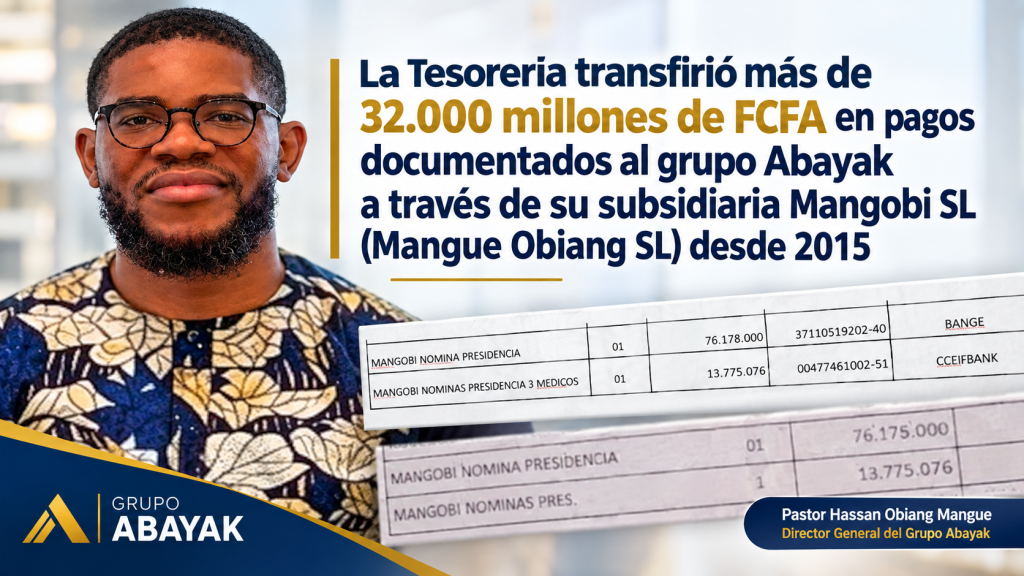
En los conceptos de los registros de la Tesorería aparece en distintas ocasiones la referencia «Mangobi nómina presidencia», sin que en dichos apuntes se especifique el número de empleados a los que corresponde el pago, sus categorías profesionales, salarios individuales u otros detalles. Por este concepto, los registros muestran pagos mensuales de 76.178.000 FCFA a Mangobi SL, mediante transferencias a una cuenta abierta en BANGE cuya terminación es -40.
El importe representa 914.136.000 FCFA al año. Entre junio de 2015 y septiembre de 2026, es decir, durante 136 meses, los pagos ascienden a 10.360.208.000 FCFA, equivalentes a más de 10.360 millones de francos CFA. Pero esta no es la única nómina que la Tesorería abona a Mangobi. Los documentos revelan que, además, aparece de forma recurrente el concepto «Mangobi nómina presidencia 3 médicos», asociado a pagos mensuales de 13.775.076 FCFA transferidos a otra cuenta de Mangobi abierta en CCEIBank, cuya terminación es -51.
Este segundo pago representa 165.300.912 FCFA al año. Si se contabiliza igualmente desde junio de 2015 hasta septiembre de 2026, los 136 pagos mensuales alcanzan un total de 1.873.810.336 FCFA, es decir, más de 1.873 millones de francos CFA. En conjunto, las dos líneas de pagos representan 1.079.436.912 FCFA al año.
Y si ambas cantidades se hubieran abonado mensualmente durante los 136 meses comprendidos entre junio de 2015 y septiembre de 2026 tal como aparecen en los archivos, el dinero transferido por la Tesorería a Mangobi bajo estos dos conceptos ascendería a 12.234.018.336 FCFA, más de 12.234 millones de francos CFA.
La cifra permite dimensionar la magnitud de esta relación financiera entre Mangobi y el Estado. Durante más de once años, una subsidiaria de Abayak SA habría canalizado más de 12.234 millones de FCFA procedentes de la Tesorería General del Estado únicamente bajo estos dos conceptos de nómina de la Presidencia del Gobierno.
Más de 32.000 millones de FCFA en pagos documentados desde su constitución
Los documentos analizados por Diario Rombe permiten establecer, por primera vez, una magnitud aproximada de los fondos que Mangobi S.L. habría recibido de la Tesorería General del Estado desde su constitución, en junio de 2015. Solo tomando en consideración tres conceptos concretos identificados en los registros de la Tesorería —los servicios de mantenimiento de inmuebles públicos, la «Mangobi nómina presidencia» y la «Mangobi nómina presidencia 3 médicos»—, los pagos acumulados entre junio de 2015 y septiembre de 2026 ascienden a aproximadamente 32.498 millones de francos CFA.
De esta cantidad, alrededor de 20.264 millones de FCFA corresponden a los servicios de mantenimiento de distintos inmuebles públicos; otros 10.360 millones de FCFA corresponden al concepto «Mangobi nómina presidencia»; y aproximadamente 1.874 millones de FCFA al concepto «Mangobi nómina presidencia 3 médicos».
En total, 32.498.018.336 francos CFA. Una cifra que equivale a más de 32.000 millones de francos CFA abonados por la Tesorería General del Estado a Mangobi durante los 136 meses comprendidos entre junio de 2015 y septiembre de 2026.
Sin embargo, esta cantidad debe entenderse como un mínimo documentado y no como el volumen total de ingresos percibidos por Mangobi. El cálculo se limita exclusivamente a los conceptos que Diario Rombe ha podido identificar y cuantificar en los documentos analizados. No incluye otros pagos que la sociedad pudiera haber recibido de la Tesorería bajo conceptos diferentes y que todavía no hayan sido identificados en esta investigación.
Por tanto, los 32.498 millones de FCFA constituyen únicamente el importe documentado hasta ahora. La cifra real de fondos públicos recibidos por Mangobi desde su constitución podría ser superior si aparecen nuevos registros, contratos o conceptos de pago vinculados a la sociedad.