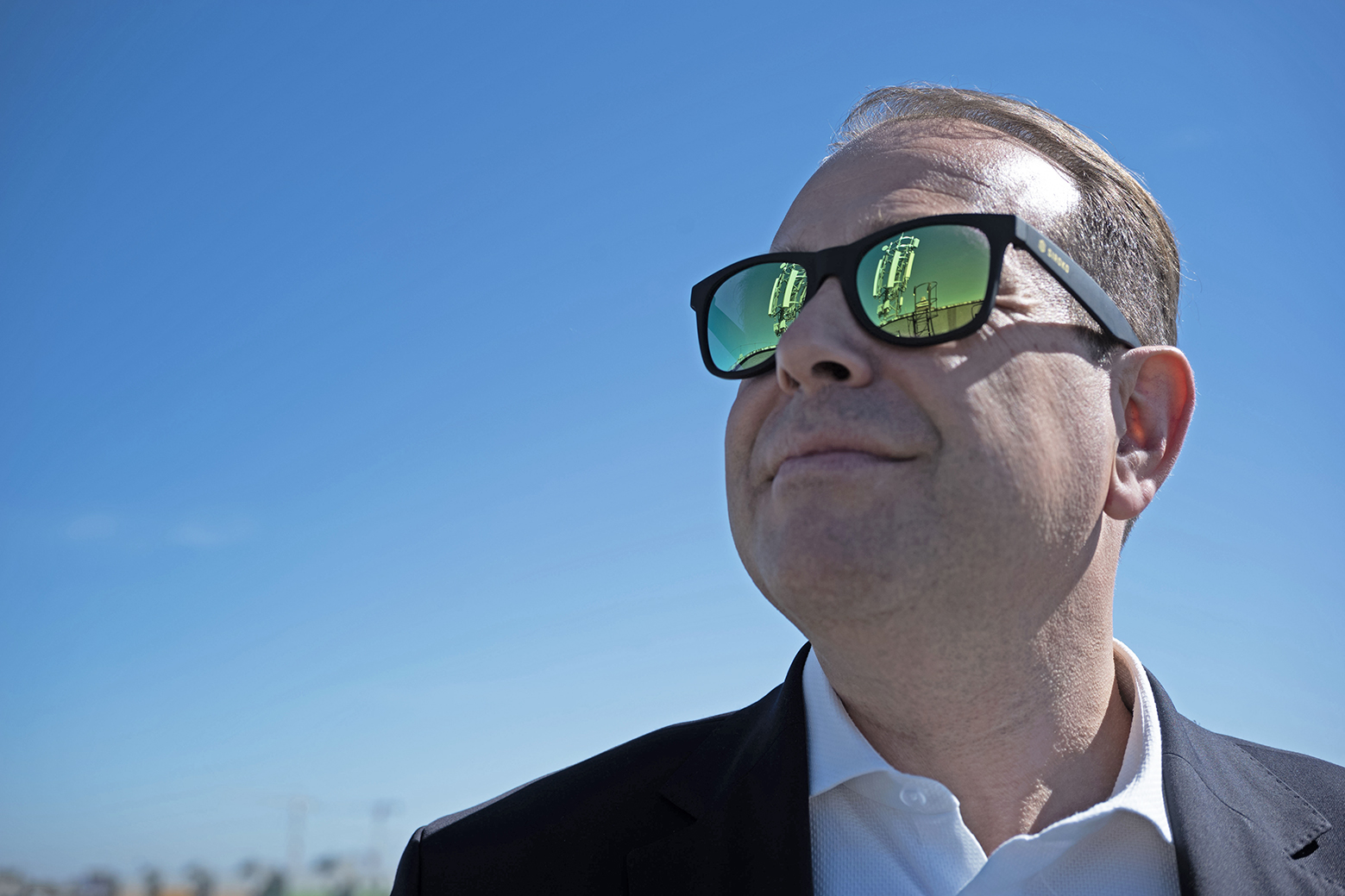
As data demand surges and the boundaries of 5G expand, the physical infrastructure supporting our digital lives has never been more critical.
Gergő J. Budai, CEO of Vantage Towers Hungary, discusses why tower infrastructure is now much more than about providing network coverage, how AI helps in going green, and what you can learn from chameleons.
The availability of mobile networks is now sometimes taken for granted; however, it takes immense effort to provide robust connections for all. That’s where Vantage Towers, a leading mobile communications infrastructure company, comes into the picture.
“Our job is to ensure that technology is available for all,” Budai tells the Budapest Business Journal in an exclusive interview. Easier said than done. Unsatiable hunger for data, sometimes semi-jokingly referred to as the “Datageddon threat,” calls for better coverage and more seamless networks in an era of geopolitical conflicts, climate change and fierce competition. Under such circumstances, network security is key.
“The recent large-scale power outages in Portugal and Spain taught us a lesson or two. Smart site concepts are, therefore, now super important: predictive AI, early-detection systems, and real-time monitoring help predict whether something is about to go sideways. Alerts can also go off if someone is loitering near or attempting to break into a base station,” Budai explains.
AI is playing a critical role in breaking the energy consumption spiral. By using modern active antennas and AI-based optimization, operators can now power down specific sectors or entire stations during off-peak hours, such as late at night, when there are no users in a given area, drastically reducing energy waste.
Sustainability: Business Necessity
Furthermore, sustainability has shifted from a reputational goal to a hard business necessity driven by the need for network stability. By installing solar panels and battery parks, Vantage Towers can operate in “island mode” during grid outages. For ultimate backup, the company can deploy diesel generators and/or the innovative green “Phinergy” system, which generates electricity through the reverse electrolysis of aluminum plates. “Climate change forces us to keep developing,” the CEO says.
Although Hungary is well-known as one of Europe’s frontrunners in mobile bandwidth terms, the exponential growth in data usage requires continued base station development and deployment. Once broad coverage is achieved, so-called small-cell networks are the next requirement in urban smart environments with connected cars and a plethora of IoT devices. Even economic giants like Germany have vast territories that still lack robust networks, keeping companies like Vantage Towers busy.
Beyond telecommunications, base stations and cell towers serve as stable points for defense and logistics, as they host various sensors and help prevent “spoofing” (the manipulation of digital map coordinates). They can even serve as charging hubs for drones.
Budai predicts that base stations could soon also serve as local energy hubs. Many stations are located near residential areas where households have their own solar panels but lack storage. By installing battery parks at these as base stations, which will evolve into mini data centers via edge computing, Vantage Towers could store local excess energy, reducing the massive energy loss currently seen in grid transfers.
Low-latency Champion
Addressing the rise of satellite providers like Starlink, Budai remains unconcerned, viewing them as complementary. While satellites are relevant in remote areas where traditional networks struggle (think jungle or desert environments), terrestrial mobile networks are more energy- and cost-effective and remain essential for the low-latency needs of smart cities. Telecommunications towers will therefore continue to serve as the backbone of modern mobile networks in the future.
The indoor market is also exploding, and Vantage Towers claims a slice of that cake. Because modern building materials often block external signals, the firm’s edge as a service provider-agnostic stakeholder lies in providing DAS (distributed antenna systems) for residential buildings, offices, garages, conference centers and stadiums.
When asked what the future holds, Budai is hopeful that technology will be used for noble purposes: goals that improve our lives.
“And as far as I am personally concerned, well, I’m sure my muse will whisper into my ear what comes next. But that’s the beauty of this world, it’s changing super-fast, and we need to get ahead of the curve and the changes.”
The Chameleon Vision
An attorney by training, Budai left legal to venture into pharma, becoming the youngest board member of Pfizer Hungary. He then switched to telco and gained a reputation for crisis management when he joined what was then Invitel. Building on that solid experience, he helped put Vodafone on the fast track by introducing 5G first in Hungary and providing a whole new level of customer experience like the Red Assistants.
Budai is known for being a fan of disruptive thinking, and embracing startup culture values has helped him tremendously to take Vantage Towers to its current level of significance. The whole operation was launched with a headcount of just six. What was once referred to as a small Vodafone subsidiary has become a giant in its own right, with a market valuation close to that of its mother company.
“Our startup approach enabled us to fine-tune our ability to build and provide services and make them ever more efficient so that we went from building 15-20 to 150-180 base stations per year,” Budai notes. Vantage Tower’s reputation precedes itself: the Hungarian team’s innovative approach are sought after abroad, from Portugal to Germany.
“I believe in the efficiency of the chameleon vision, where you keep one eye on the road in front of you, while you look to the future for new opportunities with the other one” the CEO summarizes his strategic way of thinking.
This article was first published in the Budapest Business Journal print issue of May 8, 2026.