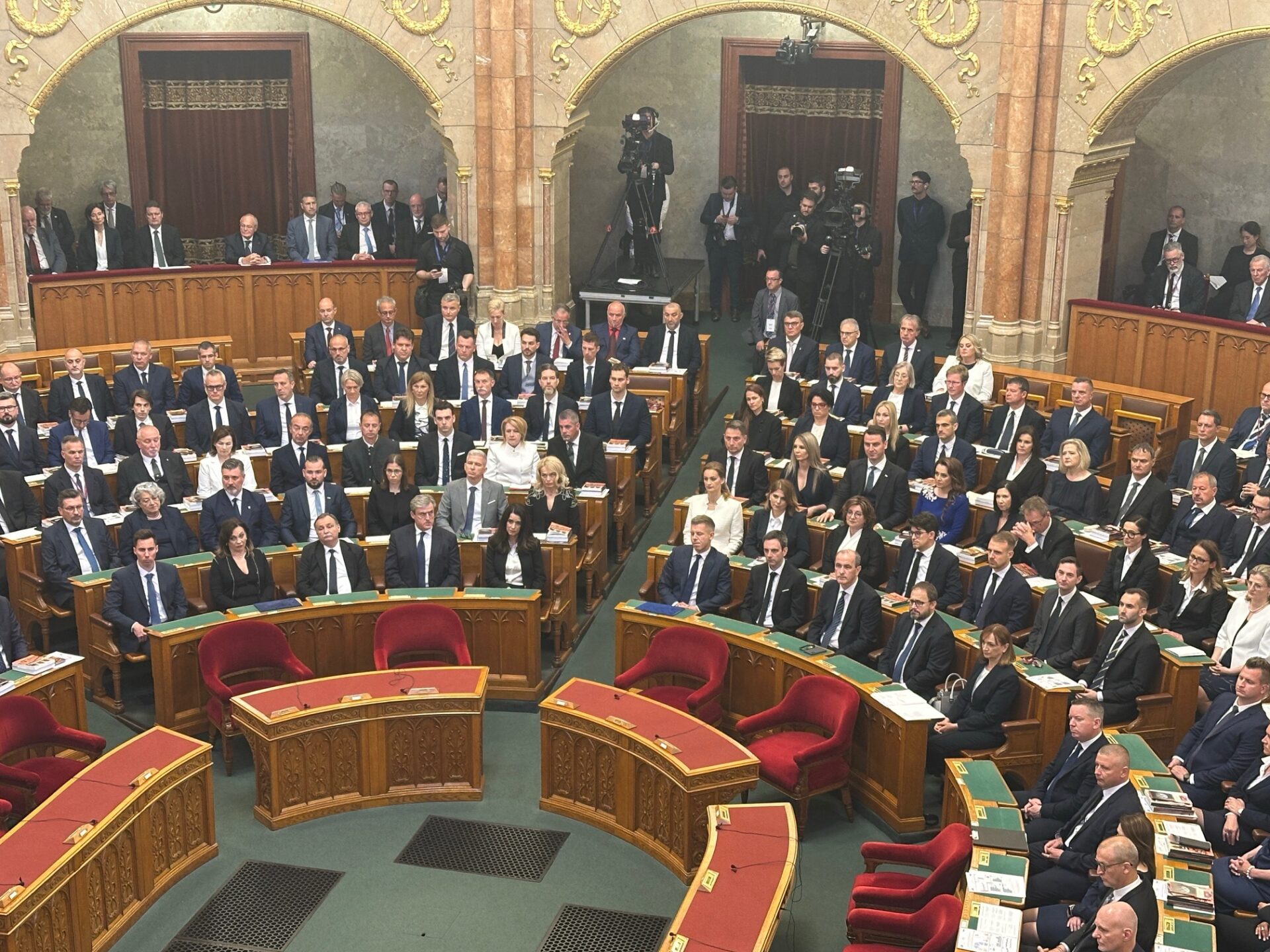
Péter Magyar has become the eighth Prime Minister of Hungary since the change of regime in 1989, if you include Miklós Németh (1989–1990), the last communist-era PM, who oversaw the transition to democracy. The leader of the Tisza Party was elected overwhelmingly with 140 “ayes,” 54 “nays,” and one abstention.
With Magyar in place, it was also agreed that the new parliament will have 20 committees, four more than in the previous term. Tisza will head 14; Fidesz, four; the KDNP (Christian Democrats) and the Our Homeland Movement, one each. The house committees proposal was adopted unanimously with 196 votes in favor.
As President Tamás Sulyok noted in his address to parliament, this is the 10th National Assembly since the change of system and the first in four parliamentary cycles to result in a change of government.
Acknowledging that Hungary’s voters had given the Tisza Party an unprecedented victory with unmatched voter participation, he reminded MPs that they represented a nation “that has always preserved its identity, legal framework and culture over the centuries, and has always been capable of renewal, even in the face of difficulties.”
He went on to tell members of parliament to put the bitterness of the election campaign behind them. “The focus must once again be solely on improving the country’s fate. There is much to repair in human relations,” state news agency MTI quoted him as saying. “How we treat, speak to, and look at one another ultimately reflects how we view our homeland. Hungary can only be built if we build it together, not against one another.”
Responsible for All
He told the newly elected MPs that they did not just represent and owe loyalty to their own parliamentary faction. “Those who agree with you, and those who do not; those who are strong, and those who need protection. You have become responsible for every citizen of the country, regardless of worldview, place of residence, or life situation,” MTI quoted him as saying. That included the national minorities, he added, who are “inseparable from our country,” and without whom national unity could not be achieved.
Sulyok’s position as president is something of an open question, given that he was seen as a Fidesz ally and was appointed under the Orbán-contolled parliament in 2024. Magyar has previously called on him to resign. In his speech, the president seemed to draw on his own background as a legal scholar, lecturer, researcher, senior legal advisor and constitutional expert, before becoming President of the Constitutional Court in 2016.
“The fundamental principle of lawyers and legislators is that it is not man who exists for the law, but the law that exists for man. This is what makes the law capable of holding a country together, and upon this is based the legal regulatory framework that stands above power,” he said.
“Legal certainty is a value that we must preserve under all circumstances. Undermining the rule of law would have unforeseeable consequences for people’s lives and their trust in the law,” he added. Sulyok said the best place to resolve issues is in parliament; mutual respect is the most effective approach, and the clear language of legal norms is the most effective tool.
History Will Judge
He told the new MPs they are now “counted among the nation-builders of the millennium,” that everyone who has the honor of representing the nation also bore a historic role, and history would judge their actions. Respect for the law was not up for debate in Hungary, he told them.
“Power can only be understood within the framework of the rule of law, and any political action can be called democratic only as long as it operates within the constitutional order of the rule of law,” he said.
Earlier, in front of Parliament, Magyar, Forsthoffer, and parliamentary group leader Andrea Bujdoso (an ethnic Hungarian born in Romania), laid wreaths at the statues of 19th-century Prime Minister Gyula Andrassy and 20th-century poet Jozsef Attila. Speaking then, Magyar said today marks “the first official day of the change of regime,” state news agency MTI reported.
In a livestream before he entered the parliamentary building, Magyar said the new parliament will pass some laws and elect its new deputy speakers at its inaugural session, before celebrations would begin at Kossuth tér at 4 p.m. Magyar said they would last until midnight, followed by “an after-party” on the Danube embankment until 1:30 a.m.
In color reporting from outside the imposing parliamentary building, MTI said Magyar had greeted supporters at the barricades and posed for photos. By 10 a.m., a sizeable crowd had gathered, and a large banner reading “Regime Change: 37 Years in the Making” (a reference to the transition from a communist state to a free-market democracy in 1989) had become a popular photo spot.