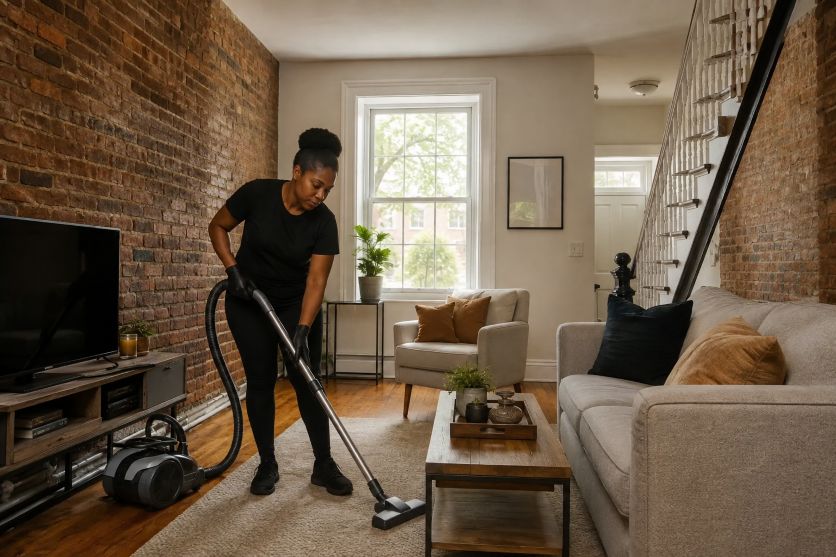

Baltimore’s housing landscape is unusually well suited to a strong market for residential services. More than half of the city’s housing stock consists of attached single-family rowhouses, a building type closely associated with Baltimore’s older neighborhoods, as documented in an analysis published by the Baltimore City Commission for Historical and Architectural Preservation. The city’s zoning code also recognizes continuous rowhouse development as a defining feature of many inner neighborhoods.
That housing pattern helps explain why local providers offering house cleaning services Baltimore MD have become relevant to homeowners, renters, landlords, and property managers looking for routine or occasional help. Baltimore had about 297,600 housing units in 2024, based on estimates from the U.S. Census Bureau, creating a sizable residential market for businesses handling cleaning, maintenance, repairs, and other household tasks.
Why Baltimore’s Housing Stock Creates Steady Demand
Rowhouses present a different cleaning environment from many detached suburban homes. They commonly extend across multiple levels, with stairs connecting living areas, bedrooms, kitchens, and sometimes finished basements. Older properties can also contain architectural details and layouts that require more time to clean thoroughly.
The importance of attached housing is not limited to a few blocks. Research from the U.S. Census Bureau previously found that townhouses and rowhouses represented 28.8 percent of the wider Baltimore-Towson metropolitan housing inventory, placing the region among major U.S. metropolitan areas with particularly high concentrations of attached homes.
Age matters as well. Baltimore contains large numbers of historic and older properties, so cleaning can overlap with renovation, turnover, and property maintenance. A 2026 Baltimore cost analysis from Angi, for example, notes that the city’s historic housing stock contributes to renovation-related cleanup demand.
What Does Professional Cleaning Cost in Baltimore?
Price is one reason residential cleaning receives attention from consumer-focused publications. It is a recurring household expense for some customers, while for others it is a less frequent service associated with moving, renovation, preparing a property for sale, or tackling accumulated dirt.
Local estimates published by Angi put the average Baltimore house-cleaning visit at about $182, with many jobs falling between $124 and $242. Hourly rates are estimated at roughly $60 to $75, although the final bill depends on the property, number of cleaners, and work involved.
Home size changes the calculation considerably. The same Baltimore pricing data estimates standard cleaning at approximately $0.10 to $0.20 per square foot. A 1,200-square-foot property might therefore cost around $120 to $240, while a 2,500-square-foot home could range from about $250 to $500.
These figures are useful as reference points rather than guaranteed prices. The HomeGuide national cost guide similarly identifies property size, number of bedrooms and bathrooms, frequency, and cleaning level as major pricing factors.
Service Variety Has Expanded Beyond Routine Cleaning
Residential cleaning is no longer represented by a single standard package. Consumers may encounter recurring weekly or biweekly appointments, one-time cleaning, deep cleaning, move-in and move-out work, apartment cleaning, and post-construction services.
Basic appointments generally concentrate on common household tasks such as vacuuming, sweeping, mopping, dusting, bathroom cleaning, kitchen surfaces, and waste removal. Research compiled by HomeGuide shows that additional jobs may include cleaning refrigerators, ovens, windows and cabinet interiors, along with laundry and other household tasks.
This variety makes comparing providers more complicated. A low quoted price may cover a different scope of work from a higher estimate. Consumers therefore benefit from checking what is included, whether supplies are provided, how additional tasks are priced, and whether the quote is based on time, square footage, or a flat fee.
Neighborhood Coverage Matters in a City of Rowhouses
Local coverage is another practical issue. Baltimore is made up of neighborhoods with different housing forms, densities, property values, and access conditions. Even within rowhouse areas, properties can differ substantially in size, renovation history, number of floors, and interior layout.
The Baltimore City Department of Planning and the city’s zoning framework recognize numerous residential districts, including areas specifically intended to preserve traditional rowhouse development. For service businesses, geography affects scheduling because providers need to account for travel time, parking, building access, and the number of appointments that can realistically be completed in one day.
For residents, this makes service-area information valuable. A company may advertise itself as Baltimore-based while serving only selected neighborhoods or extending into Baltimore County. Clear coverage information helps households determine whether a provider regularly works in their part of the city before requesting an estimate.
Why Local Service Journalism Is Paying Attention
Home-service coverage increasingly functions as practical consumer information, but it can also reveal how everyday businesses fit into broader housing systems. Readers want to know what common household jobs cost, what services typically include, and which factors can raise a final bill. Cleaning is especially suitable for this type of reporting because pricing varies widely enough that a single national average offers limited guidance.
Local data adds context. Baltimore’s attached housing, historic properties, neighborhood differences, and sizable residential inventory all influence how cleaning businesses operate and how consumers compare their options. Cost guides from organizations such as Angi and HomeGuide reflect this growing emphasis on location-specific pricing and service expectations.
A Local Industry Worth Watching
Baltimore’s cleaning sector illustrates a broader shift in how everyday home services are covered. What once might have been treated simply as a directory category can now generate useful reporting about prices, housing conditions, service availability, and consumer decision-making.
As households continue to balance time, property upkeep, moving, renovation, and recurring maintenance, demand for clear information about local providers is likely to remain relevant. Baltimore’s distinctive rowhouse landscape gives that story an especially local dimension, making residential cleaning part of a larger conversation about how people maintain and manage the city’s homes.