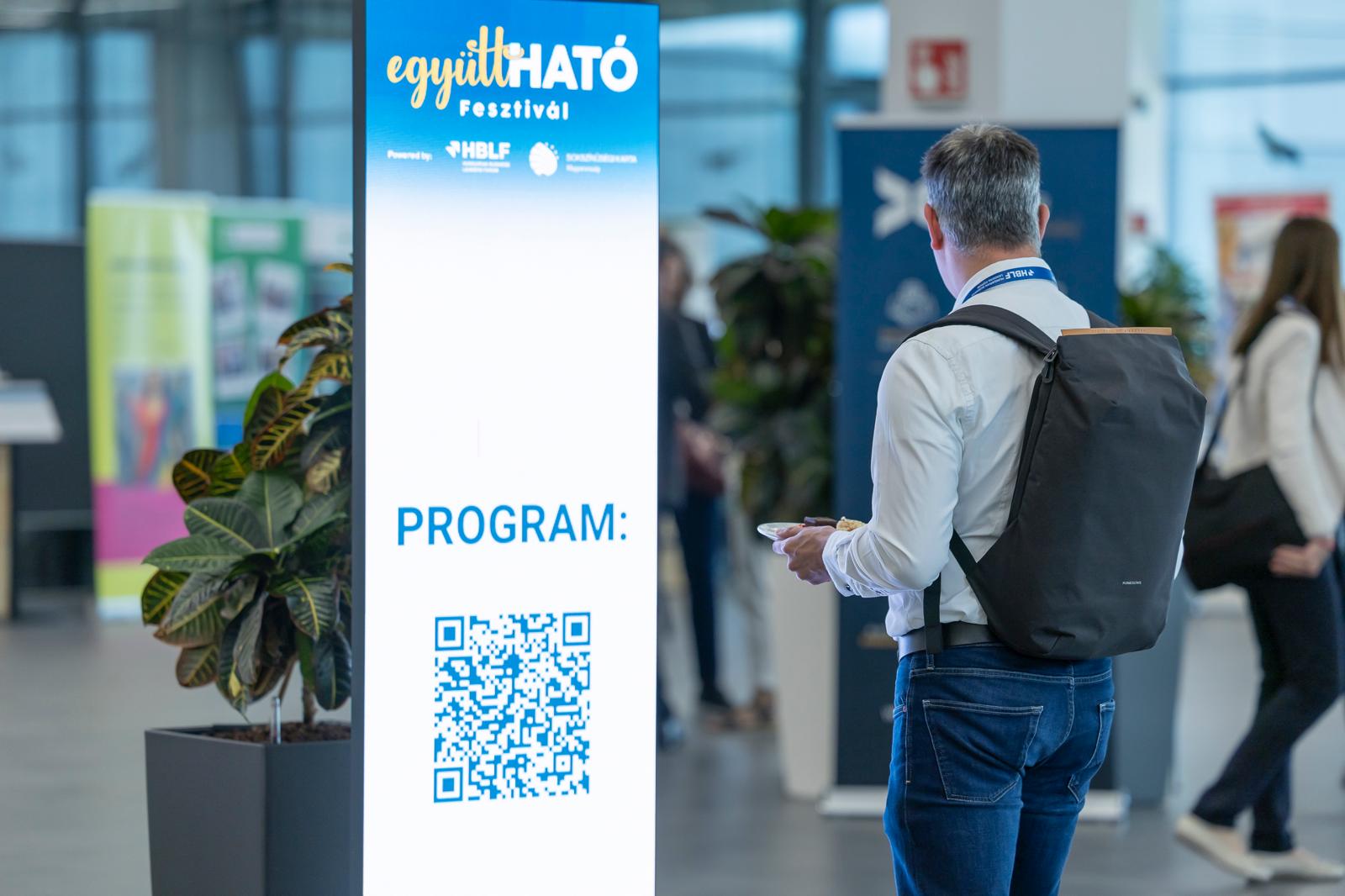
On May 21, 2026, the együttHATÓ (impactABLE) Festival will welcome visitors for the second time. This professional and socially driven event is organized as an initiative of the Hungarian Business Leaders Forum (HBLF).
The festival aims to bring together leading figures of the Hungarian business community to reflect on issues that affect us all, and to take collective action to ensure that the labor market serves not only economic goals, but also social and human value creation.
The event will take place at the Bosch Budapest Innovation Campus.
Ethical Working Conditions Are a Right for Everyone
The central idea behind this year’s festival is: “We are shaping the workplace of tomorrow together!”, with a main focus on ethical corporate governance. It will address topics such as the ethical use of AI, pay transparency, equal opportunities, and social mobility.
The initiative was launched by the HBLF in collaboration with more than forty organizations, including major corporations and civil society partners.
“Social mobility is not merely a social issue, but also an economic and community interest. With the HBLF Catalyst Award, we recognize companies and leaders who actively work to ensure that talent, diligence, and performance carry more weight than one’s starting point. We believe that a fairer labor market does not come about on its own: it is our shared responsibility to create an environment where there is a real opportunity for growth and advancement,” said Andrea Solti Istenesné, president of HBLF.
The event’s main patron is the Bosch Group in Hungary, and the festival will be hosted at one of the company’s largest development centers in Europe, the Bosch Budapest Innovation Campus.
“At the Bosch Group in Hungary, more than 50 nationalities work together on a wide range of technologies and innovations. We are building the workplace of tomorrow not only with modern tools and intelligent solutions, but also by fostering an inclusive community where ethical operations and equal opportunities are core values.
We believe that technological progress and social responsibility go hand in hand. The choice of venue is no coincidence: the Bosch Budapest Innovation Campus symbolizes exactly the kind of collaboration and openness that are essential for a fairer and more successful labor market,” emphasized András Somogyi, vice president for Human Resources of the Bosch Group in the North, Central and Eastern European region.
International Guests Have Also Joined the Initiative.
Key participants of the festival include Vilmos Benkő, founder of the Hungarian Toastmasters Club, and Luca Ekler, Paralympian. The organizers consider it essential that dialogue extends beyond top executives and business leaders, as otherwise the original purpose would be lost.
That is why roundtable discussions will also feature people directly affected, and among the participants there will be many young entrants to the workforce as well as volunteers. The goal is to ensure that conversations about exclusion and discrimination, whether affecting people with disabilities, older individuals, or Roma communities, are shaped by those who have personally experienced what it means to be different.
The festival aims to bring together an authentic community that stands out both professionally and in advancing equal opportunities, whose members can truly say that equality, social responsibility, and ethical conduct are reflected not only in corporate communication, but also in real actions.
Ethics No Longer Just a Social Issue
When we hear the term ethical workplace, we often associate it with an environment shaped by a corporate culture that actively works, on a systemic level, against exclusion and stigma. However, the 21st century has introduced many new perspectives on what ethics really means.
How can we use AI in a way that causes no harm? What is the best way to implement pay transparency without increasing tensions within an organization? How can workplaces bridge systemic inequalities that, in recent years, have not decreased but in many cases have grown?
Visitors to the Bosch Budapest Innovation Campus on May 21 can expect to explore these and similarly thought-provoking, taboo-breaking questions.