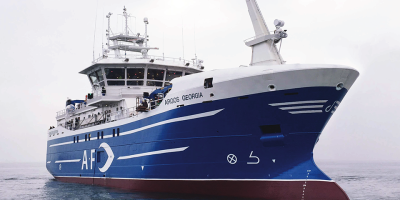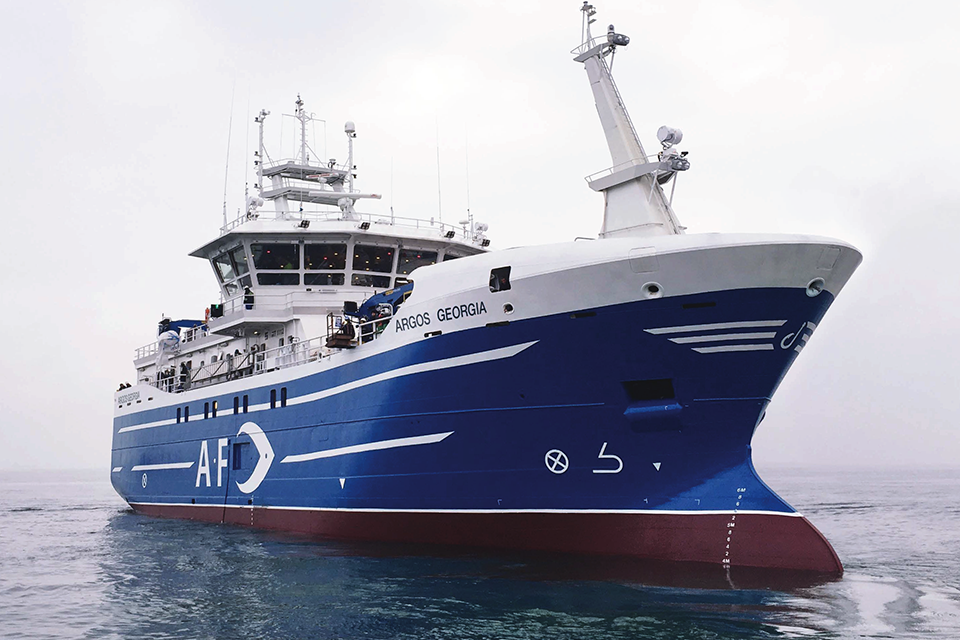

THE “uncommanded” opening of an exterior hatch on the Argos Georgia in July 2024, led to an “uncontrolled ingress of water” and the foundering of the vessel, a report into the incident has concluded. 13 crew members tragically lost their lives.
The Marine Accident Investigation Branch (MAIB) has published its findings from their investigation some 26 months after the vessel capsized and sank around 190nm east of the Falkland Islands.
The report draws a number of conclusions, firstly that the “previously closed” line hauling hatch on the starboard side of the ship “opened uncommanded and unexpectedly at the time of the accident” which caused the flooding onboard. Floodwater progressed through the vessel via open doors.
The vessel listed to starboard before it lost propulsion and the crew abandoned ship. It sank later that evening.
The report described the deteriorating situation onboard the Argos Georgia in detail, as well as the actions the crew took. A delay in raising a formal distress alert was mentioned, as well as a delayed decision to abandon the ship.
The search and rescue response was mentioned as “prompt and collaborative” after the severity of the incident had become known.
The report also referenced the extreme weather and sea conditions which “hampered” the abandonment of the vessel.
“Shoreside management deficiencies” were also noted as a safety issue with a conclusion drawn that, “the company lacked effective systems for controlling safety-critical risks and for assessing, escalating and responding to flooding, abandonment and distress emergencies in severe weather and remote waters.”
However it was also noted in the report that since the incident Argos Froyanes Limited, the owner of the vessel, have made changes to vessels in their fleet in terms of safety and design as well as revising and amending risk assessments, safety compliance manuals, and pre-departure checklists.
A number of recommendations have been made for various stakeholders, including to the Maritime and Coastguard Agency, Argos Froyanes Limited, and the Falkland Islands Government (FIG).
Penguin News (PN) contacted Argos Froyanes Limited for their response to the report, however the company declined to comment.
FIMA response
The recommendation for FIG relates to improvements to maritime search and rescue communications capability “so that direct and reliable contact can be established with vessels in distress.”
Speaking to Head of Maritime Chris Moorey, and Harbour Master Steuart Barlow, PN asked whether the Falkland Islands Maritime Authority (FIMA) accepted the findings in the report.
Mr Moorey said, “it’s a massively comprehensive report, and certainly the recommendation as it applies to us in terms of communications we welcome.
“We will be feeding back to the MAIB on our intentions.”
Mr Barlow outlined to PN that a three phase plan was in progress to update communications systems, which will give varying degrees of range with VHF working up to around 40 to 60 miles off the coast, and medium and high frequency working around 200 miles off the coast.
These planned changes would bring communications in line with higher levels of international emergency communications networks. Currently the Falklands is compliant at a lower level. The first phase, to install the new equipment, should be implemented by the end of the year Mr Moorey said, with timescales on the following phases being dependant on testing and training.
However Mr Barlow added that having this updated system would not have made a difference during the Argos Georgia incident, “because the lines of communication were already there.”
They described how during the response to the incident, while they did not have direct communications with the ship, they did have direct communication with companies and translators, “there was not a lack of information and there certainly was not a delay in information” Mr Barlow said, adding that as they had some early warning of what was happening at sea, they had begun to set procedures in motion.
Speaking of the search and rescue response Mr Moorey mentioned the different organisations involved, “this was actually truly a whole community response… but it was also international. Our nearest maritime response rescue coordination centre is Ushuaia and we communicated with them, but because there were a number of nationalities on board we also communicated with MRCCs around the world.
“Our key node for international search and rescue is JRCC Fareham in the UK, and we got in touch with them within five minutes of being notified of this evolving situation and they were hugely helpful in supporting us in communications, but also in the generation of search plans.” UK and US Coastguard agencies were involved in the response, as well as search and rescue aircraft assets from BFSAI, the FPV Lilibet, and other fishing vessels in the area.
Mr Moorey also explained that, while it would not have made a difference to the Argos Georgia incident due to the circumstances, FIMA have since translated guidance about helicopter transfer operations into other languages, “just to make the business of conducting helicopter transfers easier.”
FIMA also continue to have a role in checking safety standards on vessels with port state inspections carried out regularly, to ensure that current international standards are met.