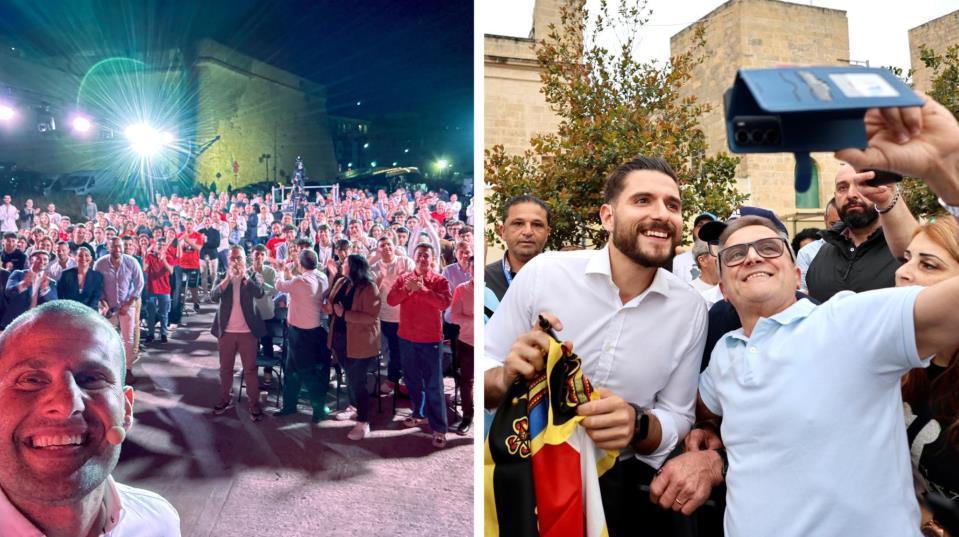
As Malta’s election campaign moved beyond its halfway point, the past seven days offered the clearest picture yet of the competing visions being presented by Prime Minister Robert Abela and Opposition leader Alex Borg. What began as a contest dominated largely by economic pledges and headline announcements evolved into a broader debate about national identity, quality of life, affordability, migration, public services and political credibility.
The week revealed not only two distinct policy approaches, but also two entirely different readings of Malta’s current condition. Labour consistently portrayed the country as a success story requiring stability, refinement and continued investment. The Nationalist Party, meanwhile, increasingly argued that Malta’s economic growth has created serious social pressures that now demand correction, restraint and a new direction.
The contrast in tone was visible from the start. Labour’s campaign continued to revolve around continuity and State intervention. Abela repeatedly described his government as a safe and experienced administrator capable of redistributing the benefits of economic growth through pensions, subsidies, family measures and healthcare expansion. Almost every Labour announcement followed the same underlying logic: Malta’s economy has performed strongly, and government therefore has the financial capacity to improve citizens’ lives through targeted support. The presentation of the election manifesto in Friday, in which Labour promised a referendum on euthanasia, encompassed a long list of ideas Labour wants to implement in the next five years. Some of them, admittedly, have been made in the past but have not been fulfilled.
The PN’s campaign evolved along a very different trajectory. Borg attempted to build a wider emotional argument around political fatigue after more than a decade of Labour government. His language consistently focused on “renewal”, “fresh breath” and the need to restore balance to a country he described as increasingly strained by overdevelopment, rising costs and rapid population growth.
Throughout the week, both parties repeatedly converged on the same broad themes while offering sharply different solutions. Healthcare, pensions, family wellbeing, housing and quality of life became central campaign battlegrounds. Yet even where overlap existed, the political philosophies diverged substantially.
One of the clearest examples was the parties’ approach to families and social welfare. Labour’s strategy relied heavily on direct intervention through grants, allowances and expanded entitlements. Abela announced or reiterated a long list of measures: extended parental leave, disability support, IVF reforms, pension increases, healthcare expansion, bonuses for older workers, assistance for carers and support schemes for first-time buyers. The campaign increasingly resembled an expansive welfare platform aimed at reassuring voters that government would remain actively involved in easing financial and social pressures.
The PN, while also promising generous measures, outlined family support differently. Borg consistently emphasised disposable income and affordability rather than broad State management. Tax reductions, mortgage-interest support, pension guarantees and incentives for younger workers were presented not as extensions of government dependency, but as ways of giving people greater financial breathing space.
This philosophical divide became particularly visible in the debate surrounding younger generations. Labour focused on national projects, economic planning and social schemes tied to long-term development. The PN concentrated on frustrations experienced in daily life – difficulty purchasing property, rising utility costs, traffic congestion and a growing sense that economic growth is no longer translating into personal comfort.
Housing affordability emerged as one of the week’s most politically potent issues. Borg’s proposals for government support on mortgage interest payments and expanded deposit assistance targeted a growing cry that younger Maltese are being priced out of the property market. His argument went beyond housing alone; it formed part of a broader critique that Labour’s economic model has benefited macroeconomic indicators more than ordinary households.
Labour attempted to defend its economic record by presenting large-scale projects and infrastructure investments as evidence of national progress. The government’s agreement to return Manoel Island to public ownership became one of the defining moments of the week. Abela used the announcement not simply as an environmental pledge, but as proof that Labour could deliver ambitious projects balancing development with public wellbeing.
The Manoel Island agreement was politically significant because it allowed Labour to reposition itself on environmental and quality-of-life concerns – issues that have increasingly troubled voters after years of rapid construction and urban expansion. By linking Manoel Island with broader plans involving parks, afforestation and public spaces, Abela sought to soften Labour’s image and demonstrate sensitivity to concerns about overdevelopment.
Yet this also exposed one of Labour’s main vulnerabilities throughout the week: credibility over implementation. Many of the proposals announced during the manifesto launch on Friday and across the campaign were projects or reforms that had already been discussed in previous years without fully materialising. The PN repeatedly exploited this weakness, arguing that Labour’s manifesto contained recycled promises rather than genuinely new ideas.
The Opposition’s strategy increasingly centred on turning the election into a referendum on Labour’s record rather than purely a debate over future plans. Borg repeatedly reminded voters of stalled infrastructure projects, abandoned reforms and unfulfilled pledges. The underlying message was consistent: after 13 years in power, Labour should be judged less on what it promises and more on what it has failed to complete.
Labour countered this line of attack by questioning the PN’s financial credibility. Abela repeatedly accused the Opposition of engaging in “auction politics” by promising expensive measures without clear funding plans. References to European fiscal rules, deficit targets and responsible planning became central to Labour’s rhetoric. The Prime Minister attempted to project managerial competence and economic seriousness, contrasting Labour’s supposedly “costed” proposals with what he portrayed as opportunistic populism from the Opposition.
This battle over credibility became one of the campaign’s defining features. Labour argued that experience and economic stewardship made it the safer choice. The PN argued that long incumbency had produced complacency, waste and political exhaustion.
The week also revealed a widening divergence on national identity and migration. In what may prove one of the campaign’s most consequential strategic shifts, Borg placed population growth and infrastructure strain firmly at the centre of political discussion. His speeches increasingly focused on overcrowding, pressure on services, labour migration and the social consequences of rapid demographic change.
This marked an important departure from traditional Maltese political consensus, where economic growth had largely been treated as an unquestioned success. Borg instead argued that uncontrolled expansion has imposed serious costs on quality of life. The PN’s proposals for population planning, labour market regulation and migration reform reflected a campaign increasingly built around the idea that Malta requires limits and breathing space.
Labour maintained almost the opposite. Abela continued presenting growth as the foundation of Malta’s prosperity and social expansion. While acknowledging infrastructure pressures and quality-of-life concerns, Labour insisted these challenges could be managed through investment, planning and continued economic strength rather than structural restraint.
Labour sees Malta as a country that must continue evolving through investment, modernisation and gradual reform. The PN increasingly portrays Malta as a country that has grown too quickly and now risks losing balance, identity and sustainability.
Another notable feature of the week was the increasing emotional targeting of specific voter groups. Pensioners, families, disciplined corps members, first-time buyers, women and persons with disabilities all became central electoral constituencies. Both parties attempted to personalise their campaigns by addressing the anxieties of particular demographics.
Labour focused heavily on dignity through healthcare, welfare and inclusion. The PN focused more on fairness, recognition and affordability.
By the end of the week, the campaign had become far more ideologically defined than during its opening days. Labour’s message crystallised around continuity, State-backed support and long-term national projects. The PN’s campaign evolved into a broader critique of the social consequences of Labour’s economic model, centred on affordability, sustainability and the need for political renewal.
The election is therefore no longer simply a contest over who can deliver stronger economic growth. It has become a debate about what kind of country Malta is becoming, whether voters still trust Labour’s long stewardship of government, and whether the promise of stability outweighs the growing desire among some sections of the electorate for change and recalibration.