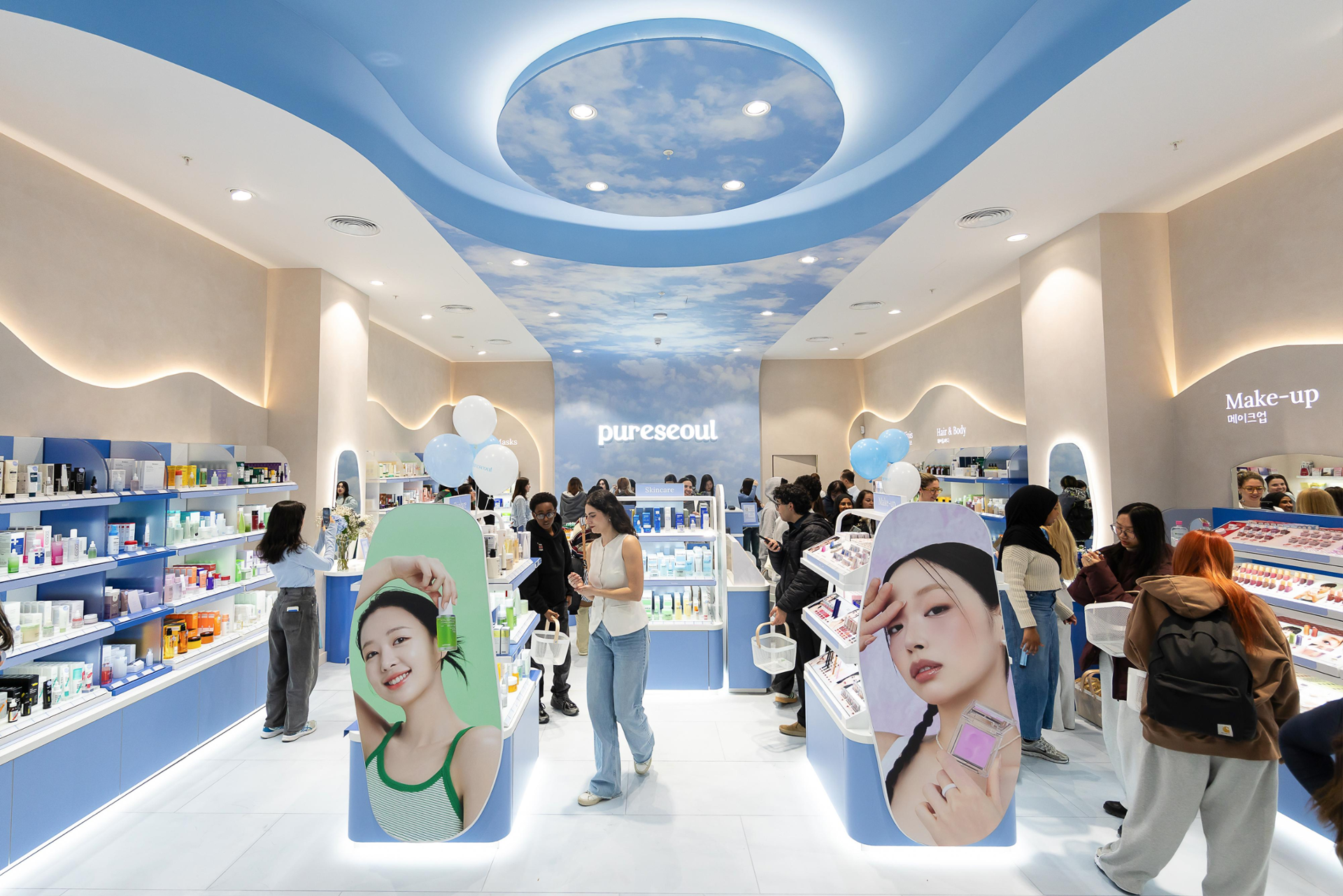
The interior of PURESEOUL, a Korean beauty retailer based in the U.K. that curates a selection of K-beauty skin care and cosmetic brands for global audiences / Courtesy of PURESEOUL
Sheet masks are old news in Korea. While they remain a staple on many K-beauty vanities, newer products and faster-moving trends have long begun to push them to the back of the shelves.
In the United Kingdom, however, they remain the trendiest, top-selling K-beauty product.
“It’s actually our bestselling product category,” Gracie Tullio, co-founder and creative director of PURESEOUL, one of Britain’s largest K-beauty specialist retailers, told The Korea Times in a video call, April 7. “Which is funny, because sheet masks are kind of not a thing anymore in Korea.”
That disconnect sits at the heart of K-beauty’s international expansion. Despite its growing global footprint, K-beauty does not travel as a finished product. It arrives delayed, reshaped and, in many cases, reinterpreted to suit local preferences.
PURESEOUL began in 2019 as an online platform with a straightforward premise — British consumers wanted Korean cosmetics but had no reliable way to get them.
Today, the company carries more than 2,000 products from over 70 Korean brands, including AMUSE, milktouch and LADOR, and operates more than a dozen physical stores across the U.K., with plans to nearly double its store count within the year.
“We’re the largest K-beauty specialist in the U.K. and one of the largest in Europe,” Tullio said. “We’re also the most visited K-beauty website in the U.K.”
But the company’s role extends beyond retail. By working directly with Korean brand headquarters rather than through intermediaries, PURESEOUL has positioned itself as something more like a market adviser, guiding brands on everything from regulatory compliance and labeling to product selection and marketing strategy.
“Every product you see on our shelves is a brand whose team we’re communicating with directly,” Tullio said. “Yes, we are a retailer, but we’re also kind of like advisers for brands as well.”
Gracie Tullio, co-founder of PURESEOUL, poses inside a London shop of the company. Tullio launched the brand to bring Korean beauty culture to international consumers. Courtesy of PURESEOUL
‘5 years behind’
Tullio’s path into K-beauty was personal before it was professional.
Years ago, she was dealing with severe acne and skin barrier damage, with limited dermatological options available locally. During her time in Japan, a friend pointed her toward a simple moisturizer from ETUDE, a Korean cosmetics brand.
Returning to the U.K., she found it nearly impossible to purchase the product. The online market was unreliable at best.
“There were so many sketchy websites,” Tullio said. “I definitely bought fake items.”
That experience eventually led her to co-found PURESEOUL with co-CEOs Leslie Tang and Wing-Sze Tang, the latter a makeup artist who had already been sourcing Korean beauty products through her international work.
From left, PURESEOUL co-founders Gracie Tullio, Leslie Tang and Wing-Sze Tang pose at a PURESEOUL store in London. The founders built the retailer around the growing global demand for K-beauty products. Courtesy of PURESEOUL
As the company expanded, so did its understanding of a structural gap between the Korean and British beauty markets. Tullio observed that Korea’s beauty industry runs on short cycles, with demand driven by novelty.
The international market, according to the PURESEOUL founder, has a fundamentally different pace.
“Korea moves so fast,” Tullio said. “It’s always about the next hot thing. The cycle is really short. In the U.K., brand relationships develop slowly, and consumer trust is built over years … Being new is a great marketing point in Korea, whereas in the U.K., being tried, tested and well-reviewed is the selling point.”
Tullio estimates the British market runs roughly five years behind Korea in trend adoption. Ingredients such as PDRN — a regenerative compound often derived from salmon DNA used in skin care and medical aesthetics — which have already peaked in Korea, are only now gaining traction among British consumers.
That lag creates a particular friction point for Korean brands. A product reformulated at home to stay current may have just reached familiarity abroad.
“In Korea, even if a product is doing well, they’ll upgrade it or release a new version,” Tullio said with a knowing smile. “But the customer was just finally understanding it, and then you take it away.”
A skin care display at PURESEOUL’s London shop highlights the brand’s curated selection of Korean beauty products, including sheet masks. Courtesy of PURESEOUL
When best-sellers don’t translate
It is also common for a Korean product’s domestic success not to translate in foreign markets. One recent example involved a “big” Korean brand planning to introduce a popular blush product to the British market. When tested internally at PURESEOUL, the product failed to show up on darker skin tones.
The issue was not about consumer preference for bolder makeup. British consumers, she noted, often favor the same understated looks popular in Korea. The problem was adaptability across a more diverse consumer base than Korean brands typically design for at home.
“They’ll still use a very natural look,” Tullio said. “But they need that pigment to work across different skin tones.”
To avoid such failures, PURESEOUL applies a strict internal vetting process. Every product on its shelves has been sampled and tested across a range of skin types and tones before reaching customers. Products that do not meet local expectations are rejected regardless of their domestic track record.
The process has also allowed the company to identify emerging brands early, including Torriden and Beauty of Joseon, before either gained wider international recognition.
Visitors take photos inside a PURESEOUL store in London in this undated photo. Courtesy of PURESEOUL
Beyond ‘K-hype’
K-beauty’s global rise is often attributed to the spread of Korean pop culture. Tullio acknowledges that connection but describes it as partial at best.
A segment of PURESEOUL’s customer base is indeed drawn to K-beauty through K-pop and K-drama fandoms. But another significant group enters through an entirely different door.
“They’re just really into skin care and ingredients,” Tullio said, adding that marketing to both audiences simultaneously requires careful calibration. Leaning too heavily on K-pop imagery risks alienating the second group entirely.
As more K-beauty companies look to expand internationally, Tullio’s central message is direct — what works in Seoul will not automatically work elsewhere.
“Localization is the most important thing,” she said. “You cannot just assume that because something works in Korea, it will work globally.”
For Korean brands entering foreign markets without local partners, Tullio recommends building a relationship before making product decisions, not after.
“You need a partner who understands the customers,” she said. “If they don’t think a product will perform, try to understand why.”
K-beauty is now a global industry by most measures. But as its expansion into markets like the U.K. continues to show, visibility abroad and genuine market fit are two different things.
Bridging that gap, Tullio has found, is a slower and more deliberate process than the industry’s reputation for speed might suggest.
U.K.-based influencers shop at PURESEOUL’s store in London in this undated photo. The brand has cultivated a strong social media following as interest in Korean skin care continues to grow worldwide. Courtesy of PURESEOUL