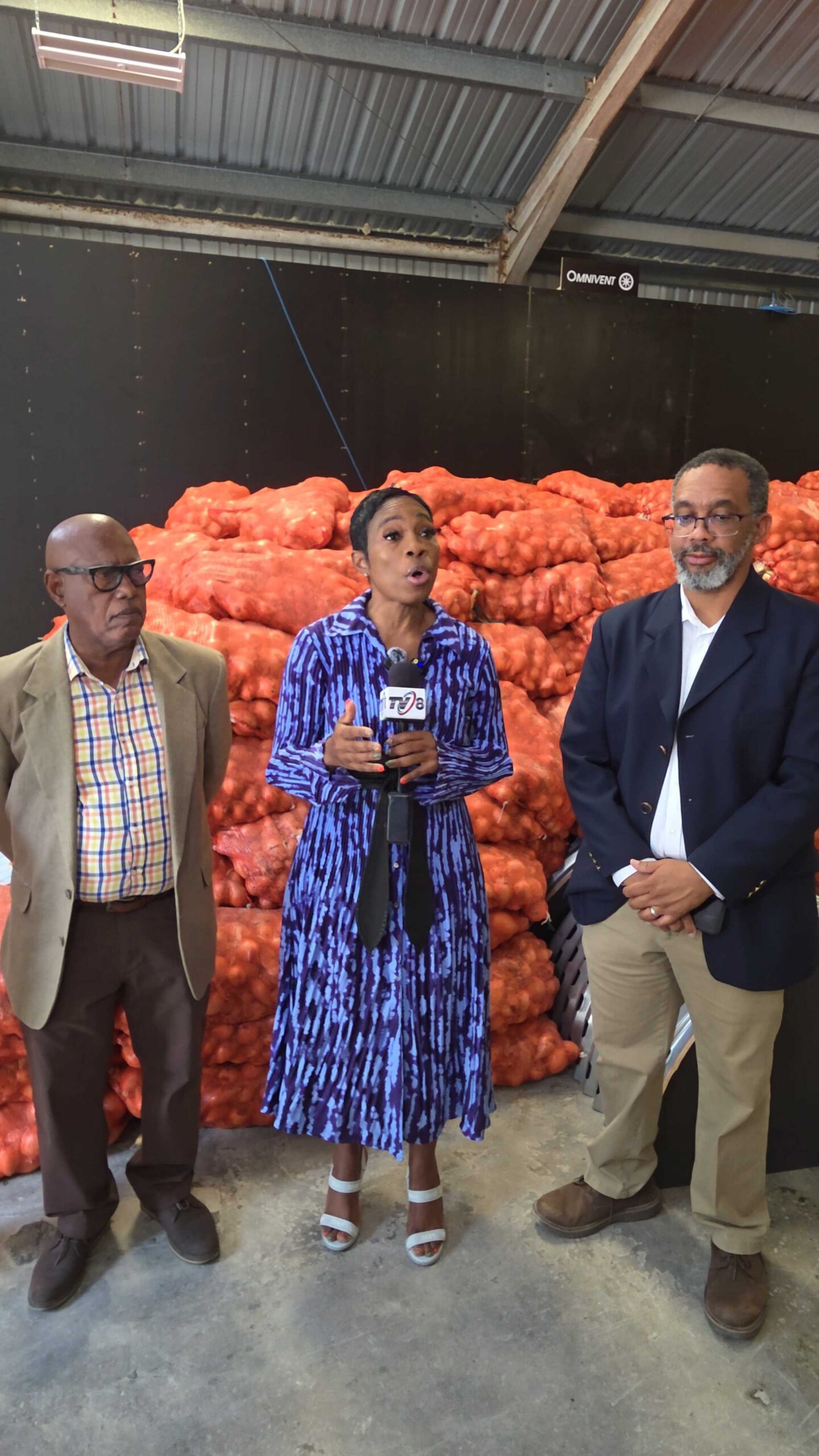
As part of efforts to bolster the island’s food security and slash its massive food import bill, government has officially launched a major agricultural project.
The Onion Escalation Project, a collaborative effort with the Barbados Agricultural Development and Marketing Corporation (BADMC), marks the rollout of an aggressive “strategic crop escalation production plan” designed to counter the volatile impacts of climate change on local farming.
Barbados has targeted 16 strategic crops under its national plan to optimise domestic agricultural yields and elevate nutritional value for citizens.
Speaking at the launch at the BADMC Fairy Valley Christ Church headquarters, Minister of Agriculture and Food Security, Dr Shantal Munroe-Knight, pointed to a stark disparity between local production and national consumption, noting that while Barbados achieved a slight production increase last year – utilising 36 acres to yield roughly 483 kilograms of onions – the island remains heavily dependent on foreign markets.
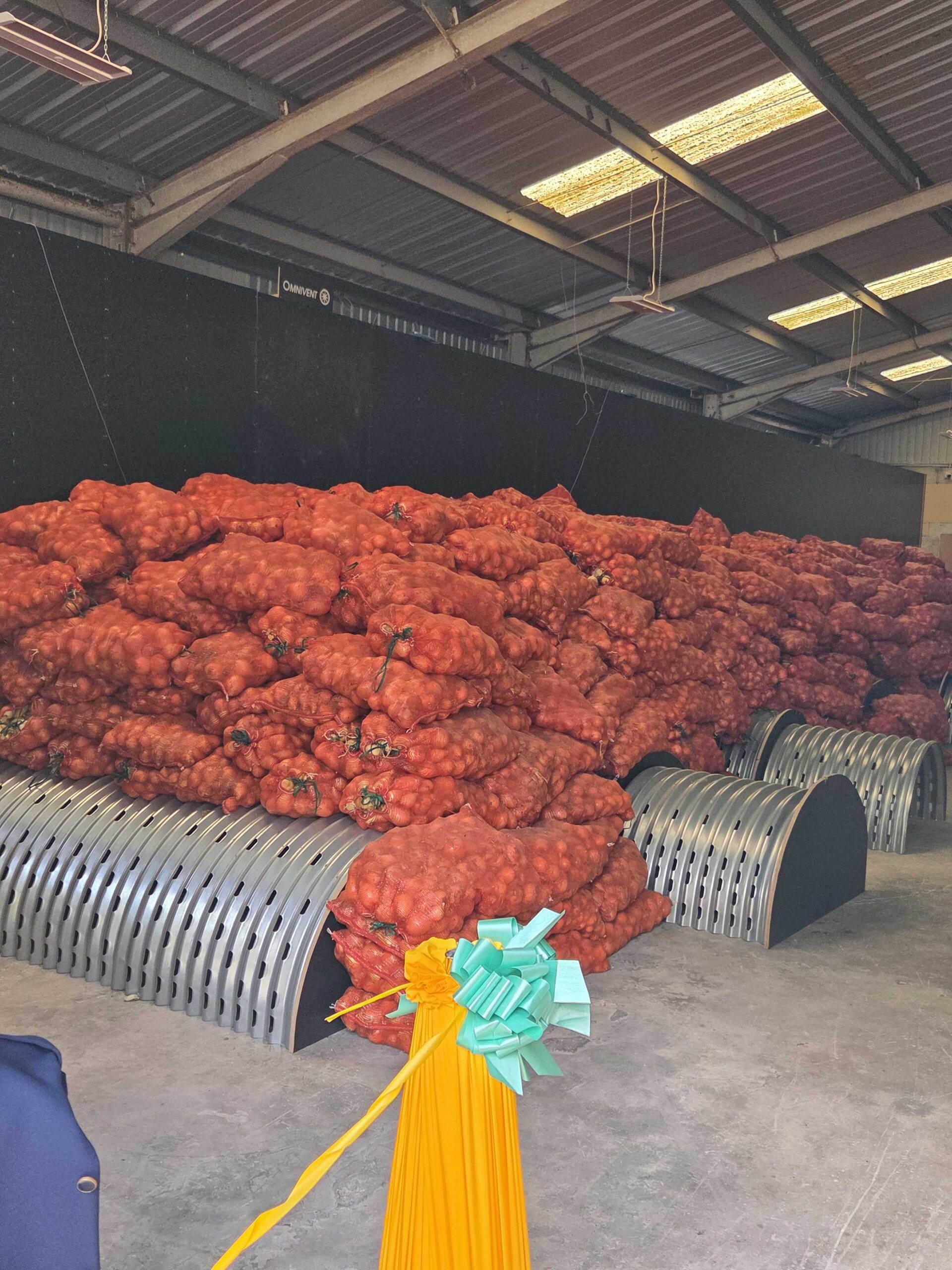
Onion Drying facility at BADMC’s Fairy Valley Christ Church headquarters.
”We are importing two million kilograms of onions. That’s what we’re doing,” Munroe-Knight stressed.
To bridge this gap, the BADMC’s escalation plan outlines an ambitious target to scale up onion cultivation to 100 acres over the next two years on a phased basis.
Central to achieving this production milestone is the commissioning of a state-of-the-art onion drying and chilling facility at Fairy Valley.
Traditionally, Barbadian farmers have been restricted to a narrow planting window between October and November, with harvesting squeezed between February and May.
By utilising advanced drying technology, the BADMC can now extend the shelf life of harvested onions from a fleeting few weeks to several months.
”With this new facility for onion drying, it means then that we can expand that onion production, that onion growing period… It means that we could move almost to year-round production under the BADMC crop escalation plan,” Munroe Knight explained.
She added that the accompanying specialised chilling facility gives farmers unprecedented assurance.
”It gives the farmers assuredness… They will not then incur a lot of the losses that we would have had before because of the wet season and unseasonal rains. Traditional onion storage time would have been just a couple of weeks or so, now, we are looking for storage for months…
“That is significant in terms of escalating our ability to grow more, to provide the level of consistency, and again to be responsive to the demands,” the minister said.
Additionally, she said unpredictable, unseasonal weather had severely crippled traditional growing cycles.
”The conditions that we had then are extremely challenged now because of climate change.
“Those of you who would remember, for instance, last November, we had heavy weather… because of those heavy rainfalls just last year, we’d have lost a number of acres for onions. So that climate change challenge is then significantly challenging our onion production,” Munroe-Knight said.
She also addressed historical friction between local producers and commercial distributors who had previously rejected Bajan onions under the pretext that they were too wet and spoiled quickly.
”Well, this facility is intended to allow us to deal with that, so we need the cooperation of those distributors as well,” Dr. Munroe Knight asserted, noting that fruitful discussions are underway with local distributor associations.
“We have a whole-of-country approach to this notion of how we do crop escalation, how we make sure that we can drive down our food import bill and most importantly, make food cheaper for Barbadians… and that requires all of us working together.
She pointed out that farmers will have the opportunity to bring their onions to the facility.
“So the BADMC has a number of off-date contracts with farmers, and of course one of those contracts will be related to onions as well. Of course all the onions that are received through BADMC will then have an opportunity to be able to be dried here and stored here as well in the facility. The infrastructural upgrade is being paired with aggressive scientific support.
“The BADMC is collaborating closely with the Ministry of Agriculture’s research section to introduce robust, climate-resilient onion varieties capable of withstanding wet conditions, alongside revised fungicide protocols to maximise crop yields,” Munroe-Knight said.
”I really want to invite Barbadians, want to invite the farming community to walk with us. It will require a level of patience, and I say patience even as the Ministry and BADMC tells me that I’m always telling them to run – because we don’t have the time. The current context requires us to be able to respond immediately, but we intend to take a strategic approach to it… and be very sure that we are able to respond to the challenges in a systematic way.”
Acting chief executive officer of the BADMC, Fredrick Inniss said the launch represents the culmination of a rigorous three-year developmental push initiated by the board of directors back in 2023.
Inniss paid tribute to the local and international expertise that brought the project to fruition, acknowledging the presence of Dr. Winston Harvey, a pioneering agricultural engineer who worked on onion solutions with the Ministry since the 1980s. He also lauded the technical partnership with Omnivent, a premier Netherlands-based global leader in specialised agricultural storage technology.
”Drying is one of the key elements of onion harvest. We have for decades been without it, but this ensures that now we actually move to a point where we actually have the capacity not just to grow the onions and send them straight to the supermarket, but if we have enough, we can actually hold them and store them for up to three months,” Inniss said.
”What you see behind me is effectively about a container worth of onions, and we are happy to say this is essentially about one-tenth of what this can actually do in this facility.
Inniss also lauded the internal BADMC teams, particularly the maintenance and projects units, who worked grueling hours and through weekends alongside the technical team to complete construction.
The Ministry and the BADMC have spent the last two months auditing internal processes, analysing available land banks, upgrading agricultural extension services, and systematically addressing ongoing challenges regarding soil quality and water access across the 16 targeted crops, which include root staples like sweet potatoes and yams.
The initiative aligns with the wider Caribbean Community (CARICOM) “25 by 25” regional food intensity mandate, which aims to reduce the region’s food import bill by 25 per cent.
(RR)