
By Kirsty Watt
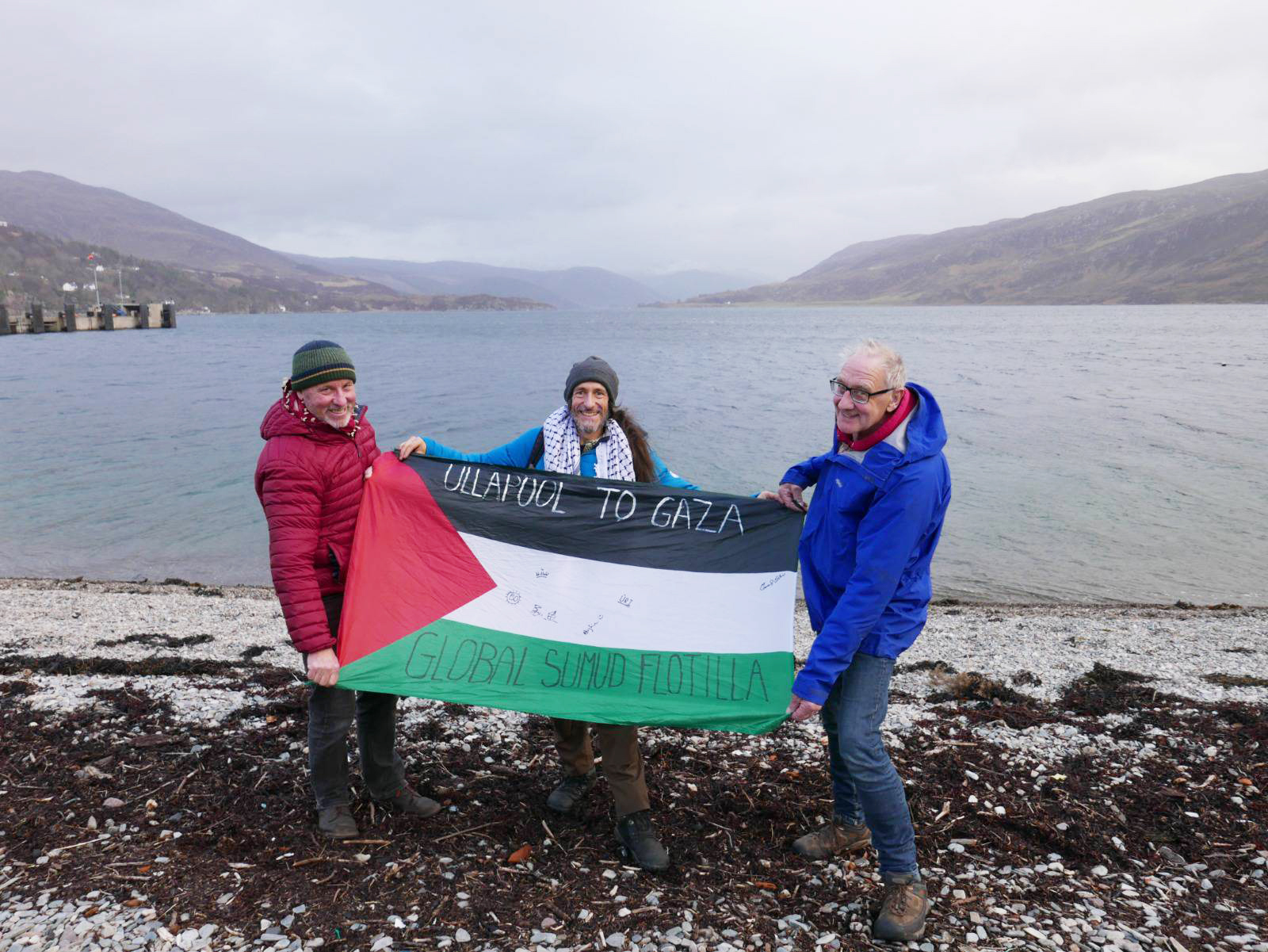
Kirsty Watt spoke to Ullapool man Bryn Higgs, who, along with hundreds of others, was en route to Gaza when he was kidnapped in international waters by masked black-clad Israeli agents. Luckily, Mr Higgs was not subjected to the brutal violence others endured…
Bryn Higgs from Ullapool was sailing in the Mediterranean last month when it happened.
He was on a 39-foot yacht with four other sailors; civilians. One boat, surrounded by around 60 others, who were all aiming to take humanitarian aid to Gaza – the Palestinian territory currently held under siege by Israel.
They were part of the Global Sumud Flotilla… until they were kidnapped, imprisoned and held at gunpoint for 36 hours.
“We were sailing in international waters, carrying humanitarian aid. We were all trained in non-violence and we were all on our way to Gaza to break the siege and open a humanitarian corridor.
“Before we got to Crete, we became aware we were being watched by many drones – as the flotilla had been since it departed a few weeks previously from Barcelona. As it got dark, we could see six drones around the boat and the flotilla. It got darker still and we lost contact with one or two of our fellow boats and wondered if they had been intercepted.
“Then we saw through the darkness a black rib coming towards us from our stern. We could see the white wake of their boat so we knew they were travelling fast, far faster than we could ever travel, so we just continued on and they came alongside us.
“They were dressed in black uniforms, black hoods, black masks and were heavily armed. They identified themselves as Israeli military – but they were 650 miles from Israel in international waters. They boarded our boat. We threw our phones into the sea because we didn’t want them going through all our data – they were very cross about that.
“They searched us at gunpoint, lined us up at the front end of the boat one by one, took control over our boat, and then forced us to leave our boat. We offered no resistance – we were simply there as civilians trained in non-violence.”
At gunpoint, Bryn (61) and his fellow sailors were taken onto a prison ship; kidnapped. And they weren’t the only ones. Twenty-two of the flotilla boats were intercepted that night; 180 civilians taken to the prison ship, their boats and belongings left drifting at sea.
“There we were held [on the prison ship],180 of us in this compound. It was almost like a cage: four metal lorry containers and Portaloos around a central area surrounded by razor wire so we couldn’t get out.
“We were kept there for 36 hours. Much of our warm clothing was confiscated, some of it later returned. I think in the 36 hours I managed to get two sandwiches. There were no blankets, nothing warm; we were very cold. There were rubber mats on the floor, but there was nothing in terms of facilities. You could lie down if there was room for you in the metal containers at night, but there wasn’t room for everyone so some people were lying down outside – and sometimes it rained.
“They would run into the cage and shout at us, throw stun grenades, point their guns around, make us kneel, make us keep our heads on the floor, make us keep our hands above our heads, screaming at us if we moved, lining us up, keeping us in these positions for long periods, over an hour sometimes.
“Sometimes they packed us into the containers and I became worried we might get shut in. It was a very frightening and unpleasant experience. Some of us were beaten up.
“[At one point] I was kneeling as I was told to do, on the ground with my head on the floor. The guy next to me was brought in and thrown onto the floor on his face. Four of them then held him down, one on each limb, and a fifth one knelt on him and punched him repeatedly in the kidneys while he screamed. He was later taken to hospital.”
It was shortly after this, completely unexpectedly, that Bryn and the other prisoners were released – handed over to the Greek coastguard and taken to Crete. After 36 hours held under gunpoint, they were free.
“We didn’t receive any support from the British Consulate in Crete. On a personal level, the staff were very friendly and kindly leant us their phones so we could phone people in the UK – that was the first contact we’d been able to have with people in the UK.
“But, we were told that the British Consulate would not be providing any accommodation, they would not be helping us get home, and the consulate wouldn’t even lend us money to buy tickets to get ourselves home. We were British citizens who had been kidnapped and held at gunpoint by masked gunmen and held for 36 hours. I thought that should be a circumstance in which British citizens received support from the Consulate. But apparently not.
“Or, apparently, it depends on who the masked gunmen are as to whether or not you receive any support, which seems astonishing. Why should it matter the nationality of masked gunmen who illegally abduct you on the high seas, surely that should be of no consequence?”
Bryn’s experience was terrifying, but other abducted flotilla participants faced worse. A total of 428 were kidnapped at sea, during two waves of abductions, and imprisoned. Harrowing testimonies reveal the prisoners suffered systematic torture, severe physical and psychological trauma, targeted gender-based and sexual violence and rape at the hands of the Israeli occupation forces. Over 100 required medical attention.
Two other men from Ullapool were part of the flotilla alongside Bryn and one of them, Hughie Stirling (68), was abducted on 18th May in the second wave of interceptions. He was held on a prison ship before being taken to an Israeli prison, assaulted and transferred to a hospital in Turkey. He made it home only last weekend. Again, the Foreign Office failed to help him.
For them, their families and the country, it’s a huge relief to have Bryn and Hughie home; but the people in Gaza are still waiting, waiting for help, waiting for their suffering to end.
Israel currently holds a near total siege on the Palestinian territory, due to the long-standing Israel-Palestine conflict, and are severely restricting food, water, electricity, fuel and humanitarian aid getting to the area.
According to GOV.UK, between 97 and 100 per cent of people living in Gaza are in need of humanitarian aid. More than 62 per cent of residential property is damaged or destroyed, the healthcare system is on the verge of collapse and at least 95 per cent of those in Gaza are “experiencing acute food insecurity, at crisis level or worse”.
And, despite a ceasefire in October last year, the Israeli military continue to attack civilians in the Palestinian territory.
In autumn last year, the UN confirmed that Israel’s actions against the people in Gaza have been, and are, that of genocide. The Genocide Convention has been triggered, but the UK government has officially rejected the determination that Israel is committing genocide in Gaza and continues to trade with, and sell arms to, the country.
Last summer, a report from the Centre for Media Monitoring also revealed that from 35,000 pieces of BBC coverage of the Israel-Palestine conflict, the BBC gave 33 times more coverage to an Israeli death than it did to a Palestinian death. Responding to the findings, the BBC claimed there had been a sampling error.
“I’m astonished that the UK government still, it seems, continues to do what it can to support what is taking place in Gaza,” Bryn said. “We hope the world will wake up to what is taking place and will respond forcefully to implement the Genocide Convention.
“We, as an international community, should not support the continuation of the atrocities [happening in Gaza] which we see every day on our phones. I think our effort, amongst all those who have joined the flotilla, is a part of a much wider global effort to restore human rights.
“There are thousands and thousands, millions, of people in this country who are desperately concerned about what is happening in Gaza. What we are doing is simply part of a national and global public effort to get our governments to come to their senses.
“Ordinary people can make a difference by hammering home to their political representatives that what is going on is not okay. The people in Gaza have as much right to global human rights as anyone else but we seem to be living in a world where these people seem to have to plead for their rights. Human rights are everyone’s – not just a privilege of those in the west.”