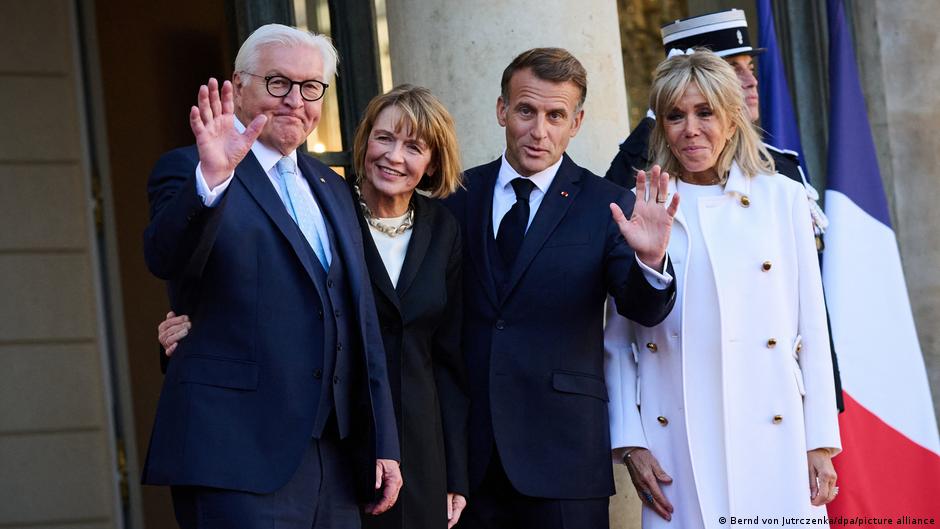
The German delegation passed through Paris without being hindered by the student strikes taking place on the streets of Paris. The motorcades moved through the French capital without disruption. Around the Arc de Triomphe and the Champs-Elysees, however, traffic was at a standstill for hours. Due to the high-profile visit, the streets were cordoned off over a wide area.
Emmanuel Macron had decided on a special gesture to send off Frank-Walter Steinmeier, his German guest: The military honors took place under the Arc de Triomphe. And so, early in the morning, the German national anthem rang out in the heart of Paris — amid sunshine and bitter cold.
It was a generous gesture of friendship and symbolism, yet it seemed to be from a bygone era. In both countries, populists on the political fringes are gaining support. In Germany, the far-right Alternative for Germany (AfD) ranks first in nationwide polls. In France, Emmanuel Macron could soon be succeeded by either Jean-Luc Melenchon of the far left or Marine Le Pen of the far right.
Added to this is an economic crisis that threatens prosperity. Unresolved issues of social justice are driving younger generations into the streets. At the same time, social media is increasingly becoming a tool of disinformation and “accelerating doubts about democracy,” Macron said in Paris.
While the AfD may soon form its first state government in Saxony-Anhalt, President Steinmeier remained confident. He insisted that Germany would continue to “play a leading role in Europe” in the future and that Germans would remain good Europeans. But he did not say where he drew this certainty from. Questions from journalists were not permitted at the joint press conference at the Elysee Palace.
A future, but no plan
Political scientist Jacob Ross isn’t surprised by this. Both Macron and Steinmeier lack a “genuine agenda for Germany, France, and Europe.” Both represent political systems that “seek to respond to 21st-century crises with 20th-century solutions,” said the expert on German-French relations at the German Council on Foreign Relations (DGAP).
Even though Steinmeier and Macron have different political styles, Ross sees parallels — especially where their policies have failed. One example of this is strategic foreign policy issues, such as dealing with Russia. “For a long time, they pursued a policy based on integrating Russia into Europe, and then both were overwhelmed by the events of 2022 and had to adjust their course,” said Ross. Since then, both have merely reacted to current affairs, according to the political scientist.
Little support for Macron’s ideas
Emmanuel Macron has made some bold moves for Europe, but without support from Berlin, says Ross. Germany’s political leadership has long reacted with caution to proposals from Paris.
A joint initiative that both countries recently promoted to the European Commission is aimed at combating unfair competition. Countries that gain an advantage through unfair practices should face strict European measures.
Macron joined German Chancellor Friedrich Merz in speaking out in favor of this. Although China was not explicitly named, the initiative is seen to be primarily aimed at that country. Beijing uses enormous subsidies to support its companies, whose products flood the European market, while European firms continue to face barriers when trying to access the Chinese market.
Germany and France have also long sought greater cooperation in the defense sector. Yet major joint defense projects are making little progress. When the planned joint fighter jet, the FCAS, fell through in June, officials emphasized ongoing cooperation on the future MGCS main battle tank. And yet differences on this became apparent during the state visit.
As German Defense Minister Boris Pistorius arrived in Paris, French Chief of the General Staff Fabien Mandon stated during a hearing in the French National Assembly that Germany had decided to withdraw from the tank project. A day later, Mandon clarified that he had expressed himself ambiguously. But some observers believe that such misunderstandings are a sign of dissatisfaction on both sides — below the political level — regarding cooperation with the other partner.
It is this political level that often ends up having to set the record straight in such cases. This time was no exception: Pistorius firmly refuted the claim that the project was on the verge of being scrapped. “The MGCS project is not over; it is not dead; it has not been terminated by anyone — quite the contrary. It is a core project of Franco-German cooperation on land systems,” said the German defense minister.
The focus is primarily on digital information processing in combat, as well as unmanned and automated systems. Germany and France would continue their cooperation, Pistorius insisted, and MGCS is an important future project for both countries and their armed forces.
The future of defense and space
On Friday, the presidents of France and Germany visited several facilities near Bordeaux that are closely linked to space exploration and nuclear deterrence. These include ArianeGroup, a Franco-German company that, among other things, manufactures the nuclear-capable M51 missiles for French nuclear submarines. The itinerary also included visits to startups that are looking far into the future.
It was unofficially reported during the visit that this focus of the trip was a personal priority for Macron. The French president has long spoken of a European dimension to France’s nuclear deterrent. Considering announcements from the US saying it would reduce its commitment to Europe, his views are gaining increasing traction.
As early as 2020, Macron proposed a strategic dialogue on the role of French nuclear weapons in European security. Several countries, including Germany, have since expressed interest. Now, further steps are being considered. The focus is on what Macron once called “forward deterrence,” such as joint military exercises and visits to strategically important locations. A permanent deployment of French nuclear weapons in other countries remains off the table. Furthermore, according to French nuclear doctrine, France always retains sole decision-making authority over the use of its nuclear weapons.
Steinmeier’s two-day state visit to France ended on Friday afternoon. So far, there has been little sign of new momentum in Franco-German relations. This makes it all the more urgent for the successors to the two presidents to develop a shared vision for the future of the relationship between the two countries starting next year.
Macron and Steinmeier will step down from their posts almost simultaneously in 2027 after ten years in office. The state visit to France thus also served as a final joint meeting, marked by some ceremonial farewells.
This article was originally written in German.