August 1, 2026
Emergency meeting of European interior ministers to take place Tuesday
An emergency video meeting of European Union interior ministers is to be held on Tuesday, according to Ireland’s prime minister, Micheal Martin.
“As Presidency holders, Ireland will convene a meeting on Tuesday of the EU Justice and Home Affairs Council… to discuss developments in Ceuta,” the Irish leader wrote on Saturday.
The Republic of Ireland currently holds the EU’s rotating presidency and Irish Justice, Home Affairs and Migration Minister Jim O’Callaghan has been tapped by Martin to lead the call.
https://p.dw.com/p/5I8Gv
August 1, 2026
EU’s von der Leyen says lessons must be learned to improve resilience
In a social media post on X, European Commission President Ursula von der Leyen said she had “offered support to Spain from the first moment” and that most of those who stormed the Spanish North African enclave of Ceuta this week had been returned to Morocco.
“Not a single person reached mainland Spain or the rest of Europe,” she said.
The head of the EU’s executive said, however, that the bloc’s “strong system” of border protections “needs to be further strengthened.”
While emphasizing coordination, she said lessons must be learned “to improve our European resilience.”
Calling for vigilance and coordination, von der Leyen ended her statement by saying, “Fighting illegal migration requires solidarity and a united European response.”
https://p.dw.com/p/5I8Dq
August 1, 2026
France says no need for Spain to leave Schengen
French Interior Minister Laurent Nunez on Saturday was cited by news agency AFP as saying that despite France’s own increased security along its shared border with Spain, “We are not asking for Spain’s suspension from Schengen.”
Addressing calls by European politicians for Spain to be temporarily booted from the freedom of travel agreement, Nunez said: “Spain does not need to leave the Schengen zone. It’s absolutely not on the table. We have great cooperation with Spain.”
Italy announced a one-month suspension of visa-free movement with Spain on Friday after tens of thousands of migrants stormed the Spanish enclave of Ceuta, overwhelming authorities.
Spain has assured EU partners that irregular entry into Ceuta does not confer a right to remain in Spain, travel to the mainland, or move freely throughout Europe.
https://p.dw.com/p/5I88n
DW reporter: Ceuta locals feel ‘a mix of of fear and anger’
DW correspondent Jan-Philipp Scholz reported high tensions in Ceuta on Saturday morning, despite the claims by the Spanish authorities that the situation in the exclave was back under control.
“I’ve still seen clashes between police, military and migrants, also between locals and some migrants this morning,” he said.
While the overwhelming majority of irregular migrants has already left the area, Scholz pointed out that thousands were still in Ceuta and Spanish authorities were growing “increasingly robust” in their efforts to get the rest to leave. Most migrants did not receive any food or water, and all the shops in the area are closed, Scholz pointed out.
“They are pushing the people away from the beaches or from overwhelmed reception centers that cannot take any more people in,” he said.
He also said that locals were feeling “a mix of fear and anger” in the wake of the incursion.
“Most people did not want to come out of their houses yesterday. And most people are still staying inside today.”
https://p.dw.com/p/5I85g
August 1, 2026
WATCH: Could the Ceuta crisis help Trump in the midterms?
Donald Trump has called the migrant crossings into Spain an “invasion.” US political analyst Michael Yaki unpacks the political strategy behind the rhetoric.
https://p.dw.com/p/5I7zE
August 1, 2026
IN PICTURES: Some migrants tell DW they don’t want to go back to Morocco
https://p.dw.com/p/5I7sP
August 1, 2026
Spanish police start installing floating barrier
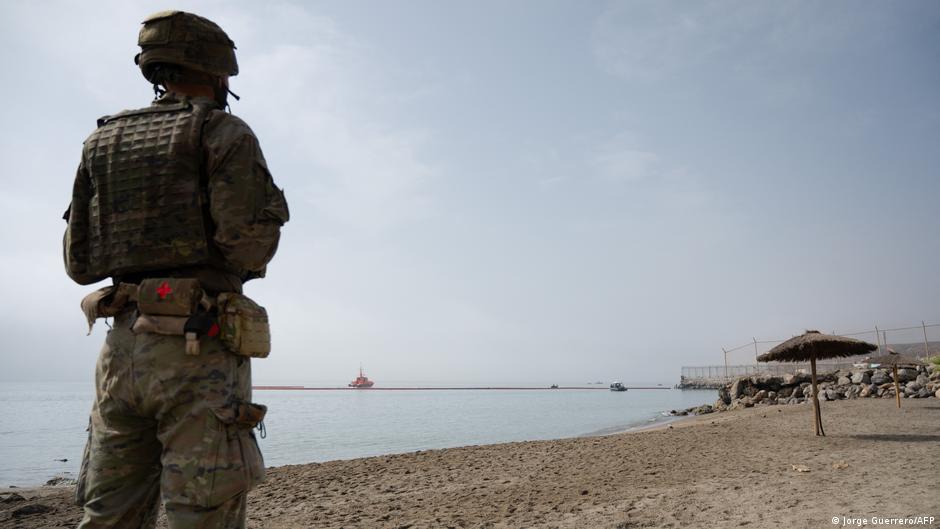
In Ceuta, Spanish authorities started laying a new pneumatic barrier on the sea border with Morocco.
The 500-meter (1,640-feet) long barrier is designed to stand 30 to 70 centimeters (12-28 inches) above the water line and up to one meter (3.3 feet) below it. It will run parallel to a line of anchored buoys, forming a channel that would be patrolled by Spanish law enforcement.
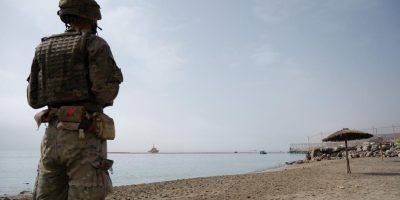
Many of the migrants that entered the Spanish territory of Ceuta in recent days achieved that by simply swimming around the existing barrier with Morocco and gaining access to the Spanish-controlled beach.
Spain’s El Mundo daily published a video online of a Guardia Civil boat installing the barrier.
https://p.dw.com/p/5I7sR
August 1, 2026
Most EU nations join call for emergency talks after Ceuta crisis
In an open letter, 22 out of the EU’s 27 members demanded a video meeting of the bloc’s interior ministers on Saturday.
The meeting should be convened “as a matter of urgency” to coordinate a joint response to the situation in Ceuta, and “prevent further uncontrolled crossings.”
Earlier on Saturday, Spain’s Pedro Sanchez also called for a meeting of interior ministers.
https://p.dw.com/p/5I7op
August 1, 2026
Sanchez: Spain managed to ‘fully restore control of the border’
In less than 48 hours following the border incursion in Ceuta, the Spanish government has managed to “fully restore control of the border, provide extensive humanitarian aid, repatriate virtually all migrants who crossed irregularly, and prevent any unauthorized movement toward continental Europe,” according to Spanish Prime Minister Pedro Sanchez.
“This has been achieved in close coordination with Moroccan authorities and with very little support from other European states,” he added in the letter addressed to European Commission President Ursula von der Leyen and other top EU officials.
He also pointedly noted that Spain was “one of the European Union’s least porous external borders, with a number of irregular entries that is half of that recorded in Italy in recent years (2021–2026), for example.”
The Spanish leader also expressed confidence that a meeting of EU interior ministers would help “establish a common response to situations of this kind and reaffirm that the security of our external borders is a responsibility shared by all member states, and not just by those on the Union’s front lines.”
https://p.dw.com/p/5I7oU
August 1, 2026
Spain’s Sanchez decries ‘selfish’ response by other EU nations
The head of Spain’s left-leaning government, Pedro Sanchez, demanded a video summit of all European Union interior ministers and slammed what he described as a “selfish” response by some EU members to the Ceuta crisis.
“Most have shown us their support and solidarity and have offered us their assistance. Others, however, have chosen to attack Spain and call for its temporary exclusion from the Schengen zone” Sanchez said, in apparent reference to Italy, which temporarily suspended free movement with Spain.
Denmark and Finland also called for reconsidering Spain’s participation in the Schengen agreement, while Portugal and France responded by beefing up border security.
“In the current international context, the European Union cannot afford this kind of selfish, polarizing and unlawful reaction,” Sanchez said in a letter to top EU leaders.
https://p.dw.com/p/5I7lX
August 1, 2026
Migrants in Ceuta boarding buses, trains back to Morocco
With no means to reach mainland Spain or stay in the African exclave of Ceuta, thousands of migrants were going back into Morocco on Friday and Saturday.
A Moroccan source cited by the French AFP news agency said the migrants would either return by bus or be taken to a train station in Morocco’s Tangier, some 70 kilometers (45 miles) away from Ceuta.
“I heard that buses had arrived to take us back home. Honestly, I just want to see my children again. I regret having come all the way here,” said 32-year-old Moroccan Rachid Aouchari.
At the same time, some of the migrants in Ceuta told DW they wanted to stay.
“And I want food. I have four days [without food],” one of them said “Nothing, nothing. Just drinking water and no food.”
“I don’t want to go back to Morocco because I don’t have anything in Morocco. Why would I want to go?”
https://p.dw.com/p/5I7kA
August 1, 2026
Spain faces diplomatic fallout as France and Italy respond to Ceuta incursion
Italy has officially suspended the Schengen agreement with Spain on Saturday for one month in response to the mass crossing in Ceuta.
The Schengen deal allows for free movement between nearly all of the EU‘s 27 member states and several others that are not a part of the bloc, such as Switzerland, Norway and Iceland. It technically includes Spain’s exclaves such as Ceuta and Melilla, but passengers are still required to pass identity checks before traveling to Europe.
Even so, many EU nations responded with alarm following the news of thousands of irregular migrants pouring into Ceuta from Morocco.
Italy’s far-right Prime Minister Giorgia Meloni has described the images coming from Ceuta as “shocking.” She said the Schengen agreement suspension is an “extraordinary measure” intended to “safeguard national security and prevent possible repercussions for our nation.”
It is unclear how the temporary suspension will be implemented on the ground.
France, which shares a land border with Spain, boosted checks and deployed hundreds of additional law enforcement officers to the border by Saturday. At the same time, France’s President Emmanuel Macron pledged solidarity and offered assistance to Spain.
Meanwhile, Spanish Prime Minister Pedro Sanchez seemed to hit back at critics online, saying that solidarity and empathy were “optional” but ” [r]espect for European treaties… is not.”
https://p.dw.com/p/5I7bj
August 1, 2026
Spain updates Ceuta death toll to 67, says new barrier will be installed
The death toll from the border collapse in Spain has been climbing since the incursion started on Thursday, with Spanish officials saying 67 bodies have been found by Saturday morning.
Spanish authorities also pledged to build a new containment barrier along the breakwater fence and into the sea for more security.
https://p.dw.com/p/5I7ad
Thousands of migrants still in Ceuta, DW correspondent reports
Reporting from the scene in Ceuta, DW’s Jan-Philipp Scholz says Spanish police and military were still out in force, and many irregular migrants remain in the Spanish exclave.
“Hundreds of migrants have spent the night on the beaches. Even though 80% to 90% have returned, there are still thousands of migrants in the exclave,” he said.
“The migrants here still complain of hunger and thirst and are trying to get water at the beach showers,” the DW correspondent added. “I’m also still hearing reports of some clashes with locals.”
https://p.dw.com/p/5I7WN
We are resuming our coverage
We wish you a good Saturday morning from Bonn, with Europe still reeling from the Ceuta border collapse. The Spanish exclave in Africa has seen some 60,000 people rush through the border from Morocco and gain entry to the Spanish city of some 85,000 residents.
While most of the irregular migrants reportedly returned to Morocco by Saturday morning, the incursion sparked alarm over the free-movement Schengen zone, with Italy even suspending the deal with Spain for one month.
Meanwhile, France boosted border checks with Spain while also pledging solidarity and offering assistance to Pedro Sanchez’s government.
The incident has inflamed the already bitter political divide on migration within the EU.
We will be bringing you more on this story, including reports from our reporter in Ceuta, throughout the day.
https://p.dw.com/p/5I7WG