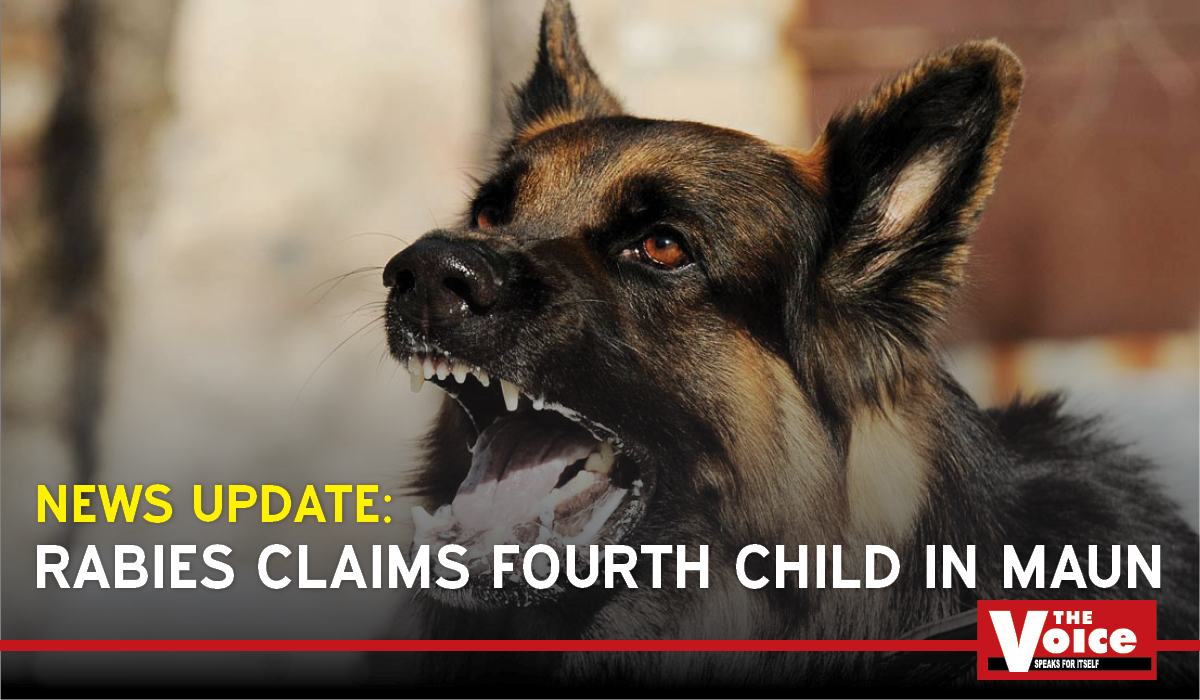
Rabies crisis in Maun has reached a critical turning point as the district struggles to contain a virus that has moved with terrifying speed from the bush into the heart of residential wards.
The atmosphere in the town is heavy with grief and fear following the confirmation that a four-year-old girl from Riverside Ward has become the latest victim of the outbreak after being bitten by a dog.
Her passing brings a devastating total to four children who have lost their lives to the disease since February, a mounting toll that has forced the government into emergency sessions.
“This is very disturbing because it appears the situation is slowly getting out of hand,” cautioned North West District Council Chairperson, Itumeleng Kelebetseng.
While the Council’s Primary Health Department recently announced the arrival of new rabies vaccines, Kelebetseng offered a sobering reality check, cautioning that these doses are a mere number compared to the scale of the threat.
“We have been grappling with shortage of anti-rabies vaccine and we just received a few, 93 vaccines to be precise, only enough to vaccine 93 people in the whole of Maun!”
With Maun’s dog population estimated at 15,000, over 7,000 of which are strays, the current vaccine stock is described as a drop in the bucket.
However in a desperate bid to break the chain of transmission and protect human life, the Council has announced a drastic culling operation, albeit it is a painfully slow exercise to carry out.
Authorities are prepared to eliminate the estimated 7,000 stray dogs roaming the district, along with an undisclosed number of street pigs that have been identified as a public health risk.
To date, only about 191 animals have been culled and 8,000 vaccinated, the figures which the Chairman admits are far too low to provide a sense of security.
“It is scary and I call everyone to be vigilant, take extra care of the children and their domestic animals to avoid further attacks by dogs and any more infections,” added Kelebetseng.
He added that the logistics of the response have been further hampered by a persistent shortage of transport, though there is hope that the pace of operations will finally gain speed as more vehicles are deployed to the front lines.
The nature of the spread has also taken a bizarre and worrying turn in the Mawana area outside Maun.
A cow was recently culled after showing clear clinical signs of the virus, and suspicions are that it likely contracted rabies by scavenging the bones of an infected dog carcass while grazing and Kelebetseng noted that this cross-species transmission proves that the virus is firmly embedded in the environment, making every roaming animal a potential carrier.
The urgency of the situation saw the Minister of Health, Dr. Stephen Modise, locked in a late-afternoon meeting on Wednesday with a technical team at the Maun Rural Administration Centre.
The Minister was also scheduled to meet district leadership the following morning, Thursday April 30th over the issues.