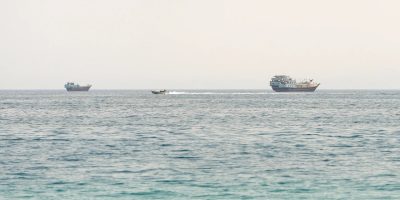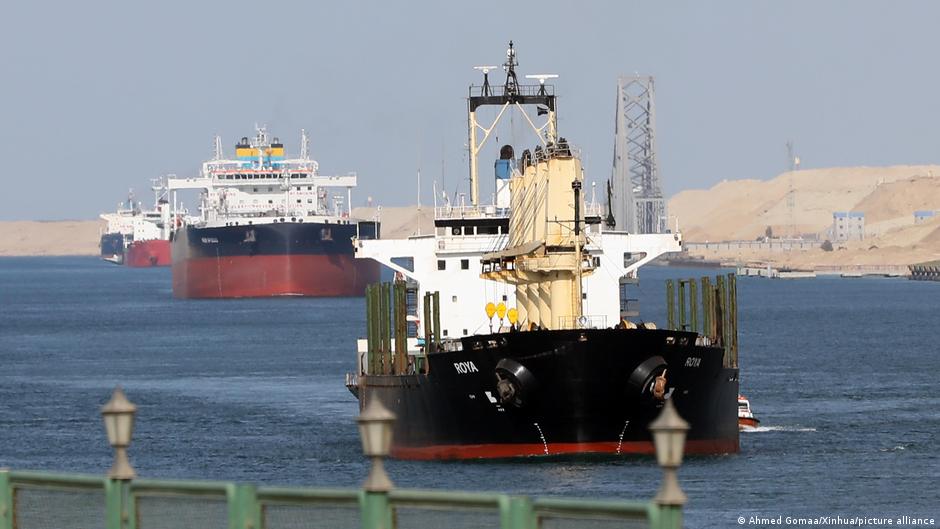
The Suez Canal boasts an array of impressive statistics. At 193 kilometers (120 miles) long, the Egyptian waterway is located between the Mediterranean and the Red Sea and it saves ships traveling between Europe and Asia approximately 10,700 kilometers. This is why, since it was opened in 1869, the canal has become one of the world’s most important trade routes.
However unrest in the Middle East has seen shipping companies increasingly avoid the Suez Canal over the past couple of years. The Houthi rebel group in Yemen has targeted shipping in the Bab el-Mandeb Strait, off the coast of Yemen. To get to the Suez Canal, ships must pass the Bab el-Mandeb and the Yemeni coast.
Recently the Houthis have again threatened to block ships passing the Bab el-Mandeb Strait, and there are fears that the trend to avoid the Suez Canal will accelerate.
This is a huge problem for Egypt. Fees paid by shipping companies transiting the Suez Canal are an important source of revenue for the country.
According to Egyptian President Abdel-Fattah el-Sissi, Egypt likely lost around $7 billion (€6.15 billion) from a decrease in traffic through the Suez Canal in 2024 alone. The Reuters news agency said that at times, losses could have been as much as $8 million (€7 million) in a month.
This is why the economic consequence of that loss extends well beyond shipping. Egypt has not been impacted by the Iran conflict in a major military way, but it is certainly seeing an economic effect.
Egypt loses billions on Suez Canal
“Economically, Egypt is in a very ambivalent situation,” says Stefan Lukas, director of German think tank Middle East Minds.
During 2025 and 2026, revenues from canal transits actually went up again, mainly because oil from the Gulf states was transported via Saudi pipelines to the Red Sea and then onwards through the Suez Canal. This was to avoid the Strait of Hormuz, which is being blocked by Iran and the US in turns. But the new threats by the Houthis to block the Bab el-Mandeb Strait could interfere with this alternative route.
It’s bad timing for Egypt: Rising energy prices and the International Monetary Fund’s reforms are already putting tough limits on Cairo’s financial flexibility.
“Higher energy prices have made imports more expensive and driven up inflation,” says Hanna Voss, an expert on the region with Germany’s Friedrich Ebert Foundation. “The uncertainty in the Red Sea and potential disruptions to the passage through Bab el-Mandeb are jeopardizing Suez Canal revenues.”
Tourism into Egypt, capital inflows and the exchange rate for the Egyptian pound are sensitive to any changes. Additionally Egypt is heavily indebted and dependent on loans from the International Monetary Fund, or IMF, as well as investments and financial aid from the Gulf States.
Just how serious the situation already is, can be seen via other numbers. According to the Associated Press, Suez Canal revenues fell from $10.25 billion in 2023 to around $4 billion in 2024. During the same period, the number of ships passing through the waterway decreased from more than 26,000 to just over 13,000. Many shipping companies preferred to detour around Africa rather than risk Houthi attacks.
No short-term solution
As the US think tank Carnegie Middle East Center explains, Egypt cannot compensate for these losses on its own because of the country’s current economic model. The government increasingly relies on large-scale state projects and military-controlled assets to generate growth, the think tank reports, while potentially productive investments and private growth are neglected. The result is growing dependence on foreign loans and investments.
In the short term at least, there are no new sources of revenue that could offset the decline in Suez revenues. Economic reforms, such as those required by the IMF, are also not progressing.
“Egypt has an interest in very rapid de-escalation,” Voss states.
This is why Cairo supports mediation between the US and Iran, albeit less overtly than Qatar or Oman. The Egyptian government wants to secure its relationships with the US, Saudi Arabia and the UAE while simultaneously avoiding an open confrontation with Iran.
British think tank Chatham House describes Egypt’s positioning as risk management. The goal is not to decide the regional power struggle but to minimize the economic damage to itself.
“The regime under al-Sissi is once again pursuing a two-pronged approach,” Lukas from Middle East Minds explained.
Outwardly Egypt is demonstrating solidarity with Saudi Arabia, condemning the Houthis’ threats and increasing security at the Suez Canal. But Egypt isn’t openly opposing Iran and behind the scenes, is keeping communication channels with the Iranians open. That behavior is driven by Egypt’s financial dependence on the wealthy Gulf states and the fear that the Suez Canal itself could become a target in the war, Lukas explained.
“All the neighboring states have an interest in stabilizing the regional order because they simply cannot afford a prolonged crisis,” Voss added.
And that is precisely Egypt’s dilemma. For Cairo, this isn’t just about foreign policy. Every escalation in the Red Sea costs the country urgently needed foreign currency. Every move towards peace increases the chances of economic recovery.
“The crucial question is whether the [Houthis’ threatened] blockade remains symbolic or takes effect,” Lukas said.
In reality the Egyptian government has little influence on that or the course of the wider conflict. Any lasting peace or diplomacy won’t be decided in Cairo but in Washington, Tehran and likely by the Houthi rebels themselves.
This story was originally published in German.