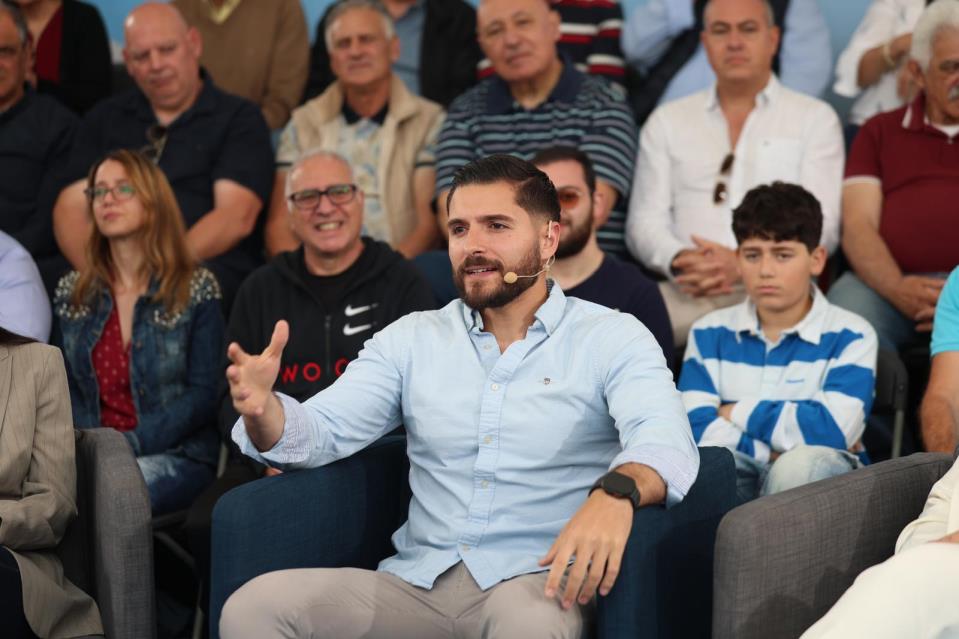
Nationalist Party Leader Alex Borg has pledged a wide-ranging package of education reforms, including curriculum modernisation, new trade centres, stronger support for neurodivergent students, and a commitment that a new school would be opened every year, during a political activity held in Żebbuġ.
Addressing supporters at a political discussion event focused on education, Borg said that the Nationalist Party was committed to giving Malta’s education system a renewed direction rooted in opportunity, skills development and inclusion.
“We will not let any survey discourage us and we will keep rolling up our sleeves. We are with you, and together we will give our country a new breath,” Borg said.
Borg said education remained the foundation of society and insisted that investment in the sector was ultimately an investment in the country’s future.
As a continued commitment to expanding school infrastructure, Borg promised that under a Nationalist-led government, a new school would be opened every year as part of a long-term strategy to modernise learning environments and respond to demographic needs.
He acknowledged that the sector faces significant challenges for both teachers and students but argued that Malta had already seen substantial investment in recent years.
Borg said that past and present administrations had invested heavily in educational infrastructure and resources, pointing to developments such as new school buildings, digital tools including interactive whiteboards, and continued investment in institutions such as the University of Malta and the MCAST.
However, he said that education must also be more closely aligned with Malta’s economic direction, arguing that schools should better prepare students for emerging industries and future labour market needs.
Borg said that new economic sectors such as artificial intelligence, data science and “new space,” alongside maritime industries, should be reflected more strongly in secondary school and vocational education.
He said a Nationalist-led government would introduce targeted courses to prepare students on these areas, building on previous collaborations between education institutions and industry partners.
He also referenced past PN initiatives linking education with industry, including partnerships involving MCAST and international training collaborations.
Another proposal announced during the event was the reintroduction of trade centres in Maltese and Gozitan localities.
Borg said these centres would provide dedicated pathways for students interested in vocational careers, ensuring they have access to specialised, practical training outside traditional academic routes.
He said that while vocational options already exist, they are not sufficiently structured or centralised, and the new centres would help strengthen skills-based education across the country.
Borg also pledged a significant reform of Malta’s curriculum, saying it is currently too theoretical and not sufficiently focused on life skills, social development and digital competencies.
He said educators had raised concerns that the system does not adequately reflect the realities of modern society or the needs of students entering a rapidly changing labour market.
A PN government would work to make the curriculum more practical, flexible and relevant, allowing teachers greater freedom to adapt lessons to students’ needs while maintaining strong academic standards, Borg said.
Teacher working conditions also featured prominently in his address, as Borg said the PN would sit down with social partners to discuss a new financial package for teachers and Learning Support Educators (LSEs), who he described as essential to the functioning of the education system.
He said there remains a significant shortage of LSEs in schools and pledged that a PN administration would ensure they are properly equipped and trained, particularly in supporting neurodivergent students.
Borg also reiterated the party’s commitment to improving inclusion in schools through the introduction of multi-sensory rooms designed to provide safe and calming environments for students who need additional support.
He said these spaces would be complemented by previously announced calming rooms for parents of neurodivergent children travelling on the Gozo Channel ferry, describing both initiatives as part of a wider inclusion strategy.
Investment in education infrastructure was also promised over a five-year legislature, with Borg saying that a PN government would significantly increase spending in this area to ensure schools are modern, well-equipped and capable of meeting future needs.
He mentioned an earlier pledge to increase student stipends by 25%, arguing that this would encourage more young people to continue their studies and become more independent and resilient.
“We are encouraging more young people to enter the education system so they can become autonomous and resilient in their future lives,” he said.
Education, he added, should be seen not only as a pathway to employment but also as a means of personal development and empowerment.
The PN leader also spoke of the importance of linking education with sport, saying that schools should work more closely with sporting structures to improve both educational outcomes and mental wellbeing among young people.
He said sport should not be treated as a hobby alone, but as an integral part of student development and national performance.
Borg concluded by reaffirming the party’s message of renewal, saying that it would continue presenting its proposals and vision despite political challenges.
He said the PN would not be deterred by surveys and would continue engaging with the public in the lead-up to its wider programme of proposals expected later this week.