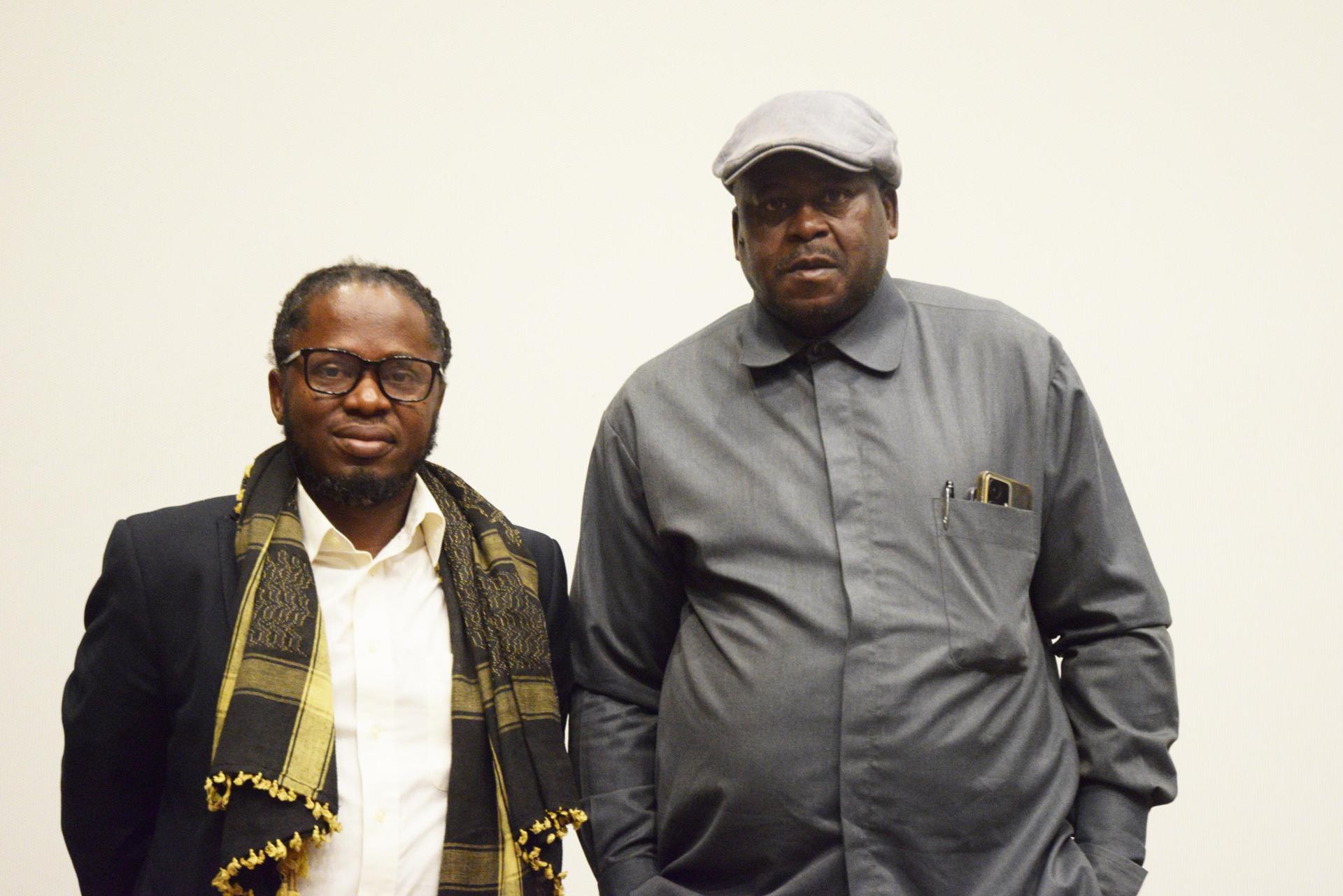
Ishmael Beah, left, and Zukile Jama participate in a seminar at Korea University in Seoul, March 31. Courtesy of Bereket Alemayehu
Two prominent African writers engaged Korea University students in Seoul in a discussion on Afropolitanism and Black consciousness, offering global perspectives through a “glocal” lens. The seminar, held on March 31 and co-hosted by the Network for Glocal Activism and the Institute of African Cultural Studies in Korea, featured renowned author Ishmael Beah of Sierra Leone and South African linguist and researcher Zukile Jama.
For Beah, a memoirist and human rights advocate, writing is a way to reclaim ownership over African narratives.
“For many years, our stories have been told by other people,” he told The Korea Times. “Even when well-intentioned, they often miss the context. And without the right context, people form stereotypes and incomplete conclusions.”
Beah is best known for his 2007 memoir, “A Long Way Gone: Memoirs of a Boy Soldier,” in which he recounts his experiences as a child soldier during the Sierra Leone Civil War in the 1990s. The book gained international recognition for its powerful and personal portrayal of war, trauma and recovery. His work has reached audiences far beyond Africa, and two of his books have been translated into Korean. He also participated in the DMZ World Literature Festa earlier in the week as part of his activities during his first visit to Korea.
He reflected on a common misconception that people fleeing war-torn countries leave simply to seek better lives elsewhere, a narrative he believes is overrated.
“Nobody wants to leave home if it’s functioning,” he said in the interview. “You leave because you can no longer live there.”
This perspective highlights a deeper issue, the global misunderstanding of African realities, but sheds a positive light on Afropolitanism on a global stage.
Afropolitanism
In his presentation at the forum, he explained that Afropolitanism is a form of identity that embraces both African roots and global belonging. It challenges older stereotypes that portrayed Africa as isolated or culturally static. Instead, it narrates the continent’s long history of exchange, migration and intellectual engagement with the wider world. Afropolitanism suggests that African identity is not confined by geography but can exist across diasporic networks, stretching from Accra and Lagos to London and New York City.
He told the audience that the concept of Afropolitanism encourages a rethinking of how Africa itself is imagined. “For much of the 20th century, Africa was often portrayed in global media through narratives of crisis — war, poverty and political instability. Afropolitanism challenges this narrow portrayal by emphasizing creativity, intellectual life and cultural dynamism across the continent and its diaspora,” he said.
“In this way, Afropolitanism is not merely a cultural label but also a political and intellectual project. It seeks to reshape global conversations about Africa by highlighting the diversity and complexity of African experiences. Rather than presenting Africa as a passive recipient of globalization, Afropolitanism positions Africans as active participants and innovators in global culture.”
Beah’s career began in 2007, and he has established himself as a powerful literary voice. Currently based in South Africa, Beah is pursuing a doctorate at the University of Cape Town’s Department of English Literary Studies. Alongside his academic work, he continues to write for the public, with two more books already in progress.
Ishmael Beah, left, and Zukile Jama speak during a seminar at Korea University in Seoul, March 31. Courtesy of Bereket Alemayehu
Black consciousness
Jama spoke to the audience about how residents of South Africa, the African continent and the world still experience the residue of the colonial past.
“We have lost our humanity and appetite for peace. The world is facing extreme corruption, internal and external wars and extreme violence,” Jama, who is currently serving as a professor in the African Language Department at the University of the Western Cape in South Africa, said.
Quoting the 1972 Policy Manifesto of the South African Students’ Organization, he said that Black consciousness is “an attitude of mind, a way of life whose basic tenet is that the Black must reject all value systems that seek to make him a foreigner in the country of his birth and reduce his basic human dignity.”
He continued, “If one is free at heart, no man-made chains can bind one to servitude, but if one’s mind is so manipulated and controlled by the oppressor, then there will be nothing the oppressed can do to scare his master.”
Colonialism and racism have robbed Black people of important qualities, he said. The Black Consciousness Movement contends that sympathizers and liberals cannot free Black people. Black people need to believe in themselves, love their Blackness and transform psychologically so that they can free themselves from bondage. The concept of Black consciousness is necessary as a means of humanizing Black people and reclaiming their instruments of humanity.
In conclusion, Jama called for bringing marginalized Black people to the center. “We cannot talk about Black freedom when Black history, Black culture and Black philosophy are on the margins,” he said. “Blackness must be part of the ecologies to create interconnectedness among all people. Black consciousness can continue to engender the principles of social justice and the liberation of Black people in South Africa, play an important role in entrenching conscientization, humanness and freedom from subservience, and is necessary for the affirmation of Black people not only in South Africa but around the world.”
Bereket Alemayehu is an Ethiopian photo artist, social activist and writer based in Seoul. He’s also the co-founder of Hanokers, a refugee-led social initiative, and a freelance contributor for Pressenza Press Agency.