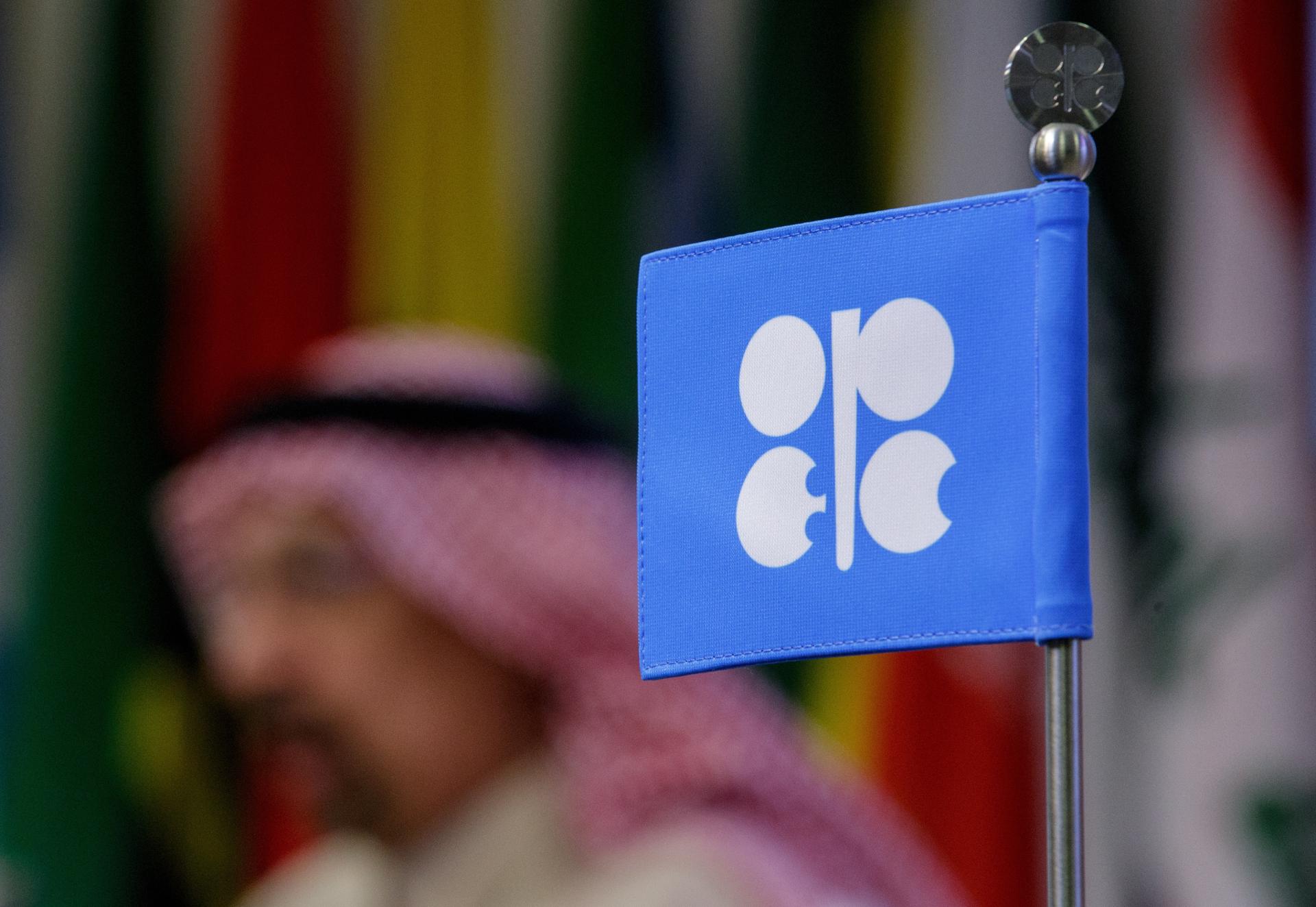

Khalid Al-Falih, President of the OPEC conference and Saudi Arabia’s energy minister is seen behind a Opec logo during news conference at the headquarters of the Organization of Petroleum Exporting Countries in Vienna, Austria, on Nov. 30, 2017 (re-issue Apr. 28). The United Arab Emirates (UAE) on Tuesday annouced it will be leaving the Organization of the Petroleum Exporting Countries (OPEC) and OPEC+ from May 1. EPA-Yonhap
DUBAI — The United Arab Emirates said on Tuesday it was quitting oil-producers’ group OPEC, as an unprecedented energy crisis triggered by the Iran war exposes discord among Gulf nations.
The loss of the UAE, a longstanding OPEC member, could create disarray and weaken the group, which has usually sought to show a united front despite internal disagreements over a range of issues from geopolitics to production quotas.
UAE Energy Minister Suhail Mohamed al-Mazrouei told Reuters the decision was taken after a careful look at the regional power’s energy strategies.
Asked whether the UAE consulted with OPEC’s de facto leader, Saudi Arabia, he said the UAE did not raise the issue with any other country.
“This is a policy decision, it has been done after a careful look at current and future policies related to level of production,” said the energy minister.
OPEC Gulf producers have already been struggling to ship exports through the Strait of Hormuz, a chokepoint between Iran and Oman through which a fifth of the world’s crude oil and liquefied natural gas normally passes, because of Iranian threats and attacks against vessels.
Mazrouei said the move, in which the UAE will also leave the OPEC+ grouping, would not have a huge impact on the market because of the situation in the strait.
Win for Trump
The UAE’s exit from OPEC represents a win for U.S. President Donald Trump, who in a 2018 address to the U.N. General Assembly accused the organisation of “ripping off the rest of the world” by inflating oil prices.
Trump has also linked U.S. military support for the Gulf with oil prices, saying that while the U.S. defends OPEC members they “exploit this by imposing high oil prices”.
The move came after the UAE, a regional business and financial hub and one of Washington’s most important allies, criticised fellow Arab states for not doing enough to protect it from numerous Iranian attacks during the war.
Anwar Gargash, the diplomatic adviser for the UAE president, criticised the Arab and Gulf response to the Iranian attacks in a session at the Gulf Influencers Forum on Monday.
“The Gulf Cooperation Council countries supported each other logistically, but politically and militarily, I think their position has been the weakest historically,” Gargash said.
“I expect this weak stance from the Arab League and I am not surprised by it, but I haven’t expected it from the (Gulf) Cooperation Council and I am surprised by it,” he said.
Mazrouei noted the UAE has been a member of OPEC and OPEC+ for a long time, but he said the world would demand more energy, suggesting his country’s move will help meet those needs.
The UAE’s exit comes as global spare capacity hovers at historically low levels, leaving the oil market increasingly tight.
Operating outside the producer group allows the UAE to fully leverage its position as a supplier of some of the world’s lowest-cost and lowest-carbon barrels.
Ultimately, the UAE views its exit from the bloc as a net positive for consumers and the broader global economy, ensuring a more responsive and reliable energy supply.