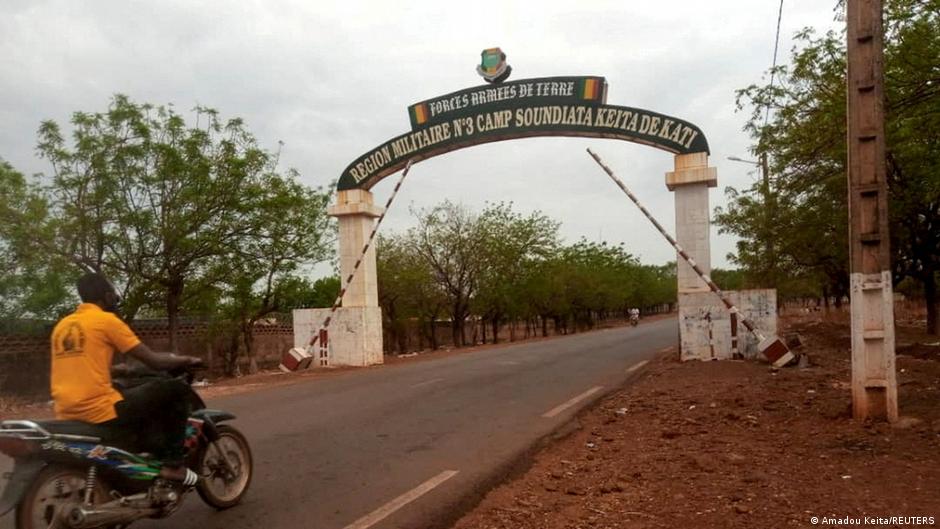
Two loud explosions and sustained gunfire rocked the area near Mali‘s main military base in Kati, outside the capital city of Bamako, early Saturday morning, according to the AFP and Reuters news agencies.
A Reuters witness reported that soldiers had been deployed to block off roads in the area. Kati is the home of military ruler General Assimi Goita.
Meanwhile, AFP reported fighting in Gao, the largest city in northern Mali, as well as in Sevare, in central Mali.
Gunfire was also heard near Mali’s international airport, AP reported.
Images of militant convoys in trucks and motorcycles moving through Kati’s deserted streets were captured by onlookers on social media, according to AP.
No group has claimed responsibility for the attacks. In a statement, Mali’s army said unidentified “terrorist” groups had attacked several positions in the capital and elsewhere in the country without specifying the locations.
Later on Saturday, the army said that the situation was under control following attacks by armed groups in Bamako and other towns.
The African Union (AU) condemned the attacks for putting civilians at risk. The organization “strongly condemns these acts, which risk exposing civilian populations to significant harm,” AU chairperson Mahmoud Ali Youssouf said in a statement.
He stressed the AU’s commitment to stability and peace in Mali.
Mali’s security crisis
Mali has been grappling with a jihadi insurgency for over a decade, battling West African affiliates of al-Qaeda and the Islamic State. It also has a much longer history of Tuareg-led rebellion in the north.
Military leaders took power in Mali after coups in 2020 and 2021, vowing to restore security in the Sahel country where militants control large areas in the north and center and frequently attack the army and civilians.
Led by Goita, the military government has relied on Russian mercenaries for security support while initially pursuing defense cooperation with Western countries. Recently, however, it has pursued closer ties with the United States.
The military rulers have cracked down on critics and dissolved political parties. Although the junta had pledged to hand over power to civilians by March 2024, in July 2025, it granted Goita a five-year presidential term that could be renewed “as many times as necessary” without holding elections.
Edited by: Sean Sinico, Saim Dušan Inayatullah