Thursday, 23 April 2026, 19:31
Last update: about 33 minutes ago
Transport Malta has announced a national integrated transport plan, titled “Malta in Motion,” that outlines “a whole synchronised system” where every transport mode leads to another.
The plan includes the awaited light-rail metro, referred to as the rapid transit system, and bolstering existing services, including improving road efficiency for private vehicles.
Malta in Motion features six core components: the rapid transit system, the bus network and services, the maritime network and ferry services, road network efficiency, public realm and active travel access – which refers to walking and cycling, a new parking police strategy.
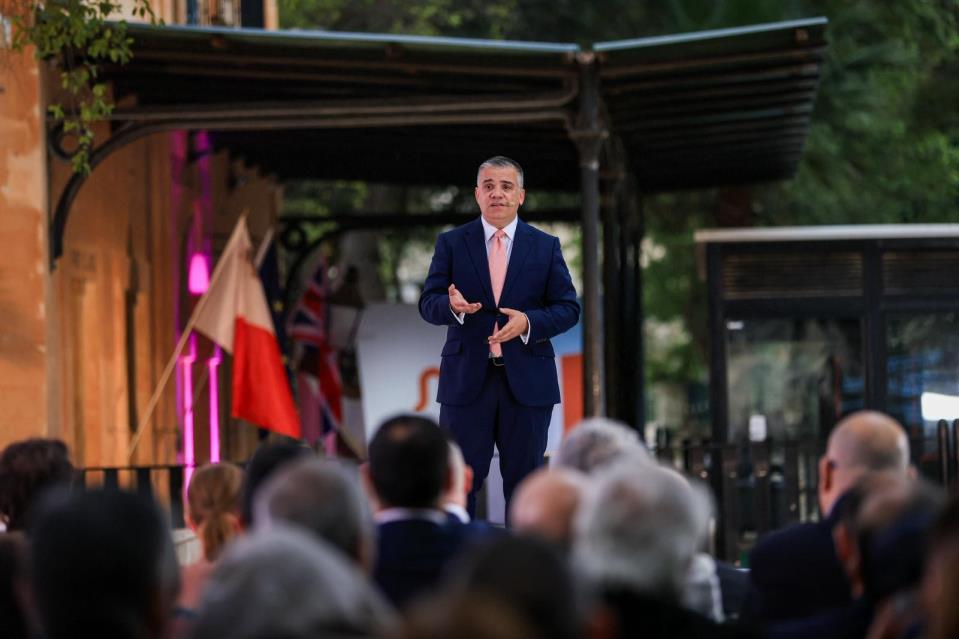
Journalists were invited to a press briefing on Thursday afternoon to go over the technical details of this 15-year national integrated transport plan. Also present for this press briefing were representatives from Transport Malta, including its CEO Kurt Farrugia, and representatives from assisting consulting groups Arup and Mizzi Studio.
This long-term national programme will look to integrate these six transportation streams together with the aim that “if any transport mode fails, there will be another to take them on their journey.” The goal is to get all transport modes to complement one another, rather than compete against each other.
This plan will integrate the transport modes with another by aligning service schedules so that one can, for example, seamlessly catch a bus to instantly catch a ferry to head somewhere. This integration also refers to careful land use and development, policy, and general integration over time.
In this press briefing, Transport Malta (TM) CEO Kurt Farrugia said that this plan, once implemented, “will give people practical travel choices that make daily journeys easier and more reliable.”
Efforts to implement this plan will stretch over the next decade and a half. Transport Minister Chris Bonett divulged the timeline for the Malta in Motion plan’s implementation later in the day.
This plan delivers on Malta’s Vision 2050, the 2050 National Transport Strategy, and the 2030 National Transport Master Plan.
A full economic forecast of the full Malta in Motion could not be provided upon request. When asked if consultants had a range of cost forecasts at hand, journalist were told that with this series of projects being so long-term, “it would be irresponsible to give a full economic forecast” since so much can change from now till the end of the 15 years. All that was provided in this regard was the cost of the metro – circa €2.8 billion.
The Rapid Transit System: central La Vallette line announced so far
While sharing the details surrounding the Malta in Motion plan, the light-rail rapid transit system, i.e., the long-awaited metro, was mentioned. It was clarified that the hybrid approach being discussed, costing an estimated €2.8 billion, refers to a single central line that will connect key centres from the northern areas of Malta to its south.
The dubbed “La Vallette line” will connect principal areas across Malta’s centre from north to south. Specifically, it is envisioned to have stops at the Malta International Airport, Mater Dei Hospital, the University of Malta, Qormi, Valletta, and St. Paul’s Bay.
Breaking down its costs, Arup’s representatives said that €1.8 billion is required for construction costs, another €160 million would go towards planning and engineering design costs, and another €40 million towards project management costs for a sub-total of €2 billion. The €2.8 billion total factors in a risk that adds on an additional 40-45%.
Approximately, the La Vallette line will cost the Maltese islands between €130 million and €150 million per kilometre built. Stations will cost around a quarter of the total costs.
This line could take between three and four years – or longer – to be constructed, once works start, McDaid said.
Only the La Vallette line is being focused on for now, though there are plans to add two more lines. For instance, McDaid said that the La Vallette line is good for north-south and south-north travel, though another line must be proposed for east-west and vice-versa.
Gozo was not factored into this rapid transit system. Arup consultants shared that buses will be the central service available within Gozo.
TM CEO Farrugia said that through this project, 24 kilometres of light-rail lines will be constructed.
Some parts of this service will be underground, some will be at street level (at-grade), and other sections will be elevated. The topography and built environment of the Maltese islands is currently being studied to determine how the metro will pass through certain areas. This phase is vital, since underground infrastructure was said to be 10 times costlier than elevated infrastructure, and elevated infrastructure was said to be one and a half times more expensive than what could be developed at street level.
Journalists were told that underground sections are more likely to be constructed for densely populated and highly developed regions.
“We believe that all components will fit into this puzzle that will fit into this rapid transit system,” Farrugia said.
This metro service will offer a high capacity “turn up and go” service to connect buses, ferries, and active transport modes. Arup consultant Larissa Miller said that through such a system, people will not wait longer than 10 minutes to depart from their starting stop. Her colleague, Arup director Donal McDaid, said that light-rail systems typically accommodate between 6,000-6,500 people per hour.
It was said that the hybrid approach now being undertaken is more technically complex than the original fully underground service that was initially announced before the 2022 general election.
“It is an ambitious but achievable project for Malta,” said Arup director Donal McDaid.
Bus network and services, service schedule to be reviewed
The bus network and its services will remain the backbone of the Maltese public transportation system.
The bus service schedule will be reviewed and a multi-tiered approach will be introduced to ameliorate bus services around the country. Consultants outlined three kinds of bus routes: primary routes, secondary routes, and local and on-demand routes.
Primary bus routes refer to high-frequency, cross-regional connections along dense urban corridors with high travel demands. Secondary bus routes are those that offer greater coverage for Maltese towns and villages to key centres; for these, it was said that the frequency of these routes, “for sure,” needs to be higher. Thirdly, local and on-demand bus routes are those that connect villages and rural areas, mostly for last mile connections.
The present bus concession expires in 2029, meaning that a new one will be required for 2030 onwards. This new concession, in around four years’ time, will serve as an opportunity to better align the national bus network to the rapid transit system still in development.
“We will be designing a new bus system that makes sense for current infrastructure,” journalists were told.
In Malta nowadays, Tallinja buses carry around 250,000 passengers daily, indicating serious pressure on this transport mode.
Maritime network and ferry services
With ongoing works already at testing stage, it is envisioned that solely through ferry services, people in the south of Malta will be able to make their way to Gozo via Valletta, Sliema, and Buġibba. The new ferry set to move from Sliema to Buġibba to Gozo is in its “last days of testing” at the moment.
This national programme looks to introduce new and improved cross-harbour inter-island journeys to improving mobility around the Maltese islands. It will also improve ferry timetables to better meet passenger demand, as well as identify what could improve passenger experience.
Another core element of this pillar is to identify where maritime services could be introduced around the country’s coast to offset reliance on road transport.
Road network efficiency
This long-term programme commits itself to promoting more consistent travel times across the road network to reduce this aspect of uncertainty for daily commuters.
Several intervention areas where highlighted, such as but not limited to: construction traffic management, dynamic signage on upcoming road spaces and construction, real-time traffic information, and incident detection.
A central aspect of this plan is coordinating all transport modes together. When asked how they will guarantee that people can “seamlessly” go from one transport mode to another, through aligned schedules, when present bus services regularly struggle to remain punctual, Arup transport planner Miller mentioned the implementation of smart traffic systems to bolster road network efficiency. For instance, in some places abroad, certain traffic lights can detect when a bus is approaching and act accordingly to prioritise the passengers inside.
Parking policy and strategy
With parking playing a major role in shaping road behaviour and economic activity, Malta in Motion will incorporate a national parking strategy and action plan to guide Malta’s parking management.
Among several deliverables are introducing new Park and Ride (P&R) centres near major transit stations and transport hubs, as well as providing residential parking facilities at key locations.
TM CEO Farrugia dispelled questions that this may include paying for on-street parking, citing that government policy is against this option.
Public realm and travel access (walking and cycling)
Malta in Motion will look to improve accessibility on the ground for all in a way that is integrated with land use and transport.
This will include “high-quality public realm at transport hubs,” meaning that safety and comfort will be incorporated into these spaces by design.
Works for this pillar will build on works that are already underway, such as the C-SAM cycling network, to align with walking and cycling strategies.
Concluding this press briefing, journalists were told that in coordinating these transport modes together, the goal is not to penalise cars.
“It’s about having better alternatives and changing culture and behaviour,” McDaid said, noting that he can see this happening in Malta, “All these things will come together, but ultimately, there is no silver bullet [to solve traffic congestion].”