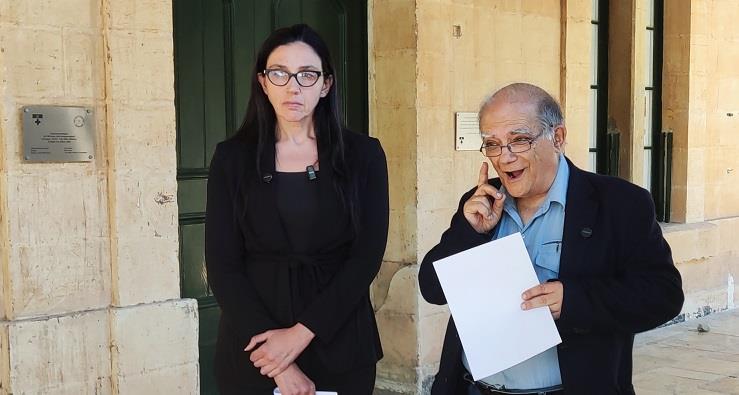
ADPD-The Green Party has raised concerns over the government’s newly announced transport vision, centred on a single rail line linking northern Malta to the airport over a 15-year period at an estimated cost of €3 billion. Speaking at a press conference near Birkirkara old railway station, party officials argued that such large-scale proposals tend to surface when elections approach, questioning both the timing and intent behind the announcement.
Party Chairperson Sandra Gauci acknowledged that the proposal implicitly recognises a key reality: Malta’s transport challenges cannot be solved through a single project. Instead, they require a combination of transport modes and long-term structural changes-an approach ADPD has consistently advocated. However, she criticised the lack of detailed information, noting that essential elements such as route alignment, passenger capacity, environmental impact, financing, and integration with existing systems remain unclear.
Gauci also pointed to the government’s apparent haste in initiating preliminary geological studies, describing it as further evidence that the proposal is being driven more by electoral considerations than by careful planning. She warned that presenting a major infrastructure project without transparency risks undermining public trust.
Deputy Chairperson Carmel Cacopardo emphasised that even the government has admitted that buses will remain the backbone of Malta’s public transport system. This, he argued, strengthens the case for prioritising a Bus Rapid Transit (BRT) system, built on dedicated lanes, frequent services, and reliable journey times. According to Cacopardo, international experience shows that BRT systems can deliver high-capacity and cost-effective solutions far more quickly than rail projects.
He criticised past large-scale metro proposals as unrealistic, suggesting they were designed to give the impression that traffic conditions could remain unchanged while investing heavily underground. Without addressing road congestion and car dependency, he argued, such projects risk failure.
Central to ADPD’s critique is the continued dominance of private cars. Cacopardo warned that if parking remains widely available and road space continues to favour cars, any rail system would struggle to attract sufficient users. Evidence from other countries, he noted, shows that mass transit systems succeed only when accompanied by policies that actively discourage car use.
The party reiterated its call for a coherent, integrated mobility strategy that delivers both immediate improvements and long-term solutions. This includes reallocating road space to public transport, enforcing bus priority measures, and better integrating alternative modes such as bicycles and e-scooters.
Without these broader changes, ADPD cautioned, the proposed railway risks becoming an expensive project with limited impact rather than the transformative solution Malta urgently needs.