Her fingers are emaciated down to the bone. The ring she fiddles with nervously hangs loosely on her finger. Hassaina—as the 45-year-old Sudanese woman prefers to be called for security reasons—is deeply scarred, both mentally and physically.
It has been about six months since she and her four children survived the massacre in their hometown of el-Fasher in the embattled Darfur region of Sudan. They have since fled to Uganda, where they now live as refugees. The trauma runs deep: “I saw genocide with my own eyes and experienced it firsthand,” Hassaina tells DW through tears.
War has been raging in Sudan for three years. Aid organizations estimate that hundreds of thousands of people have died in the fighting or as a result of the war. The violence reached a peak last October: The Rapid Support Forces (RSF) militia, which is fighting against the government army and allied militias, captured el-Fasher, the largest city in the Darfur region, after a long siege and carried out a massacre of immense proportions against the civilian population. It was a few days that completely changed Hassaina’s life.
“The atrocities have a hallmark of genocide,” concludes UN chief investigator Mohamed Chande Othman in an interview with DW. In February, after about three months of research, he presented his 30-page report to the UN Human Rights Council in Geneva and also submitted it to the International Criminal Court (ICC) in The Hague.
He based his conclusion on three key findings. “The first one is to have mass killings. Secondly, you find physical harm through torture and horrendous gender-based violence, which is really traumatic, as proven by the evidence that we have. And the third element is the long-term starvation through denial of humanitarian access, destruction of medical facilities.”
The RSF siege of el-Fasher
The RSF had previously besieged el-Fasher for over 18 months. They shut down the internet and telephone networks. Not a single bean, grain of rice, or drop of gasoline got through the RSF roadblocks. And no one could escape. The reason for the siege: El-Fasher was home to the headquarters of the army’s 6th Division, against which the RSF is fighting.
At the start of the war, the soldiers had still managed to defend the city. Then the RSF cut off their supply lines. The population was declared the enemy. When the army units finally surrendered, the roughly 250,000 remaining residents were left defenseless at the mercy of the RSF.
Hassaina and her family were among them. When the RSF began bombarding the city with artillery and drones on the night of October 25–26, 2025, Hassaina ran off with her teenage children; she lost sight of her husband, who had gone to organize help for an injured nephew. But the RSF fighters had previously used excavators to dig a 30-km (18-mile)-long trench around the city. Behind it, an earthen wall had been piled up—an insurmountable obstacle, Hassaina reports: “In the chaos, I fell into the trench and was buried under earth and corpses. I saw so many dead people around me.”
In exchange for a ransom paid by a relative in Australia, Hassaina and her children finally regained their freedom and, after further twists and turns, made their way to a Ugandan refugee camp
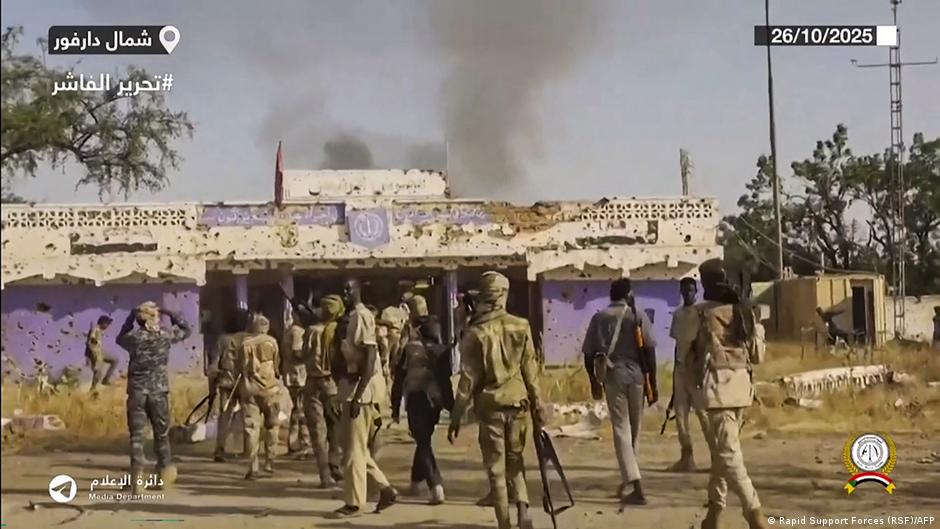
The paramilitary group documented its crimes extensively: After the complete blackout of el-Fasher, the fighters used the internet, which they had restored, to post videos of their atrocities on their Telegram channel, accompanied by grandiose music. These videos show the militia’s crimes up close: Aerial shots show off-road vehicles driving through the city. The trench is visible—as are thousands of people fleeing across the grassy landscape and being stopped by this trench: a death trap.
In one video, you can see RSF General Abu Lulu—clearly recognizable by his tousled curls, as confirmed by various media outlets and think tanks—shooting everyone in the trench who is still alive. Another video from the same day, filmed at the hospital in el-Fasher, shows fighters walking through the half-bombed building and executing everyone still alive in their beds or crouching on the floor—war crimes and crimes against humanity captured on camera.
Reports of mass rape
According to estimates by the International Organization for Migration (IOM), only about 100,000 people managed to flee the attacks on the day of the assault. Some, like Hassaina and her children, made it to the Tawila displacement camp 70 km to the southwest, where food.was provided.
Bob Kitchen of the International Rescue Committee, one of the few aid organizations present, was also working there. The extent of the brutality inflicted on these people has deeply disturbed him. “Almost everyone that we spoke to had been raped.” From infants to grandmothers, he told DW. “It was predominantly gang rape with very, very significant violence. We heard reports of tiny infants, six months old, being raped. We had very elderly women, 72, 75 years old, being raped all in front of their families. So there’s very clear punishment involved in.”
What took place in el-Fasher during the siege went largely unnoticed by the rest of the world. There were only sporadic reports in the media. A team of forensic scientists from the renowned Yale School of Public Health in the US tracked those events in real time using satellite imagery. In their latest analysis, the team was able to prove that the RSF had already destroyed the fields and farming villages in the surrounding area that fed the city in the run-up to the assault—and that the people were thus deliberately starved.
From space, the forensic experts were also able to spot bodies and bloodstains on the dusty streets during those days in October when the RSF captured the city. They counted around 150 piles of bodies and numerous mass graves, according to Nathaniel Raymond of Yale University. His team is working to calculate the death toll based on estimates: “That left us with around 70,000 people presumed dead or missing,” he told DW.
Following the largely overlooked siege of el-Fasher, the openly displayed massacres of October sparked an international outcry. Calls for investigations are growing. In Hassaina’s eyes, the international community has made itself complicit. “The international community has let us down; it should have intervened during the siege to prevent worse from happening,” she says through tears. “But nothing happened.”
This article translated by Nico Fischer was originally written in German
Edited by: Chrispin Mwakideu